
Role of Abiotic Factors on Diversification and Adaptation of Insects in Selected Area of Lahore, Pakistan
The study was conducted to reveal the morphological and taxonomic distribution pattern of dominant insect species under different abiotic conditions in diverse areas of district Lahore, Punjab, Pakistan. Three various non-agro urban-based ecological sites (Safari Park, Punjab University and Model town Park) randomly selected for field surveys, insect collection and abiotic factor study during the year of 2019-2020. A total of 234 individuals classified into 12 orders, 50 insect species were recovered across all sampling sites. The results indicated that the highest number of insect species with abundant taxa were trapped in Safari Park (62%), followed by Punjab University (26%) and Model town park (12%), respectively. The most dominant insect species are Coleoptera, Lepidoptera, Hymenoptera, Hemiptera, Orthoptera and Diptera, respectively. The purpose of the study was to assess role of abiotic factors on diversification and adaptation of insects in selected area of Lahore, Pakistan. Among the site-specific difference, PCA analysis of the study revealed a significant difference in ecological diversification and adaptation pattern.
Introduction
The concept of diversification describes the short- term cumulative evolutionary changes that occur in the heritable characteristics of a specific biota [1]. The term adaptations may express to an individual or an organism’s capability to change to cope with fluctuating ecological environments [2]. In particular, adaptations of behavioral, morphological, physiological, either solitarily or as a group can refer more specifically as an internally directed system of adaptive activities that facilitate the organism for survival and reproduction [3]. Several biotic and abiotic factors regulate the pattern of insect diversification and adaptation in terms of its abundances and distributions.
Insect distribution categorized into groups recognized as orders [4]. The majority of the insect distribution classified into seven main groups (orders). The major orders include Coleoptera, Hymenoptera, Lepidoptera, Hemiptera, Diptera, Orthoptera and Odonata [5]. The study of phylum Arthropoda is a significant field of biology called entomology [6]. In terrestrial ecosystem functions, they contribute to nutrient cycling, pollination, seeds dispersion, and act as predators [7]. At least 70% of all angiosperms are insect-pollinated [8]. Several insect species could provide raw materials for human use and offering primary resources such as honey, silk, and beeswax. They naturally decompose the soil organic matter and provide the essential nutrients and raise the biodiversity of soil microbes [9]. Among the abiotic variables, temperature, humidity, wind, and soil are the critical abiotic components. Extremes of these abiotic changes can limit the geographic range of insect population, either by causing direct natural mortality or by restricting the range of host plants or animals [3]. They can behaviorally avoid stress by escaping, migration, changing activity patterns or changing morphology, life history, or physiology [10]. Such temperature-driven physiological changes increased the rates of growth, population, development, overwintering and migration [11, 12, 13, 14]. Wind dispersion causes a significant effect on insect distribution and adaptation mechanisms. Tiny insects or wingless insects generally depend on air currents to carry them to new sites, but they tend to settle in areas with low wind speeds [15]. Human activities or human- induced disturbance could attribute as a source of increasing air pollution, which directly or indirectly distressed almost every ecosystem [16]. The purpose of study was to assess to the role of abiotic factors on diversification and adaptation of insects in selected area of Lahore, Pakistan.
Materials and Methods
Study Site Description
Present research work conducted in the different areas of the district Lahore in 2019-2020. These studies sites recognized as Safari park, Punjab University and Model Town Park. Safari park, also known as Wildlife Park, situated on the east-west side of the city. Model Town Park is also considers as hotspots of biodiversity of aquatic and terrestrial insect community and diversity. Punjab University is a dynamic educational institute located inside the city. In- situ examination of insect appearance and identification was performed at Pest Laboratory, Institute of Molecular Biology and Biotechnology, University of Lahore, during this study period. Insect collection was started at different intervals of the monitoring day (morning, noon, afternoon, or evening) during each sampling time.
Collection techniques generally categorized into two types- Active and Passives [17]. In the first kind of collection, the collectors find out insects either manually or by using the appropriate apparatus suited according to insect type. During the second phase of collection, different kinds of traps were chosen to capture the biodiversity of insects, and the sampling work was done in a passive wise manner.
Active Collecting Methods
In manual collection the slow-moving or tiny insects present in crevices places such as under loose bark, plant debris or building or in dung were handpicked. Aspirators consist of a plastic vial with the desired diameter and length. Using this mini sucking type aspirator, we collected arthropods predatory mites and thrips living in infected plant tissues. A beating sheet/ tray were used to collect non-flying or slow-moving insects easily. The large and fast-moving insects such as butterflies and dragonflies were captured by using aerial nets with larger hoops. Aerial nets with smaller hoops attracted other smaller insects such as flies, wasps, and bees. We collected certain specimens from fruit trees by using Parathyroid insecticides. In brief, the target area was sprayed or fogged with the insecticide, and the affected insects fell in the collection box or jar.
Passive Collecting Methods
In passive techniques, we generally collect the insects in different habitats by using a variety of trapping methods. For example, color traps, yellow sticky strips, or light traps are commonly used for the collection of indigenous insect specimens. Yellow color has been widely recognized as an insect attractant and serves the purpose of great attraction to insects. Yellow sticky bands suspended to tree/plants in each sampling site. we captured the specimens of aphids, house flies, leaf miners, whiteflies, fruit flies, black flies, mosquitoes, and other flying insects.
Preservation and Identification of Insect Samples
All the collected specimens were preserved by appropriate methods and materials, depending on their size, anatomy, and delicate features. The fumigation method was used for the synthetic killing of almost all members of insect specimens. For the fumigation method, alcohol or ethanol (70% concentrated) and Silica gel used as a widespread killing and preserving agent. Placed the insect in the jar for 1-5 minutes and fumigant vapors elevated to the top section of the jar and killed the insect.
Determine the Insect Diversity with Abiotic Factors
Standard procedures monitored the relevant abiotic parameters such as soil temperature, air temperature and humidity level and wind speed of each study site. An instant- read thermometer probe recorded the soil temperature of each study site. The thermometer’s probe deep inserted into the soil profile (10-15cm depth) to possibly monitor the accurate reading of the soil temperature of each study sites. The atmospheric temperature was observed at each habitat patch during the study period using a mercury-filled thermometer. We also monitored the relative humidity level in each study location. RH of each site observed using a digital metrological instrument known as a hygrometer. In this study, wind speed (m/sec) also measured at each site of the location by a digital metrological instrument known as an anemometer. To check the soil condition of each site, the bulk soil samples (0-20 cm from topsoil) were collected at each habitat patching using hand auger. Further, soil physiochemical analysis was procured from the Soil Fertility Research Institute, Punjab, Lahore.
Statistical Analysis
Statistical data were analyzed using two ways ANOVA, and the species differences among the insect groups or differences at different locations were compared with the level of significance at 0.05%. The software was used for the statistical procedure using Minitab version 16 or SPSS for graphical representation.
Results
The obtained results of this research are summarized and interpreted as follows: Before preliminary research work, soil samples from various patches of the experimental field located at three study sites were randomly collected to measure the underlying soil physicochemical properties such as pH, EC, organic matter contents, and nutrient contents (N, P, K). The soil of three places was almost similar and exhibited highly alkaline (pH range: 8.0-8.2) with loamy texture (Table 1).
| Soil Characteristics | |||||||
|---|---|---|---|---|---|---|---|
| Locations | pH | EC (ms·cm-1) | Organic Matter (%) | Available Phosphorus (mg•kg-1) | Available Potassium (mg•kg-1) | Available Nitrogen (mg•kg-1) | Texture |
| Safari Park | 8 | 1.3 | 0.84 | 4.7 | 125 | 42.3 | Loamy |
| Punjab University | 8 | 1.3 | 0.77 | 8.5 | 110 | 44.5 | Loamy |
| Model town Park | 8.2 | 1.4 | 0.91 | 5.3 | 115 | 42.8 | Loamy |
Table 1: Study of soil characteristics under different locations.
A total of 31 herbivorous insect specimens were collected during different sampling time at Safari Park, Lahore. 20 insect species were collected during spring and 11 insect species during autumn. The insect community belongs to Coleoptera and Hymenoptera orders were the largest order of species and strongly dominated at this study site. Coleopteran group mainly comprised a variety of beetles and ladybirds, whereas the Hymenoptera group mostly dominated by the wasp and honey bee, respectively. The Thysanopteran groups, Hemiptera, and Mantodea, comprised the least abundance of all insect individuals sampled. In addition, decay materials, moist soil, and living plants were the most common habitat of the insect community at Safari Park. At Punjab University a total of 13 insect specimens were collected during different sampling times. Among, 8 insect species were collected during spring and 5 insect species during autumn. The most prevalent insect species at this place belonged to the Coleopteran group, Diptera, Lepidoptera, and Hymenoptera, respectively. Across this sampling site, the largest number of insect species were identified from the Coleoptera group followed by Diptera and Lepidoptera. Hymenoptera group was found with the least abundant (rare) insect species at this sampling location. In addition, moist soil, green plants, decay materials and containers were the most common habitat of the insect community at different locations of Punjab University. The specimens were also monitored at different places of Model town Park. The community was dominated by 4 different groups. Among them, the insect community (each of 2 individuals) was dominant by the Orthoptera and Lepidoptera group. The Orthoptera group classified with grasshopper species, whereas the Lepidoptera group identified with butterfly species. Two groups (Odonata, Hemiptera) were similar in their composition and found with the least abundance. Different insects have different economic Importance as shown in Table 2.
| Sr. No | Insect Species/ Specimen | Economic Importance |
|---|---|---|
| 1 | Omocestus viridulus | Scientific research |
| 2 | Apis dorsata | Food production for human and toxicology study |
| 3 | Danaus plexippus | Pollination of human crops |
| 4 | Blatta orientalis | Ecological monitoring |
| 5 | Odontotermes obesus | Soil formation, decomposition & nutrient cycling |
| 6 | Cicindela sp. | Predators |
| 7 | Heteronchyus mossambicus | Pest of crops |
Table 2: Economic importance of most common insect species in the study areas.
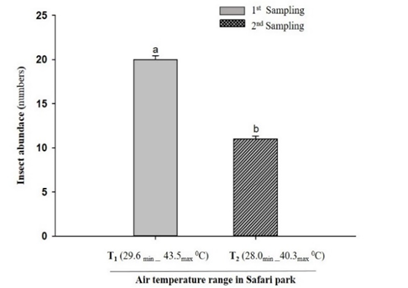
For this study site, the natural variation in seasonal air temperature was recorded at two sampling intervals (Figure 1). The relative air temperature recorded at the 1st sampling interval during spring and the 2nd sampling interval during autumn. The average air temperature range (29.6min-43.5max°C) observed at the 1st sampling interval, whereas average variation in the air temperature range (28.0min-40.3max°C) recorded at 2nd sampling interval. Results revealed highly significant differences in maximum numbers of species and individuals at both sampling intervals. The highest insect abundance (20 individuals) was observed at 1st sampling less abundance of insect species (11 individuals) was collected during the successive sampling interval of this site. Dominant order is Hymenoptera followed by Coleoptera, Orthoptera Lepidoptera, Hemiptera and Mantodea.
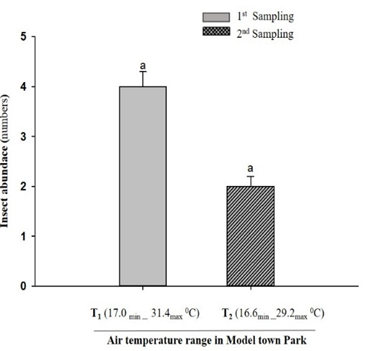
For this study site, the average air temperature range was 17.0min-31.4max°C and 16.6min-29.2max°C observed during the first and second sampling intervals, respectively. The air temperature did not significantly affect (P<0.05) (Figure 2) the insect abundance at both sampling intervals. Follow-up analysis indicated that more number of insect abundance (4 individuals) found at the first sampling time (T1). However, only two insect species were detected during the next interval of sampling collection at the (T2). Among the sampling distribution, a total of six insect species belong to Orthoptera, Lepidoptera, and Odonata.
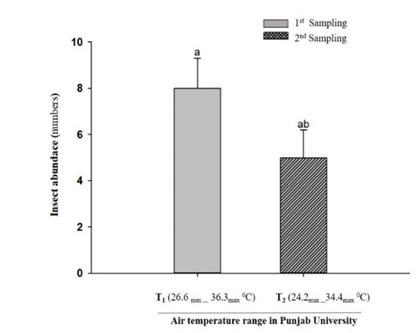
For this study site, the average atmospheric temperature range remained 26.6min-36.3max°C and 24.2min-34.4max°C degree during the first and second sampling intervals, respectively. The results indicate that insect abundance with a number of individuals and species were significantly found at both temperature gradients (P<0.05) (Figure 3). In particular, the highest number (08) of individuals and species was conceived during the initial sampling stage. During T2 temperature fluctuation, 5 individuals belong to different species conserved at the second sampling stage. The dominant species of this study site were Coleoptera, Lepidoptera, and Diptera (Figure 2).
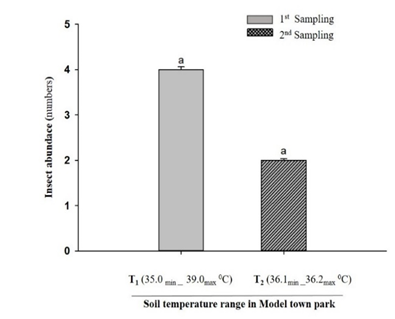
The average soil temperature of the Model town Park was 35.0min-39.0max°C and 36.1min-36.2max°C degree during the first and second sampling intervals. The abiotic soil temperature gradients, referred to as T1 and T2, had no significant effect on insect abundance (P<0.05) (Figure 4). Four insect species belong to Coleoptera and Lepidopteran group were detected during the first interval of sampling collection at the T1 temperature. Only two species of the Hymenoptera group were collected at the T2 (Figure 3).
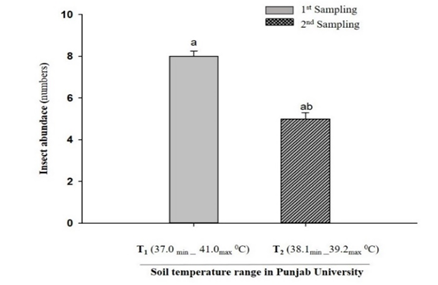
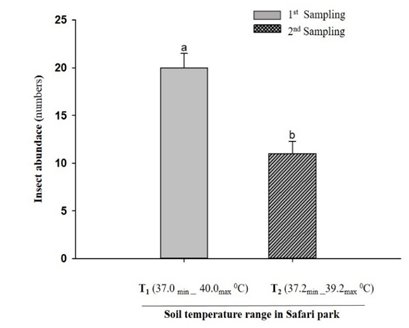
For this study site, the average soil temperature gradient was 37.0min-41.0max°C and 38.1min-39.2max°C observed during the first and second sampling intervals, Total of 8 insect species found at this treatment sample (T1). 5 numbers of insect abundance found at T2 sampling treatment. The dominant species associated with these temperature gradients were Coleoptera, Lepidoptera, and Diptera (Figure 4). At Safari Park location, the average soil temperature gradient was 37.0min-40.0max°C and 37.2min-39.2max°C degree during the first and second sampling intervals. There was a significant change in insect abundance with varying soil temperature gradients from the first sampling to the next sampling intervals. 20 individuals found at T1 soil temperature ingredient, while 11 individuals at T2 soil temperature range. In addition, dominant order is Hymenoptera, followed by Coleoptera, Orthoptera, Lepidoptera and Hemiptera (Figure 5).
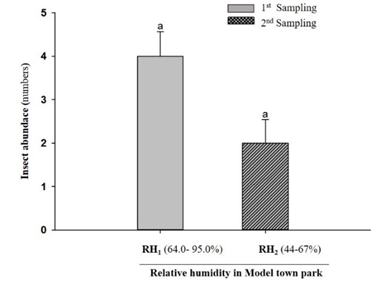
The average humidity range (RH1: 64.0-95.0 %) observed at 1st sampling interval, whereas average variation in the relative humidity range (RH2: 44-67 %) recorded at
2nd sampling interval. The results of this study site showed the non-significant difference in mean humidity range and insect abundance (P<0.05). 4 insect species belonging to the Coleoptera and Lepidopteran group found during the first interval of sampling collection. Only 2 species of the Hymenoptera group were collected at the RH2 (Figure 6).
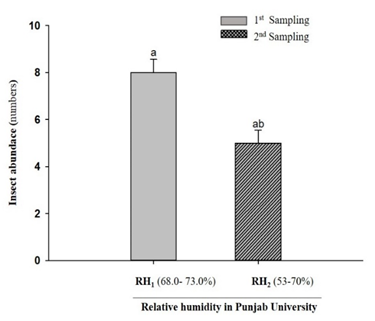
The specific air humidity level of this study site was RH1 (68.0-73.0 %) and RH2 (53.0-70 %) during 1st and 2nd sampling intervals. The average change in humidity level caused a significant impact on the distribution and abundance of insects (P<0.05) (Figure 7). Hence, the RH1 level acclimatized the 8 number of insect species, whereas the RH2 level sustained 5 numbers of different insect species, and dominant species were Coleoptera, Lepidoptera and Dipter respectively (Figure 8).
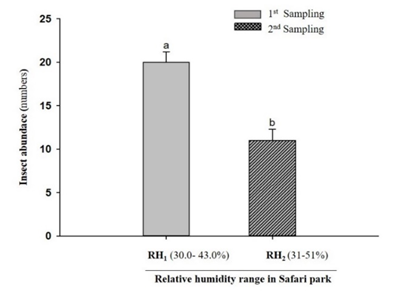
The specific air humidity level of this study site was RH1 (30.0-43.0%) and RH2 (31.0-51%) during the 1st and 2nd sampling interval (P<0.05) (Figure 9). 20 individuals were collected during the 1st sampling time. 11 individuals were collected during the second sampling interval, which was highest than any other places of abundance, and dominant orders were Coleoptera, Lepidoptera, Hymenoptera, Orthoptera and Hemiptera, respectively.
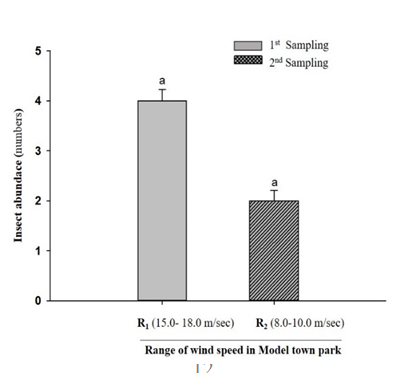
Wind speed of this study site was recorded as R1range (15.0-18.0 m/sec) and R2 range (8.0-10 m/sec) during the first and second sampling intervals, respectively. Wind speed was driven in a smooth motion, but insect abundance did not find significant numbers at both sampling times of this place (P<0.05) (Figure 10). 4 species were sampled during the first sampling and 2 insect species were collected when average speed driven with R2 range (8.0-10.0 m/sec).
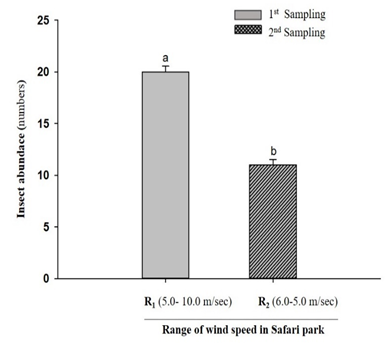
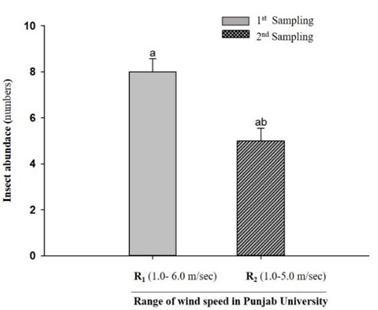
The average wind speed range (R1: 1.0-6.0 m/sec) observed at 1st sampling time, the results of this study site showed a significant difference (P<0.05) (Figure 11). 8 insects were collected during first sampling and 5 insects were collected during second sampling, dominant species were Coleoptera, Diptera, Lepidoptera, and Hymenoptera. The specific wind speed range of this study site was R1 (5.0-10.0m/sec) and R2 (6.0-5.0m/sec) during 1st and 2nd sampling intervals. (P<0.05) (Figure 12). 20 individuals were found during the 1st sampling time. 11 individuals were found during the second sampling interval. Dominant orders were Coleoptera, Lepidoptera, Hymenoptera, and Orthoptera.
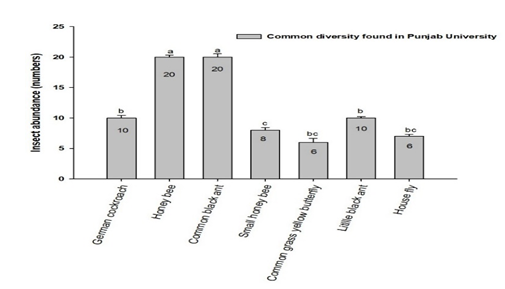
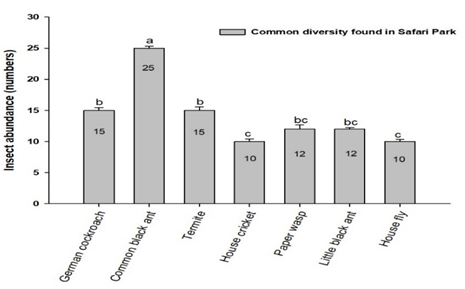
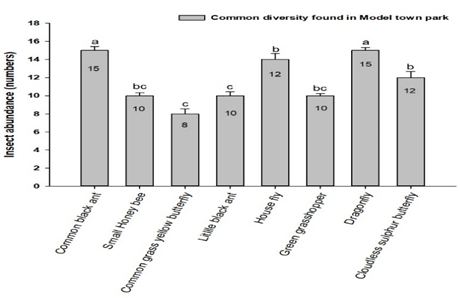
The sampling data of our study also reveals the common and dominant insect diversity (P<0.05) (Figures 13 & 14).
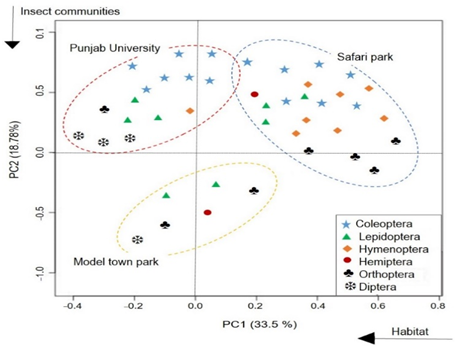
To reveal the diverse community pattern with their geographical association, we used the Principal Component Analysis (PCA) to explain the community difference at specific locations. Common insect communities were ordinated into main groups (dominant taxa) according to their ecological positions (Figures 15 & 16). The first and second canonical axes (PC1, PC2) accounted for 33.5% and 18.7% of the total variance of the species data, respectively. The insect communities, along with their abundant morphospecies, were classified into six taxa. There was a distinction between the Safari park, Punjab University, and Model Town Park.
Discussion
The impact of natural abiotic conditions on indigenous insect community has never been comprehensively studied at the regional scale [18]. Here, we investigated the community composition and distribution pattern associated with the specific ecological niches and abiotic environmental conditions. A total of 234 individual insects, 12 orders, and 50 insect species were found in the different habitats surveyed in the Lahore region. Among sampling sites, Safari Park was the greatest hotspot of the major insect community and species diversity followed by Punjab University and Model town Park, respectively. The highest abundance of insect community at Safari Park is likely due to the high planting density and a wide range of vegetation communities.
Principal Components Analysis (PCA) analysis determined the patterns between geographical locations and the abundance of insects. The results demonstrated that Coleoptera taxa were the most abundant (53.41%) insect order in the study area and their morphospecies abundance and distribution pattern widely associated at the Safari Park and Punjab University, respectively (Figure 16). This finding validates with the previous report of Tscharntke T, et al. 2004 [19] who identified the coleopterans as the most diverse and predominant insect order during the ecological study in tropical environments. At Safari Park, the maximum air temperature during spring is usually about 43.5°C, while during the autumn season; the minimum air temperature is 28.0°C. Results revealed the highest number of insect populations and significant differences in maximum amounts of species/individuals at both sampling intervals (Figure 1). In Punjab University the abundance of identified species was higher in spring as the increase in the temperature range (26.6-36.3°C) and abundance was low as decrease temperature range (24.2-34.4 °C) in autumn, respectively.
The air temperature of Model Town site was comparatively in the low range (17.0min-31.4max°C and 16.6min- 29.2max°C), and the seasonal difference in insect abundance and distribution pattern did not appear significant in terms of the high number of species/individuals. Similar findings also reported by Yadav R, et al. 2013 [20] who suggested that the sensitive temperature range can reduce or extend the life cycle of certain insect species. The rare species identified from Coleoptera and Lepidoptera may have a narrow range of low-temperature tolerance to this geographical condition Perveen F, et al. 2014 [21], the RH level increased from one sampling range (RH1: 30.0-43.0 %) to the next one (RH2 31.0–51%) at the study location of Safari Park. The result of this research is in harmony with Norhisham AR, et al. 2013 [22] suggested that increases relative humidity contributes to population increase in insects. Given the importance of these factors, our result indicated that the reasonable change in temperature gradient and RH level (68-78%) could play a vital role in determining which insect species are the most suitable at the Punjab University site. The majority of morphospecies classified into coleopteran, lepidopteron, Hymenoptera, and Hemiptera. These findings are in line with the observations of Chang XN, et al. 2008 [23] who demonstrated that the Coleopteran species strongly associated with a warmer climate with plenty of air moisture content. In the case of insect abundance and distribution pattern at Model Town Park, the study site indicated the least species occurrence and diversification. Although the average humidity range (RH1: 64.0-95.0 %) was highest at
1st sampling interval, only four numbers of coleopteran and lepidopteran species detected. The increase in RH% may also pose a negative impact on arthropod population due to causing a fungal pathogen invasion of arthropods [24]. The significant impact of wind speed (R1: 5.0-10.0 and R2: 6.0-5.0 m/sec) accelerated the highest insect abundance and species diversity at Safari Park found a strong positive correlation (R2=0.6497) between wind velocity and an abundance of Orthoptera. The minor difference in wind speed (R1:1.0- 6.0 and R2:1.0-5.0 m/sec) during each observation interval caused the slight difference in community composition and species abundance at the study site of Punjab University. In the case of Model town Park, the relative wind speed was high (15-18 and 8-10 m/sec).
Conclusion
The insect collection was carried out in diverse sampling areas of district Lahore, Punjab, Pakistan. Three sampling sites (Safari Park, Punjab University, and Model town Park) and two sampling seasons (spring and autumn) were considered as hotspots for insect collection and abiotic factors study during the year of 2019-2020. Mounted and conserved insect specimens further used for identification and classification purposes. The predominant morphospecies of this diverse study site at Safari park including, Coleopteran, Hymenoptera, Hemiptera, respectively. The abundance of insect species recovered in the selected areas of Punjab University indicates the most prevalent insect species belonged to the Coleopteran group, Diptera, Lepidoptera, and Hymenoptera, respectively [25, 26, 27].
Principal Component Analysis (PCA) for explaining the community difference at specific locations with significant sampling difference (>52%) was derived at three sampling sites according to the community compositions and distribution. Major insect communities, along with their abundant morphospecies, were classified into six taxa. Concerning habitat preference, the vast majority of insect species were Grassland Safari park-obligates (62%), while very few were Punjab University terrestrial-obligates (26%) and Model town park woodland-obligates (12%) [28, 29].
Acknowledgment
The authors extend heartiest thanks to all those who cooperated in completing the project. Thanks also go to the administration of Botanical Gardens of Punjab University, Safari Park and Model Town Park who always extended their nice cooperation in the collection and observation of insects.
References
-
Wagner CE, Harmon LJ, Seehausen O (2012) Ecological opportunity and sexual selection together predict adaptive radiation. Nature 487(7407): 366-369.
-
Stebbins G (1989) Adaptive shifts toward hummingbird pollination. _In:_ Stebbins G, et al. (Eds.), The evolutionary ecology of plants. 1st (Edn.), Westview Press Boulder, pp: 39-60.
-
Wood TE, Burke JK, Rieseberg LH (2005) Parallel genotypic adaptation: when evolution repeats itself. Genetica 123(2): 157-170.
-
Brose U, Dunne A, Montoya J, Petchey OL, Schneider FD, et al. (2012) Climate change in size‐structured ecosystems. Philos Trans R Soc Lond B Biol Sci 367(1605): 2903- 2912.
-
Bruno B, Fulvio C, Nascetti G (2011) Pattern of species occurrence in detritus-based communities with variable connectivity. Web Ecology 11: 1- 9.
-
Akunne EC, Ononye UB, Mogbo TC (2013) Insects: friends or enemies? Global Journal of Biology, Agriculture and Health Sciences 2(3): 134-140.
-
Fergnani P, Sackmann P, Cuezze F (2008) Environmental determinants of the distribution and abundance of the ants, Lasiophanes picinus and L. valdiviensis, in Argentina. Journal of Insect Science 8(1): 1-16.
-
Bale JS, Hayward SAL (2009) Insect overwintering in a changing climate. Journal of Experimental Biology 213(6): 980-994.
-
Robertson G, Swinton S (2005) Reconciling agricultural productivity and environmental integrity: A grand challenge for agriculture. Frontiers in Ecology and the Environment 3(1): 38-46.
-
Olvido AE, Elvington ES, Mousseau TA (2003) Relative effects of climate and crowding on wing polymorphism in the southern ground cricket, _Allonemobius socius_ (Orthoptera: Gryllidae). Florida Entomologist 86(2): 158-164.
-
Matenaar D, Broder L, Bazelet CS, Hochkirch A (2014) Persisting in a windy habitat: population ecology and behavioral adaptations of two endemic grasshopper species in the Cape region (South Africa). Journal of Insect Conservation 18: 447-456.
-
Menendez RA, Gonzalez M, Collingham Y (2007) Direct and indirect effects of climate and habitat factors on butterfly diversity. Ecology 88(3): 605-611.
-
Nowrouzi S, Andersen AN, Macfadyen S, Staunton KM, VanDerWal J, et al. (2016) Ant diversity and distribution along elevation gradients in the Australian wet tropics: the importance of seasonal moisture stability. PloS One 11(4): 1-20.
-
Oliveira FQ, Batista JL, Malaquias JB, De Brito CH, Dos Santos EP (2011) Susceptibility of the predator _Euborellia annulipes_ (Dermaptera: Anisolabididae) to mycoinsecticides. Revista Colombiana de Entomología 37(2): 234-237.
-
Brown JH, Gillooly JF, Allen AP, Savage VM, West GB (2004) Toward a metabolic theory of ecology. Ecology 85(7): 1771-1789.
-
Fuentes JD, Chamecki M, Roulston TA, Chen B, Pratt KR (2016) Air pollutants degrade floral Scents and increase insect foraging times. Atmospheric Environment 141: 361-374.
-
Axmacher JC, Fiedler K (2004) Manual versus automatic moth sampling at equal light sources: A comparison of catches from mountain Kilimanjaro. Journal of Lepidoptera Society 58(4): 196-202.
-
Bruyn LD, Sofie T, Verhagen R, Scheirs J (2001) Effects of Vegetation and Soil on Species Diversity of Soil Dwelling Diptera in a Heathland Ecosystem. Journal of Insect Conservation 5(2): 87-97.
-
Tscharntke T, Brandl R (2004) Plant insect interactions in fragmented landscapes. Annual Review Entomology 49(1): 405-430.
-
Yadav R, Chang NT (2014) Effects of temperature on the development and population growth of the melon thrips, Thrips palmi, on eggplant, _Solanum melongena_. Journal of Insect Science 14: 78.
-
Perveen F, Khan A, Sikander (2014) Characteristics of butterfly (Lepidoptera) fauna from Kabal, SWAT, Pakistan. Journal of Entomology and Zoology Studies 2(1): 56-69.
-
Norhisham AR, Faizah A, Rita M, Khalid RH (2013) Effect of humidity on egg hatchability and reproductive biology of the bamboo borer (Dinoderus minutus Fabricius). Springerplus 2(1): 9.
-
Chang XN, Gao HJ, Chen FJ, Zhai BP (2008) Effects of environmental moisture and precipitation on insects: A review. Chinese Journal of Ecology 27(4): 619-625.
-
Sharma HC (2013) Climate Change Effects on Insects. Combating Climate Change an Agricultural Perspect 4: 6-16.
-
Fox R, Brereton TM, Asher J (2015) The State of the UK’s butterflies 2015. Wareham, Dorset: Butterfly Conservation and the Centre for Ecology & Hydrology 22: 147-160.
-
Lister BC, Garcia A (2018) Climate‐driven declines in arthropod abundance restructure a rainforest food web. Proceedings of the National Academy of Sciences of the United States of America 115(44): 10397-10406.
-
Phamdthera H (1995) Influence of temprature, humidity and feeding on the development of Chilo partellus adult, in laboratory and field conditions. Bull Univ De Stinate Agri UK 59: 70-74.
-
Robinson SI, Orla B, McLaughlin BM, Gorman EJ (2018) Soil temperature effects on the structure and diversity of plant and invertebrate communities in a natural warming experiment. Journal of Animal Ecology 87(3): 634-646.
-
Wepprich T, Adrion JR, Ries L, Wiedmann J, Haddad NK (2019) Butterfly abundance declines over 20 years of systematic monitoring in Ohio, USA. Plos One 14(7): e0216270.
- Evaluation of Proximate and Mineral Compositions of Momordica charantia L. (Cucurbitaceae)
- Targeting Superbugs: Efficacy of Bacteriophage Therapy against Antibiotic-Resistant Pseudomonas Aeruginosa in Urinary Tract Infections
- Genetic Insights into Prepubertal Gynecomastia: A Comprehensive Analysis of a Rare 45,X[2]/ 46,X, + mar[28] Karyotype
- The Efficiency of Biological Treatment Plants in Some Private Hospitals in the City of Basra, Iraq
- Exploring the Combined Efficacy of Carvacrol and Friedelin against Multi-Drug Resistant Bacteria in Upper and Lower Respiratory Tract Infections
- Isolation, Identification and Comparative Analysis of Oral Microbial Communities in Smokers and Non-Smokers: A Scientific Investigation