
Short Body Mackerel (Rastrelliger Brachysoma) in the Java Sea, Indonesia
Between 1961 and 2016, the average annual increase in global food fish consumption (3.2 percent) outpaced population growth (1.6 percent). In per capita terms, food fish consumption grew from 9.0 kg in 1961 to 20.2 kg in 2015, at an average rate of about 1.5 percent per year [1]. Indonesia has a very large potential of fish biological resources. Biological resources according to the Law of the Republic of Indonesia No. 5 of 1994 include genetic resources, organisms or parts thereof, populations or biotic components of other ecosystems with benefits or value that are tangible or potential for humanity.
Introduction
Between 1961 and 2016, the average annual increase in global food fish consumption (3.2 percent) outpaced population growth (1.6 percent). In per capita terms, food fish consumption grew from 9.0 kg in 1961 to 20.2 kg in 2015, at an average rate of about 1.5 percent per year [1]. Indonesia has a very large potential of fish biological resources. Biological resources according to the Law of the Republic of Indonesia No. 5 of 1994 include genetic resources, organisms or parts thereof, populations or biotic components of other ecosystems with benefits or value that are tangible or potential for humanity.
Rastrelliger brachysoma (short body mackerel) is a small pelagic fish resources variety of mackerel that is the most commercially important [2]. This species is listed as data deficient. Given the absence of an international management body, further monitoring of this species is needed on the national level, in addition to species-specific data on landings, effort and population status [3]. These species landings are primarily reported in combination with mixed Rastrelliger spp. [4], this fish group is a basic need for livestock and fishery products based on Regulation of The Presidential of The Republic of Indonesia Number 71. The preference rate for mackerel in Java in 2008 was 7.87% for fresh mackerel and 5.1% for salted fish (processed mackerel) [5]. The highest expenditure for fresh mackerel is DKI Jakarta Province, Banten Province and West Java Province [2]. Mackerel chosen for its distinctive taste, high nutritional content (especially omega 3), affordable or cheap prices and easily obtained in every traditional market [2, 6]. One of the basic information that needs to be known in managing fish resources is information about the bioecology of the fish. The objective of the paper is to review the bioecology of the fish in the Java Sea, Indonesia.
Rastrelliger Renus
Rastrelliger genus consists of only three species, namely R. brachysoma, R. kanagurta, and R. faughni. R.brachysoma and R. kanagurta are widely exploited; R. faughni is not of high commercial importance. They have similar characters and can be identified by: 1. Genetic identification based on mtDNA sequence analysis Muto, et al. [7, 8, 9, 10] based on analysis restriction fragment length polymorphism [7, 11] and based on random amplified polymorphic DNA (RAPD) [12, 13]. 2. Morphology identification [2, 10, 12, 13, 14].
Rastrelliger brachysoma in the Java Sea, Indonesia
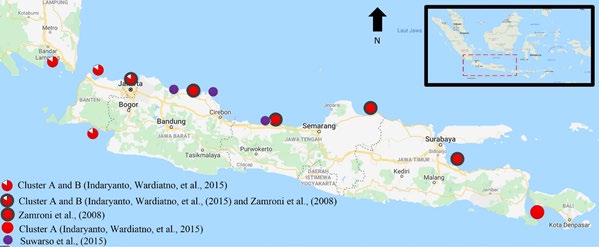
The Rastrelliger genus can be clearly identified using the molecular method. The dendrograms NJ phylogenetic tree collaborated by the minimum spanning network shows that R. brachysoma in the Java Sea is divided into two clusters that are cluster A and cluster B [4]. The ratio of cluster members in this study is Jakarta (A: 89.6%; B: 10.4%), Lampung (A: 75.5%; B: 24.5%), Pelabuhanratu (A: 80.0%; B: 20.0%), Banten (A: 89.1%; B: 10.9%) and Banyuwangi (A: 100%). Based on these results we then used analyzed RFLP, the results of virtualization RFLP mDNA using HincII and HindIII enzymes indicate that R. brachysoma in the Java Sea is also divided into two clusters [4]. Based on the two previous research results, then in March 2013 an RFLP analysis was carried out on 13 mackerel from Pelabuhanratu, and the result is cluster A 76.9% and B 23.1% [15]. Zamroni, et al. [11] reported that the result of analysis RFLP mDNA in R. brachysoma form north Jakarta, Indramayu, Pekalongan, Rembang and Pasuruan (Madura strait) showed no significant differences in fish samples genotype.
The phylogenetic relationships confirmed the morphological classification of Rastrelliger species, the body depth ratio of R. brachysoma ranged from 1:2.6 to 1:3.9 and was highest than 1:4.1 for R. kanagurta [5]. R. brachysoma is not much different among both the cluster based on the morphology and morphometric characters [15].
![Figure 1: Dendrogram of R. brachysoma fork length/FL (cm) data from Indaryanto, et al. [15] and Suwarso, et al. [16] research.](/fulltextimages/5293/fig_1.jpeg)
Based on Indaryanto, et al. [5] and Suwarso, et al. [16] research, based on fork length / FL (cm) mackerel is divided into 4 groups, namely the western region fish (Lampung, Pelabuhanratu and Jakarta), the middle region fish group (Indramayu and Pekalongan), the Nursery Ground group (Banten and Blanakan), and fish groups in the eastern region (Banyuwangi). Indications of R. brachysoma spawning in the waters of Indramayu and Jakarta Bay occur around the west season (October to November); larger (more mature) gonads are found around the Jakarta Bay [17].
Differences in fish size between different regions and times are thought to be influenced by the environmental conditions of the waters especially the temperature and the availability and quality of different foods. Changes in environmental conditions (temperature, salinity, plankton abundance, etc.) in shallow coastal waters occur very quickly because they are strongly influenced by land. the north coast of Java is very vulnerable to fishing activities and environmental conditions (eg., pollution) so that it affects growth and reproduction [11]. R. brachysoma is a fishing target on the north coast of western Java while Decapterus spp. is on the central and eastern parts [17]. Genetically, R. brachysoma are low genetic diversity so that population conditions are very vulnerable [5, 11]. Whether the ecosystem pressure that causes fish in the western region has two clusters, or cluster B is the population from the southern part of the South China Sea. More research is needed on this matter [18].
Acknowledgment
This study was a collaborative research program and partly funded by IPB University (Indonesia) and University of the Ryukyus (Japan), conducted as part of the international graduate program for the Asia-Pacific region. We are grateful to Dr. Makoto Tsuchiya (Program Leader and Professor of Science, University of the Ryukyus), Dr. Hideyuki Imai (University of the Ryukyus), Prof. Yusli Wardiatno (IPB University).
References
-
FAO (2018) The State of World Fisheries and Aquaculture 2018-Meeting the sustainable development go. In Journal of Applied Poultry Research. Rome.
-
Indaryanto FR, Tiuria R, Wardiatno Y, Zairion (2018) Ikan Kembung {Scombridae: Rastrelliger sp.} : Genetik, Biologi, Reproduksi, Habitat, Penyebaran, Pertumbuhan, dan Penyakit. Bogor: IPB Press.
-
Collette B, Di Natale A, Fox W, Juan Jorda M, Nelson R (2011) Rastrelliger brachysoma. The IUCN Red List of Threatened Species.
-
Indaryanto FR, Abdullah MF, Wardiatno Y, Tiuria R, Imai H (2015) A Description of Lecithocladium angustiovum (Digenea: Hemiuridae) in Short Mackerel, Rastrelliger brachysoma (Scombridae), of Indonesia. Tropical Life Sciences Research, 26(1): 31-40.
-
Indaryanto FR, Imai H, Wardiatno Y (2015) Genetic variation of short body mackerel, Rastrelliger brachysoma of Jawa Island, Indonesia based on mtDNA control region sequences. AACL Bioflux 8(5): 648-655.
-
Indaryanto FR, Saifullah (2011) Analysis of Consumer Preferences on Fish Purchases in the Rau Main Market and Old Market, Serang City of Banten. Jurnal Penelitian Ilmu-Ilmu Sosial Dan Eksakta 22(3): 56-65.
-
Indaryanto FR, Wardiatno Y, Imai H (2015) Genetic and Morphometric of Short Body Mackerel (Rastrelliger brachysoma). Prosiding Seminar Nasional Kelautan Dan Perikanan 4.
-
Jamaluddin JAF, Ahmad AT, Basir S, Rahim MA, Nor SAM (2010) Rastrelliger systematics inferred from mitochondrial cytochrome b sequences. African Journal of Biotechnology 9(21): 3063-3067.
-
Muchlisin ZA, Masazurah AR, Abu Talib A, Siti Azizah MN, Samsudin B, et al. (2009) Genetic identification of four Malaysian mackerel species off Coast of Peninsular Malaysia based on molecular marker, pp: 74-77.
-
Muto N, Alama UB, Hata H, Guzman AMT, Cruz R, et al. (2015) Genetic and morphological differences among the three species of the genus Rastrelliger (Perciformes: Scombridae). Ichthyological Research 63(2): 275-287.
-
Zamroni A, Suwarso, Mukhlis NA (2008) Reproductive biology and genetic population of Short mackerel (Rastrelliger brachysoma, Scombridae) in the coastal water of northern Java. Jurnal Penelitian Perikanan Indonesia 14(2): 215-226.
-
Darlina MN, Masazurah AR, Jayasankar P, Jamsari AF, Siti AM (2011) Morphometric and molecular analysis of mackerel (Rastrelliger spp) from the west coast of Peninsular Malaysia. Genetics and Molecular Research 10(3): 2078-2092.
-
Jayasankar P, Thomas PC, Paulton MP, Mathew J (2004) Morphometric and Genetic Analyzes of Indian Mackerel (Rastrelliger kanagurta) from Peninsular India. Asian Fisheries Science 17(1): 201-215.
-
Collette BB, Nauen CE (1983) FAO Species Catalogue. Scombrids of the World. An Annotated and Illustrated Catalogue of Tunas, Mackerels, Bonitos and Related Species Known to Date. In FAO Fisheries Synopsis 125(2).
-
Indaryanto FR, Wardiatno Y, Imai H (2020) Morphological Study of Short Mackerel (Rastrelliger brachysoma) from Pelabuhanratu Water Based on RFLP Analysis.
-
Suwarso, Ernawati T, Hariati T (2015) Reproductive Biologyand Spawning Estimation of Short Mackerel (Rastrelliger Brachysoma) In The Northerncoast Of Java. Jurnal Bawal 7(1): 9-16.
-
Suwarso S, Hariati T (2003) Biology and Ecology Of Small Pelagic Fish In North Beach Jawa Barat And Selatan Sunda 9(7): 29.
-
(2015) Regulation of The Presidential of The Republic of Indonesia Number 71. Presidential Regulation No. 71 of 2015 concerning determination and storage of goods and essential goods. Jakarta: Minister of law and human rights of the Republic of Indonesia.
- California Red-Legged Frog and Non-Listed Amphibians Response to Non-Native Fish Removal
- Industrial Standardization of the Bio-OS: Algorithmic Codification of Resilience Engineering Guidelines and Version V8 Architecture
- Climate Variability and the Sustainability of Snail Farming in Nigeria: Past Trends, Present Challenges and Potential Outlook
- The Evaluation of the Surveillance System of Anthrax in Gilgit-Baltistan, Pakistan, 2018
- Natural Decline to Extinction of A New Zealand Rabbit Population
- Mitochondrial Bio-Logistics: Steering Co-Enzyme Q10 and Lycopene Synergies within the Science 4.0 Bio-OS Framework