
Preliminary Length-Weight Relationship and Cytogenetic Studies of Periplaneta americana (Insecta: Blattodea)
This study was carried out to reveal the length-weight relationship, sex ratio and chromosome number of Periplaneta americana. One hundred specimens of P. americana were collected from different locations around Ekiti State University environment. For sex ratio and the length-weight relationship between male and female P. americana, seventy specimens were examined for sex ratio and length-weight relationship between male and female P. americana, while thirty specimens were observed for cytogenetic study. Meiotic chromosomes of male P. americana were prepared from their testes using standard methods and photomicrographs of the chromosomes were taken. From this study, the sex ratio was 1.3: 1 (male to female), there was no significant difference (P>0.05) after comparing the mean total length and the mean body weight, and also the mean forewing length versus mean body weight. The total length and body weight of male P. americana showed a negative correlation (r=-0.2149) while the females P. americana were positively correlated (r=0.1086) between the total length and body weight. However, negative correlation (r=-0.0412) was also observed between total length and body weight in all the specimens collected. For the forewing length and body weight relationship, a positive correlation was observed in male (r=0.1367), female (r=0.2453) and total population (r=0.5167). Also, the meiotic metaphase chromosome showed 16 bivalents and 1 univalent, although no secondary constitution was observed. Therefore, the total and forewing length of P. americana can be used to determine their weight.
Introduction
The American cockroaches, Periplaneta americana are insects which belong to the family of Blattidae in the taxonomic Order of Blattodea. They are characterized by a metamorphosis which is made up of three life stages, the egg, the nymph and the adult stages. The American cockroaches have large size and reddish-brown colour with faded edges on thorax [1, 2] and the length is about 3.8m [1] with mature wings that are developed and cover the whole abdominal length. The male wings stretch slightly outside the tip of the abdomen, while those of the female are almost similar with the length as the abdomen. However, Nymphs are the same in appearance but are smaller and also lack wing. Young
nymphs are greyish brown but after the process of successive moulting, the colour become reddish-brown [2].
About 4000 cockroach species have been described worldwide and most of them are nocturnal [3]. A single female has the potential to produce between 210-1440 offspring. Therefore, only a few cockroaches are needed to establish a population in a particular area [1]. Sexes of adult P. americana can be easily distinguished by the presence of styli on the ninth abdominal segment only in an adult male. Sexes can also be differentiated in nymphs by the presence of a sharp median notch on the caudal margin of the ninth sternum of the females whereas the males have a smooth or a slightly indented end on their ninth sternum [4].
There are variations in diploid chromosome numbers across orders of insects, and both the mean as well as the variance in chromosome number differ among insect order. For instance, Lepidoptera has an average of 30 chromosomes ranging from 7 to 190 but Diptera possesses 11 chromosomes on average and the reported chromosome numbers vary from 6 to 26. As reported by Blackmon and group, these differences in chromosomal mutation rate could contribute to this diversity in chromosomal numbers across taxa [5].
Melters and colleague [6] revealed that the presence or absence of localized centromere influences chromosome number. Insects have different types of chromosomes based on the location of the centromere, a large number of insects possess either acrocentric or metacentric chromosomes. However, a reasonable fraction of insects, including all Lepidoptera and Hemiptera possess holocentric chromosome. Also in the absence of centromere, highly fragmented chromosomes can segregate successfully during meiosis [6]. Many chromosomal studies have been carried out on diverse organisms. However, Mukha, et al. [7] reported that apart from some ants and termites, little is known about the genetics of population of any structural pest. Even up to recent years, works on chromosome structure and number on cockroaches are close to nil [7]. The number of chromosome mechanism involving the determination of sex and sex chromosome systems are intrinsically linked. Factors important in determining variation in chromosome number also include differences in meioses that might allow some groups to segregate rearranged chromosome more reliably [5]. A recent analysis suggests that lower chromosome number can increase the probability of transitioning to haplodiploidy, and certain sex chromosome system may favour fusions more strongly than others [8].
This study is therefore aimed at providing preliminary information on the length-weight relationship, the sex ratio of P. americana and also exploring the chromosome number of P. americana.
Materials and Methods
Source of Cockroach Samples
A total of 100 Cockroach specimens were obtained from two different locations around Ekiti State University environment with approximately 300 m distance between locations. The specimens of P. americana were collected at night by handpicking them into a cage before they were moved to the Department of Zoology and Environmental Biology Laboratory of Ekiti State University, Nigeria for further analysis.
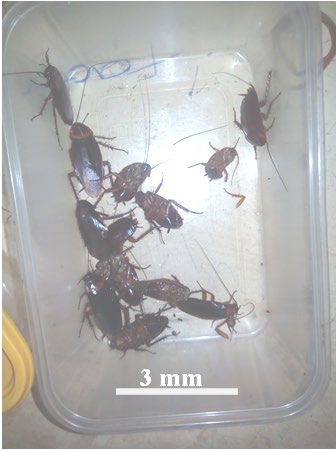
Identification of cockroaches: Sex and species of the cockroaches were identified using standard taxonomic classification as reported by Ross [9]. Figure 1 shows some P. americana caught during the period of study.
Length-Weight Measurements
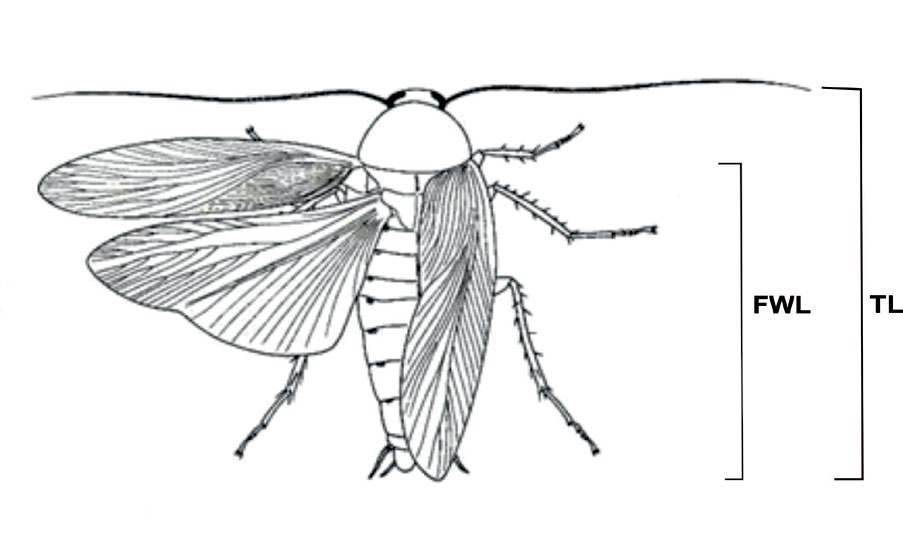
Seventy (70) samples were selected for length-weight measurement. The cockroaches were numbered serially and measurements of total length and length of the forewings (Figure 2) were taken using a metre rule. The body weight was determined using a digital electric weighing scale (TH-1000, PEC Medical USA). Student’s t-test was carried out using Microsoft Office Excel (2007) to determine any significant difference in the length and weight measured between the male and female P. americana.
Chromosomal Studies
Chromosome observation and microscopy: A total of 30 samples were used for chromosomal studies. Life cockroach was held at the thoracic cavity and the wings were removed using a pair of scissors. After this, the abdominal segment was dissected to open the dorsal area along the 5th and 6th abdominal segment. Then a few drops of the physiological solution were added to the exposed testes. Few testes lobes were taken and fixed in Carnoy’s fluid for 4 hours. The lobes were separated and fixed in a watched glass in acetocarmine stain for 15 minutes. The stained testis lobe was kept on a plain slide and two drops of acetic acid were added to it. The material was macerated using the thumb by pressing the coverslip with a filter paper and mounted on the microscope stage after heating for a few minutes. The observation was done with the magnification lens of ×40 using a binocular research microscope. Only the cells with well- spread out chromosomes were selected for chromosome photomicrographs under ×1000 objective (oil immersion).
Results
Sex Ratio and the Length-Weight Relationship between Male and Female P. americana
Seventy (70) samples were selected for length-weight measurement across the two sampling sites. Male P. americana was larger (39) in number than female specimens (31) with the sex ratio of 1.3: 1. Table 1 shows the length and weight of P. americana during the study period. The mean total length, body weight and forewing length of male P. americana were higher but not significantly different from those of the female. Analysis of the length and weight of the total population showed no significant difference.
| Parameters | N | Mean total length ±SD | Mean body weight ±SD | Mean fore wing length ±SD |
|---|---|---|---|---|
| Male | 39 | 4.0±0.22a | 1.2±0.2a | 3.0±0.22a |
| Female | 31 | 3.9±0.4a | 1.2±0.17a | 3.0±0.21a |
| Total population | 70 | 4.0±0.30a | 1.2±0.9a | 3.0±0.22a |
Table 1: Length and weight of P. americana during the study period.
*Means of a column with same superscript are not significantly different (p> 0.05) N=Number of cockroach Table 1: Length and weight of P. americana during the study period.
The range of the total length in male P. americana was 3.6-4.5 cm and that of female was 2.2-4.3 cm. While the range of body weight was 0.6-1.5 g in male P. americana, it ranged from 0.9-1.6 g in the female cockroach (Table 2). Also, forewing length ranged from 2.3 to 3.4 cm and 2.7 to 3.5 cm in male and female P. americana respectively.
| Population | Range of total length (cm) | Range of body weight (g) | Range of forewing length (cm) |
|---|---|---|---|
| Male | 3.6-4.5 | 0.6-1.5 | 2.3-3.4 |
| Female | 2.2-4.3 | 0.9-1.6 | 2.7-3.5 |
| Total | 2.2-4.5 | 0.6-1.6 | 2.3-3.5 |
Table 2: Ranges of length and weight of P. americana population.
In Figures 3, negative correlation was recorded between total length and body weight of male P. americana while Figure 4 illustrated positive correlation in the female cockroach. However, in the total population (Figure 5), a negative correlation was also recorded between total length and body weight.
For the logarithmic relationship between forewing length and body weight, positive correlation was observed in the male, female and total population of P. Americana (Figures 6-8).
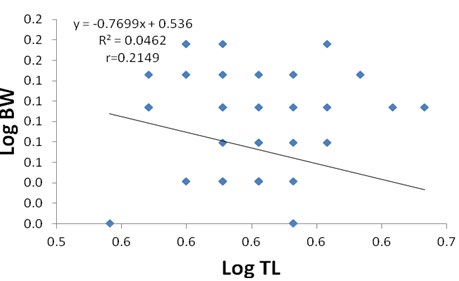
*BW=Body weight *TL=Total length Figure 3: Logarithmic relationship between total length and body weight of male P. americana.
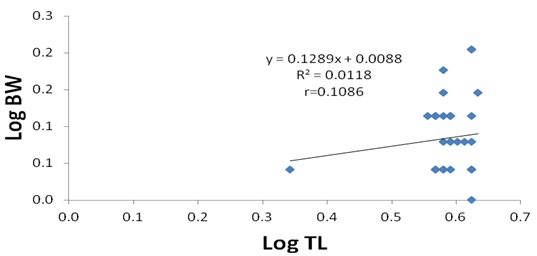
*BW=Body weight *TL=Total length Figure 4: Logarithmic relationship between total length and body weight of female P. americana.
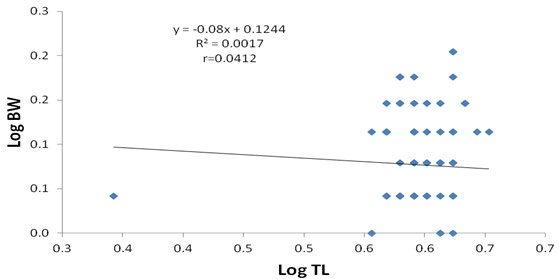
*BW=Body weight *TL=Total length Figure 5: Logarithmic relationship between total length and body weight of the total population of P. americana.
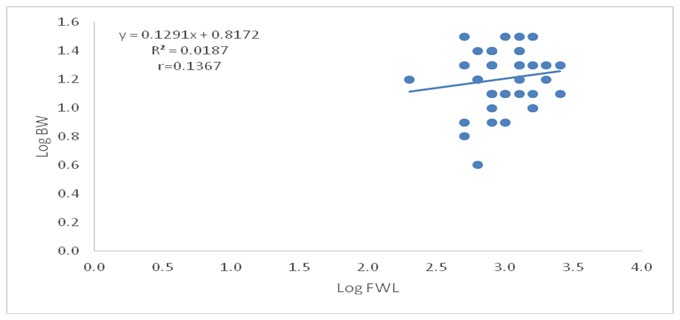
*BW= Body weight *TL= Total length Figure 6: Logarithmic relationship between forewing length and body weight of male P. americana.
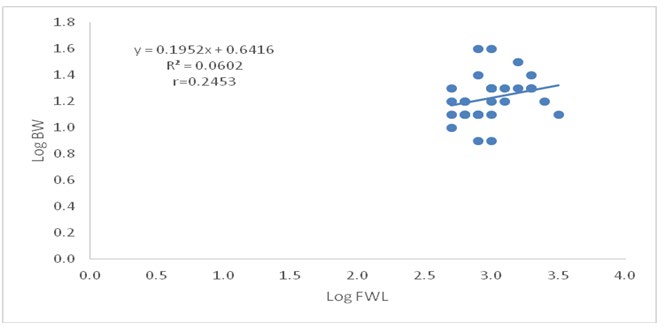
*BW= Body weight *TL= Total length Figure 7: Logarithmic relationship between forewing length and body weight of female P. americana.
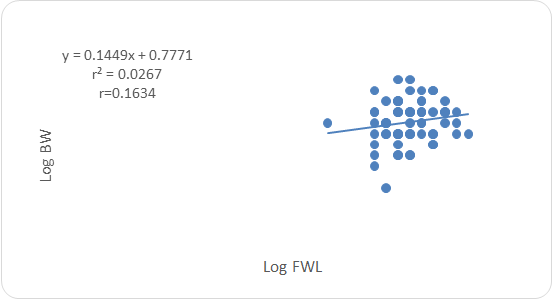
*BW= Body weight *TL= Total length Figure 8: Logarithmic relationship between forewing length and body weight of the total population of P. americana.
Chromosome Observation of P. americana
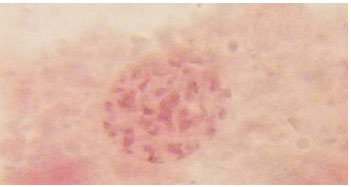
Figure 9 shows the microscopic observations of the chromosomes of male Periplaneta americana. A total number of sixteen (16) bivalents and 1 univalent were recorded.
Discussion
This study revealed some morphological features and chromosome number of the American cockroach, Periplaneta Americana. It was observed that there was no statistically significant difference in body weight, fore wing size and body length between the male and female in the whole population. This indicates that the body dimension, size and weight of both sexes are the same. The body length observed in this present study falls within the range of the result of Roth, et al. [10] who reported 3.5-4.0 cm.
The sex structure observed in this study showed that the number of males is almost equal to the female numbers in this population. The trend may be attributed to an increase in dynamic changes and numbers of the respective individuals. Cockroaches are one of the most populous insects usually associated with built structures and are carriers of various allergens [11]. They are also known as potential mechanical vectors of microbial pathogens of man and animals [12], therefore it is important to study the population of this organism.
About 4000 species of roaches have been described. The overwhelming majority of roaches possess a metacentric X chromosome which cannot easily form centric fusions with autosomes and might explain the rarity of complex sex chromosomes in this order. Two species that reproduce parthenogenetically are reported and chromosome numbers range from 16 in Lophoblatta fissa to 80 in Macropanesthis rhinoceros [5].
The result of this study showed a meiotic phase in the male cockroach and found a chromosome number of 33 (16 bivalents and 1 univalent).
However, early work by Cochran, et al. [13] has reported 23 to 24 chromosomes in randomly collected embryonic cells in wild type and mutant stocks of German cockroaches, with the secondary spermatocytes containing either 11 or 12 chromatin body while mitotic metacentric and diploid cells are also 23 and 24 chromosomes. Though centromeres are not usually distinguishable during meiosis but at mitosis, they are mainly metacentric. Chromosomal alteration (change in number and structure of chromosomes) may result from an occasional mishap in meiosis which may lead to chromosomal aberrations [14] and this may cause mutation. These changes may not even reflect in their phenotypic appearance [15].
Conclusion
In conclusion, there is a relationship between total and forewing length and body weight in P. americana. This study suggests that the weight of P. americana specimens can be predicted from the total and forewing length. Also, the cytogenetic study may help enhance a better resolution of issues relating to taxonomy. However, more populations from the six (6) geo-political zones in Nigeria should be studied to provide better information.
References
-
Pechal JL, Austin TW, Szalanski AL, Gold RE, Tomberlin JK (2008) Genetic analysis of Periplaneta amencana (Blattodea: Blattidae) in Central Texas using the ITSI Region. J Agric Urban Entomol 25(3): 179-191.
-
Mahyoub J Sharawi S, Assagaf A (2018) Overview on controlling the American cockroaches (Periplaneta americana). Research Review International Journal of Multidisciplinary 3(12): 730-739.
-
Burgess NRH (1993) Cockroaches (Blattaria). In: Lane RP, Crosskey RW, (Eds.), Medical Insects and Arachnids, Springer, Dordrecht, pp: 473-482.
-
Wilcove DS, Rothstein D, Dubow J, Phillips A, Losos E (1998) Quantifying threats to imperilled species in the United States. Bioscience 48(3): 607-615.
-
Blackmon H, Ross L, Bachtrog D (2016) Sex determination, sex chromosomes, and karyotype evolution in insects. Journal of Heredity 108(1): 78-93.
-
Melters DP, Paliulis LV, Korf IF, Chan SWL (2012) Holocentric chromosomes: convergent evolution, meiotic adaptations, and genomic analysis. Chromosome Research 20(1): 579-593.
-
Mukha DV, Kagramonova AS, Lazebnaya IV, Lazebnyi OE, Vargo EL, et al. (2007) Intraspecific variation and population structure of the German cockroach, Blatella germanica, revealed with RFLP analysis of the non- transcribed spacer region of ribosomal DNA. Medical Vetinary Entomology 21(2): 132-140.
-
Pennell MW, Kirkpatrick M, Otto SP, Vamosi JC, Peichel CL, et al. (2015) Y fuse? Sex chromosome fusions in fishes and reptiles. PLoS Genetics 11: e1005237.
-
Ross HH (1965) Textbook of Entomology. In: 3rd (Edn.), Wiley and Sons, New York, NY, USA.
-
Roth LM, Willis ER (1960) The biotic associations of cockroaches. Smithsonian Inst, Was DC 141: 1-470.
-
Rosenstreich DL, Eggleston P, Kattan M (1997) The role of cockroach allergy and exposure to cockroach allergen in causing morbidity among inner-city children with asthma. N Engl J Med 336(19): 1356-1363.
-
Cloarec A, Rivault C, Fontaine F, Le Guyader A (1992) Cockroaches as carriers of bacteria in multi-family dwellings. Epidemiol Infect 109(3): 483-490.
-
Cochran DG, Ross MH (1969) Chromosome identification in the German Cockroach: wild-type and mutant stocks. J Hered 60(2): 87-92.
-
Griffiths AJF, Miller JH, Suzuki DT, Lewontin RC, Freeman WMG (1993) An introduction to genetic analysis. In: 5th (Edn.), Elsevier Ltd, pp: 840.
-
Hoffmann A (2014) Evolutionary Limits and Constraints. In: The Princeton Guide to Evolution. Losos Jonathan B, Baum David A, Futuyma Douglas J, Hoekstra Hopi E, Lenski Richard E, et al. (Eds.), Princeton University Press, pp: 247-252.
- Natural Decline to Extinction of A New Zealand Rabbit Population
- Mitochondrial Bio-Logistics: Steering Co-Enzyme Q10 and Lycopene Synergies within the Science 4.0 Bio-OS Framework
- Hymenoptera Specimens from the Caño Negro Wetland, of the National Museum Collection, Costa Rica
- Science 4.0: Comprehensive Architecture of the Biological Operating System (Bio-OS) A Framework for Systemic Resilience and Industrialized Bio-Governance
- Rabbit on, or Hare Back? Understanding Climate Change
- Clinical Validation of Science 4.0: Flow Steering and Epigenetic Drift Inversion on a 76-Year-Old Hybrid System