
The School, the Family and the Community and the Knowledge of Domestic Rodents, as Invasive Exotic Species
In the Research, it is proposed through a system of workshops, to link 8th grade schoolchildren from the “Antonio Aúcar Jiménez†school located in the city of Santa Clara, Villa Clara province, Cuba, to the knowledge of Invasive Exotic Species and their undesirable effects on vulnerable Cuban ecosystems and human health, particularly on domestic rodents Rattus Rattus Linnaeus, 1758, Rattus norvegicus and the mouse Mus musculus Linnaeus, 1758. For the effective development of this research. They use methods of the theoretical and empirical level, to approach the multilateral study of the research object. Research represents a novel way of appropriating new knowledge about domestic rodent species by 8th grade students studying at the school. With the application of the instruments it was found that the students have little knowledge about these invasive alien species and their undesirable effects. To mitigate the difficulties revealed, the workshop system was developed, which was subject to the criteria of external evaluators who assessed it as relevant. The implementation of the workshops confirmed the progress made by students and residents of the community surrounding the school. Through the workshops, spaces for reciprocity and reflection are created about the importance of knowing significant aspects about domestic rodents as Invasive Exotic Species.
Introduction
In the National System of Education in Cuba, a series of transformations are being carried out at present and secondary education is not exempt from it, and precisely the Invasive Exotic Species (IES), must be approached in this type of education. To be more eloquent, in the new textbook [1], that is being introduced in the 8th grade in the subject Biology 2 on an experimental basis, in Chapter 7. Main threats to biodiversity, it is necessary to deal with what is related to IES in Cuba, highlighting those species that human beings have used in agricultural, industrial and health production processes, emphasizing their responsible use [2].
It is agreed that, at present, biological invasions are considered globally as the second reason for species extinction, after habitat loss [3, 4]. About three-quarters of these known extinctions have occurred on islands [5, 6, 7, 8].
The humans have caused unprecedented changes in the ecosystems of the entire planet and have redistributed plant and animal species voluntarily or accidentally. As a consequence of these changes, certain species have an invasive behavior in the localities of introduction, being more susceptible the altered or degraded habitats [9].
The biological invasions began to gain strength in the first half of the 20th century, but scientists were slow to focus their attention on them. Several naturalists of the 19th century such as Charles Darwin, Alphonse De Candolle, Joseph Hooker and Charles Lyell made reference to naturalized and invasive species, although they were considered essentially curiosities at that time and it was not perceived that they would become one of the greatest threats to global biodiversity [10].
Assert that IES are those introduced species that become established in a new environment, proliferate and spread in a destructive manner, negative to human interests [11, 12].
The rats Rattus rattus and R. norvegicus and the mouse Mus musculus, introduced species that are not representatives of the native fauna of Cuba, the natives of the island only knew them upon the arrival of the ships from the European continent [13].
The problems caused by rodent pests are multiple and are manifested by the increased epidemiological risk. They are the dominant group of mammals that cause damage in a wide universe of activities [14].
The domestic rodents are important vectors of more than 40 diseases like leptospirosis, bubonic plague, typhoid, salmonellosis, encephalitis, brucellosis, trichinosis, tularemia, schistosomiasis, rabies and rat bite fever, among others. It is estimated that rats (both black and brown) have caused more deaths in the last 10 centuries than those caused by all the wars and confrontations in the history of man Pérez, et al. [15].
The authors of this research have been able to confirm that the Urban Basic Secondary School “Antonio Aucar Jimenez” is located in Santa Clara city, in Villa Clara province, Cuba, and it is near the War River, whose waters are turbid, dirty and with high levels of pollution, With numerous dumps created by the surrounding community on its margins and a sewage ditch that runs in front of the school on both sides of the street due to the absence of a sewage network, the presence of domestic rodents has been noted in this environment.
In spite of this situation and through observation, it has been possible to verify that there are deficiencies on the part of students and teachers of the school related to the knowledge of biology, ecology and undesirable effects that these IES cause to the environment and health of the population, as well as the ways to mitigate this situation. In order to solve the problem, the following objective is outlined: To propose a system of workshops to contribute to the dissemination of domestic rodents as IES, from the educational project of the school.
Materials and Methods
The research was carried out in the “Antonio Aúcar Jiménez” Basic Secondary School, in the City of Santa Clara, Villa Clara, Cuba (Figures 1&2).
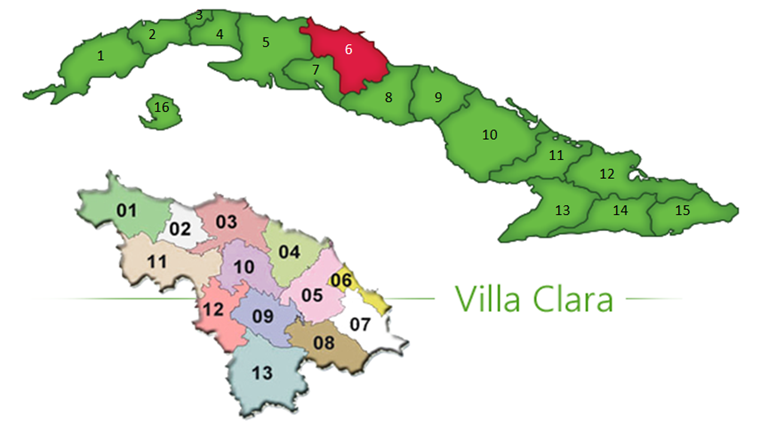
Figure 1: Above. Map of Cuba, showing the 15 provinces of Cuba and the special municipality of Isla de la Juventud:
- Pinar del Río,
- Artemisa,
- La Habana,
- Mayabeque,
- Matanzas,
- Villa Clara, 7 Cienfuegos,
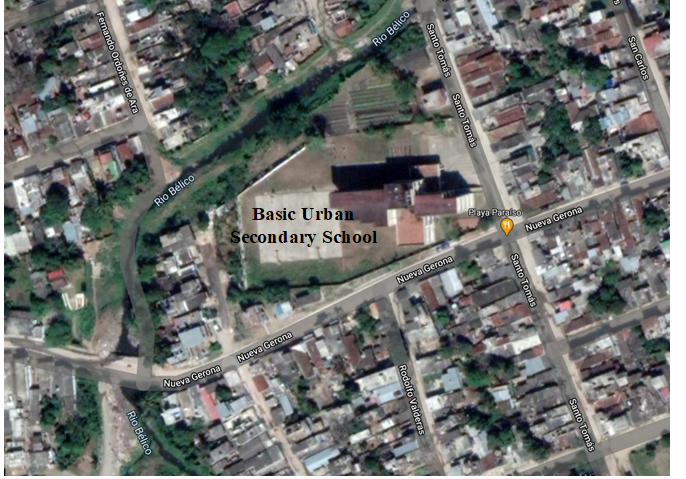
The city of Santa Clara is located about 100 meters above sea level, in an undulating terrain surrounded by conical hills (<350 meters above sea level) belonging to the Cubanacán dome (Alturas de Santa Clara). It is crossed by the Belico and Cubanicay rivers (formerly the Savannah and Monte rivers, respectively), which belong to the Sagua la Grande river basin, and some tributary streams (tributaries of the Ochoa river, whose course runs to the east) of the Sagua la Chica river. Its soils are mostly settled on a bed of serpentine rocks that give it little productivity; only to the north are more evolved soils. The characteristic vegetation goes from the cuabals to the typical Cuban savannahs and forests, standing out, within the urban limits, the Historical Cultural Park, Capiro Hill and Mount Carrascal, as well as the Managed Floristic Reserve, Savannahs the Santa Clara in the outskirts of the city. The Villa Clara Botanical Garden deserves a special mention. It is located on the grounds of the “Marta Abreu” Central University in Las Villas, one of the oldest in Cuba.
The characteristic climate is the tropical one of savannahs with precipitations higher than 1000 mm per year distributed in two well differentiated seasons: a humid one (from May to October) and another dry one (from November to April). Temperatures range, on average, between 22 (January) and 27 (summer months) degrees Celsius. As is typical of tropical latitudes, the greatest differences in temperature occur between day and night with values that can reach 32 and 33 degrees Celsius in the summer evenings. The relative humidity is quite high, especially in the months of May to September, so the wind chill could exceed the instrumental records by several degrees.
The Theoretical and Empirical Methods used in the Research were the Following
Historical-logical: To determine the particularities of the elaboration theory of the workshops, analytical-synthetic, to value the main contributions of Cuban and foreign scholars to the subject of research. Besides, there are reconciled and contrasted the criteria derived from the consulted sources and the analysis of the results of the diagnosis of needs, with the objective of orienting the workshops’ structure, inductive- deductive. This method allowed, from the instruments used and the bibliographic consultations carried out, to make inferences about the real situation presented by the students, teachers and inhabitants of the community in the knowledge of the IES and especially of the domestic rodents. The method of ascending from the abstract to the concrete was used for the design and elaboration of the workshops, and the structural systemic one was used in the determination of the system’s structural and organizational requirements.
Within the empirical methods were considered the analysis of documents that provided the necessary information of the current state of the object of research, considering several authors who have worked on the subject and its results, the survey to know the opinions of students and community members about their knowledge about the IES and especially of domestic rodents. The criteria of external evaluators were assumed with the purpose of knowing the evaluations of these on the proposal.
Percentage Analysis was used as a Procedure
The theoretical and empirical methods used in the research were the following Historical-logical: To determine the particularities of the elaboration theory of the workshops, analytical- synthetic, to value the main contributions of Cuban and foreign scholars to the subject of research. Besides, there are reconciled and contrasted the criteria derived from the consulted sources and the analysis of the results of the diagnosis of needs, with the objective of orienting the workshops’ structure, inductive-deductive. This method allowed, from the instruments used and the bibliographic consultations carried out, to make inferences about the real situation presented by the students, teachers and inhabitants of the community in the knowledge of the IES and especially of the domestic rodents. The method of ascending from the abstract to the concrete was used for the design and elaboration of the workshops, and the structural systemic one was used in the determination of the system’s structural and organizational requirements.
Within the empirical methods were considered the analysis of documents that provided the necessary information of the current state of the object of research, considering several authors who have worked on the subject and its results, the survey to know the opinions of students and community members about their knowledge about the IES and especially of domestic rodents. The criteria of external evaluators were assumed with the purpose of knowing the evaluations of these on the proposal.
Percentage Analysis was used as a Procedure
The population is made up of 36 students that constitute the enrollment of the 8th 3 of the “Antonio Aucar Jimenez” Basic Secondary School and as a sample 12 students that constitute the members of the workshop. The criteria of the sample in this sense was intentional not probabilistic.
Results
Based on a preliminary diagnosis, the workshop system was designed to contribute to the school’s educational project, which was validated through practice and readjusted in accordance with the needs of the students and the particularities of the context.
The following is an analysis of the aspects evaluated in the review of the normative and methodological documents. It included the director program Health Education, Biology Program 2, 8th grade, the Methodological Guidelines and the textbook, which allowed us to confirm that Environmental Education is declared as an objective the treatment of the content is only explicit in Unit 1 when dealing with environmental sanitation, but in the rest of the units it is left to the intention of the teacher.
It was carried out an initial survey to the students of the group 8vo 3, with the objective of confirming the knowledge that they have about domestic rodents as EEI and their undesirable effects to the Cuban vulnerable ecosystems and to human health, and the results were the following.
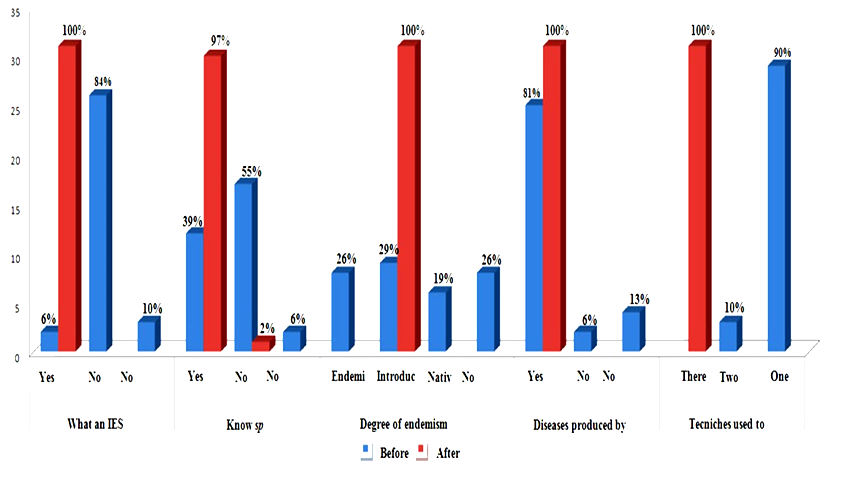
In the question 1 about if students know the meaning of what is an EEI, 26 answer that they do not for 84.0%, 2 state that they do for 6.0% and 3 do not answer the question for 10.0%. In the first case they explain that they are species introduced by man, or that they live outside their area and are introduced by man or by chance.
In the second question related to whether the guava and the mouse are the same species, 12 students say that for 39.0%, 17 say that they are different for 55.0% and 2 do not know for 6.0%.
Question 3 related to the degree of endemism of the species (8) answers that they are endemic for 26.0%, 9 state that they are introduced for 29.0%, 6 state that they are native which represents 19% and finally 8 do not know for 26.0%.
Question 4 referred to diseases produced by rodents, 25 students responded that rats and mice produce diseases, which represents 81.0%, 2 said no for 6.0% and 4 did not respond for 13.0%. It is necessary to emphasize that only 5 students cite leptospirosis as an example, the rest do not refer to any.
Question 5 concerning knowledge of control methods, only 3 students for 10%, propose two control methods, the rest only recognize mousetraps as a means of elimination.
All of the respondents stated that there are no activities in the school about the negative effects on human health caused by rats and mice.
The following are referred to as causes of the presence of domestic rodents in the community:
- Presence of garbage cans.
- Dumping of garbage and waste in the river.
- Lack of hygiene in the houses.
The application of the different instruments made it possible to determine the following deficiencies:
The normative documents make explicit the need to systematize the work of Environmental Education, the treatment of Invasive Exotic Species as content of Environmental Education. However, this subject is not reflected in the current programs of the national education system.
There is a lack of knowledge about domestic rodent species, their control routes and importance. There is little knowledge about the diseases transmitted by these vectors. There are no activities that contribute to the knowledge of IES and in particular of domestic rodents. Among the potentialities for the development of the work we can mention. There are possibilities of carrying out multiple activities from the educational project of the center that contribute to the dissemination of knowledge of domestic rodents as IES. The motivation of the students to know more about the subject. The logistic support offered by the school and the community because of the interest of the subject. Taking into account the results obtained, once the instruments are applied, a system of workshops is proposed to provide a solution to the scientific problem.
Criteria of External Evaluators
The proposal of the system of workshops is submitted before its application to the evaluation by the method of external evaluators. This method allowed the analysis of different aspects of the proposal that required consideration. Later, the criteria about the indicators to be evaluated were compiled and the information was processed, restructuring certain ideas, before its application in practice.
The selected external evaluators are directors of the center, teachers who work with the degree and public health workers. A survey was applied to them, to evaluate the feasibility and relevance of the proposal of activities.
All of them analyzed and reviewed the proposal and issued their criteria. In this sense, 100.0% of the respondents stated that the proposal is very necessary, given the presence and abundance of rodents on the riverbanks caused by the dumping of waste and garbage. 100.0% consider it very relevant. 80.0% admit that it is a new and original way of articulating the educational project, the research work and the problems present in the town.
All those surveyed consider that the proposal of the workshop system can be generalized.
Proposal of Solution to the Scientific Problem
The workshops have been conceived in a systemic way, special attention is given to the cognitive aspect to attend to the needs related to Environmental Education.
Below is the designed proposal.
Workshop 1: Domestic rodents • Objective: To contribute to the knowledge of the general characteristics of the domestic rodents that makes it an IES.
Procedures: After coordinating with the specialist from the Ministry of Technology and Environment who attends this project, an exchange with the students is carried out, where it is informed about the project that is carried out in the Republic of Cuba, the general characteristics of the species that are in this category and, from them, those that are present in the province of Villa Clara.
In the second moment of the activity, bibliographies are distributed and the work is organized in such a way that each subgroup is dedicated to determine the general characteristics of the IES that the species assigned to them present: Mus musculus, Rattus rattus or R. norvegicus. In a plenary session, each group socializes the information and presents initiatives.
In this workshop it will be addressed as a historical fact that according to Borroto, et al. [13] the cat Felis silvestris and the black rat R. rattus should have arrived to Cuba possibly in the first Colombian ships. The former as a companion animal and controller of the latter, and that in Old Havana the remains of both species have been collected in sites from the second half of the 16th to the 19th century.
- Conclusions: As a conclusion of the activity, the students should express with a word what this first workshop has brought them.
- Orientation of the next workshop: It is oriented the search of information about the species assigned to each one of the groups for the next workshop.
Workshop 2: Knowing the domestic rodents
- Objective: To identify the different species of domestic rodents by their morphological characteristics.
- Procedures: With the available bibliography and information gathered by the students and teaching media at hand (plates, photos, printed and audiovisual materials) each subgroup is dedicated to characterize the species that corresponds to them, as well as to highlight the benefits and damages of the same one.
Each subgroup must prepare its own means and initiatives that will allow it to socialize the results of its work in an efficient way.
The teams should prepare an interview guide to be applied to the selected public health personnel. The interview should focus on diseases transmitted by these vectors, main symptoms, levels of infestation and infection in the community, polyclinic or municipality, measures applied for vector control, ways in which the school and community can contribute. It is important that the researcher explain to the students the characteristics that the interview should have.
- Conclusions: The activity is concluded by assessing the importance of it on the part of the student body.
- Orientation of the next workshop: The visit to the doctor’s office, polyclinic, hygiene and epidemiology center and the application of the interview are oriented for the realization of the next workshop.
Workshop 3: Title: Rodents and diseases
- Objective: To contribute to the knowledge of diseases transmitted by domestic rodents.
- Procedures: With the help of the math teacher, the way to tabulate the results of the applied instrument is demonstrated.
With the presence of the doctor from the nearby office, the exchange is encouraged where the students present the results of their research with the use of graphics that allow a better understanding of the information.
Due to the importance of the disease in the area, the family doctor is asked to detail the possible ways in which the human being can become infected, initial symptoms, behaviors to follow, affectations that it causes to the different organ systems, consequences of not attending the office early, measures to follow by the family and neighbors, in the case that there is a member of the community affected. Other diseases will also be addressed, such as: bubonic plague, typhoid fever, salmonellosis, encephalitis, brucellosis, trichinosis, tularemia, schistosomiasis, rabies and rat-bite fever.
- Conclusions: The activity concludes with a call for the importance of the dissemination of information, since a series of factors converge in the community that favors the presence and abundance of these vectors.
- Orientation of the next workshop: It is oriented for the next workshop the search of information among relatives and neighbors about the methods used for the control of domestic rodents.
Workshop 4: Pathways to control rats and mice
- Objective: To describe the procedures that is carried out for the control of population density, recognizing the importance of the utility of the species in the food chains.
- Procedures: Based on the information obtained by the population, each subgroup makes a list, classifying in control methods in chemical, mechanical and biological.
With the collaboration of colleagues from the anti-vector campaign, students are exposed to important aspects to be taken into account in the control:
How is rat extermination carried out? How much bioratticide is suitable for population management? How often should it be done?
What precautions should be taken by the population to carry out rat extermination in their homes? Each group will complete the list and present a method of control to their peers through a form of graphic propaganda.
- Conclusions: The workshop concludes with an assessment of the need to disseminate in the community the importance of knowing the precautions to be taken to carry out effective rat extermination
- Orientation of the next workshop: The selection of small texts for the elaboration of messages directed to different population groups is oriented for the next one.
Workshop 5: Art and rodents • Objective: To develop advertisements that addresses the issue of rodents, such as IES and measures for their control.
• Procedures: To the development of this workshop we invite the teachers of Artistic Education to support the work of each one of the teams, which will be directed to elaboration of flyers where the diseases that can transmit the rodents are exposed rodents, symptoms and consequences of not attending the doctor in time.
Preparation of posters, advertisements, brochures and newsletters containing useful information, to contribute to the proper control of populations of rats and mice.
All the means available at the center and those provided by the group are used in the preparation of propaganda. The purpose of each one of the prepared media must be determined, as well as the audience to which it is directed and where it should be placed in the community.
• Conclusions: The conclusions of the activity will be in charge of the teacher of Artistic Education where the value of the graphic information is highlighted. The student group will select one per team to place on the central mural of the school.
• Orientation of the next workshop: It is oriented to make a visit to the community and distribute the advertisements in the previously agreed places. Communicate the results of the investigation to the District Delegate with the objective of undertaking joint actions in the eradication of domestic rodents. The presentation of the results in a special morning is also oriented.
Workshop 6: Rodent War (Participatory community activity)
- Objective: To contribute to the sanitation of the War River by creating joint brigades.
- Procedures: Create a brigade of students, teachers and community members to effectively contribute to the cleanup of the Belico river, adjacent to the “Antonio Aucar Jimenez” basic secondary school.
Create a brigade of students “Guardians of the river” who will talk to the community members, so that they do not dump waste into the river, making them aware of the health consequences of this bad habit.
Place advertisements and notices in the cleaned up area to avoid the dumping of waste in the area (Figure 3).
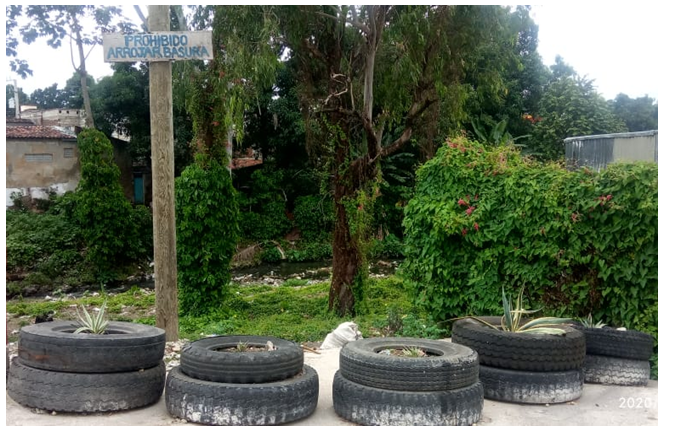
- Conclusions: The students, together with teachers, family members and other community members, effectively contributed to the sanitation of a part of the Warsaw River that runs near the school.
- Orientation of the next workshop: The students are told that they must prepare themselves to communicate the results of the workshops carried out.
Workshop 7: Organizing efforts
- Objective: To prepare the student body to communicate the results of the workshops.
- Procedures: The student collective selects from the information collected that which will be presented to the different factors, and organizes the form of presentation and means to be used.
The invitations for the activity are prepared and the place and time are determined.
- Conclusions: To conclude, the students are asked to express their experiences about the work developed.
- Orientation of the next workshop: The students are oriented to the different ways of disseminating the results of the work done among the neighbors and community leaders.
Workshop 8: Protecting My Community
- Objective: To disseminate the results of the work among the main factors and neighbors of the community.
- Procedures: After coordinating with the different factors of the community, such as family doctor and nurse, president of the popular council, district delegate, administrators of the state entities located in the community, school management and community neighbors, the students who participate in the research will report the final results of the research emphasizing the measures to be taken into account for the control of domestic rodents, communicable diseases, and behavior to be followed by all community members.
The different factors will be given graphic propaganda elaborated for the disclosure of the aspects previously discussed.
Suggest to the president of the Popular Council to extend this information to all the council and to pronounce for the cleaning and maintenance of the river since the rodents find favorable conditions of life in the margins of the same one.
• Conclusions: The students were asked to disseminate the results of the research among the main factors and neighbors of the community adjacent to the “Antonio Aucar Jiménez” Urban Basic Secondary School.
At the conclusion of the workshop system, a final survey was applied to the students 100% of the students define the IES as species introduced in the country that cause damage to the economy and to man, 68.9% also refer that their reproduction is uncontrolled, they have many children and cause damage in warehouses, fields and transmit diseases 96.7% of the students establish the differences between the species of domestic rodents. 100% of the students recognize more than three diseases transmitted by rodents, among them are: leptospirosis, rabies, fever, typhus and bubonic plague. The 100% cites more than three methods of control, among which the traps or mousetraps, the cats as biological controller of the species, rat extermination and poisoned posts stand out. 100% of the students cite the elimination of garbage cans and dumps near the houses as the main measure to prevent rodents. 86.6% consider that food should be kept in covered containers in the house, 93.5% agree that rat extermination should be done systematically, and 68.9% say that there should be cats in the houses. 100% of the students value the workshop system as very good and affirm that they have learned a lot about rats and mice.
Eliminate them from their homes. En la figura 4, el gráfico de barras representa los resultados de la encuesta inicial y final.
Discussion
The theme to work on was proposed by the authors, because of the need that is reflected in the community where the center is located. It was accepted by the student collective with interest and motivation. For the development of each of the workshops the work was organized in three subgroups, according to the intellectual and personal interests and the location of some students was negotiated for the benefit of the authors.
In order to develop the workshops properly, the authors had an extensive bibliography on the subject that was provided by public health and materials extracted from the Internet. However, the students were asked to do their best in this endeavor.
For the development of each of the workshops, the work was organized in three subgroups according to intellectual and personal interests, and the location of some students was negotiated in the interest of the authors of the research.
The work was conceived by tasks, individual and collective, where it was insisted that the collective result would be the fruit of the individual work that each subject could do, this coincides with what was proposed with other authors [15, 18, 19].
The proposal was made up of eight interconnected workshops, in correspondence with what expressed about system, when they assert that the system as a scientific pedagogical result, as a more or less theoretical analytical construction that tries to modify the structure of a certain real pedagogical system, aspects or sectors of reality and/ or the creation of a new one, whose purpose is to obtain superior results in a certain activity [20, 21].
In the workshops implemented, learning by doing prevailed, the link between theory and practice and experiential learning. It is valid to emphasize that in them, the authors conceived a practical component, where the students interacted with the community, the institutions, public health personnel and other factors present in the surroundings, because to work the Environmental Education it is necessary to educate the ways of acting of the students and community, only this way the work will be truly effective, which is in agreement with what is expressed by Pérez, et al. [15].
For the development of the workshop system, the authors were supported at all times by the school management, the head of the year, non-teaching workers and teachers. All the facilities were offered for the good development of these, which aroused the interest and curiosity among teachers and students for the novelty of the proposal, not having a background in terms of organization and the subject to be developed in the school [15, 19].
Evidently, the authors of the research confirm that the organization of the workshop system favored collective work, occupied the time of the students in recreational and healthy activities that contributed to their general integral culture and strengthened the values with greater emphasis on responsibility and industriousness, promoted the orientation of the students through the discovery of their affinities towards different professions or trades, and encouraged scientific research [4, 19, 21].
It is agreed the system of workshops can be carried out in the different educational levels, for it is necessary to take into account the characteristics and age of the students, besides it can be implemented by the modalities of circle of interest and scientific society [19, 21].
The evaluation of the students was directed towards their knowledge, habits, abilities and attitudes and special attention was given to knowledge, since in this way they will be able to contribute to the dissemination of the negative impacts of this species on human health in particular.
Finally, and perhaps by way of conclusion, it can be stated that the results obtained by the students in the second survey applied, clearly demonstrated the effectiveness of the workshops implemented in the “Antonio Aucar Jimenez” basic secondary school. However, it is considered by the authors that for a second version, it would be convenient to have specimens preserved in liquid or taxidermied to facilitate the identification of domestic rodent species. In addition, the number of students to participate in the workshops should be increased in order to have a greater influence on the different factors present in the community.
References
-
Mosquera MM, Santana MD, Arredondo AC, Rodríguez CHD, Caballero JI, et al. (2019) Biología II 8vo grado (provisional). Editorial Pueblo y Educación. La Habana, Cuba pp: 240.
-
Armiñana GR, Fimia DR, Iannacone J (2020) Todo o casi todo del Caracol Gigante Africano. Editorial Universitaria VRIN-Vicerrectorado de Investigación Universidad Nacional Federico Villarreal. Lima, Perú pp: 49.
-
Latombe G, Pyšek P, Jeschke JM, Blackburn TM, Bacher S, et al. (2017) A vision for global monitoring of biological invasions. Biological Conservation 213: 295-308.
-
Armiñana GR, Fimia DR, Olivera BD, Ferrer ZY (2017) Las especies exóticas invasoras en Cuba. Incidencia en la salud humana. Centro Nacional de Áreas Protegidas (CNAP). Proyecto: PNUD/GEF. La Habana, Cuba pp: 160.
-
González H (2007) Biodiversidad de Cuba. Ediciones Polymita. Ciudad de Guatemala pp: 330.
-
Mc Murtrie P, Edge KA, Crouhley D, Willians M (2008) Resolution island operational plan: stoat eradication. Department of Conservation, Invercargill, New Zealand.
-
Barun A, Niemiller ML, Fitzpatrick BM, Fordyce JA, Simberloff D (2013) Can genetic data confirm or refute historical records? The island invasion of the small Indian mongoose (Herpestes auropunctatus). Biological Invasion 15: 2243-2251.
-
Armiñana GR, Olivera BD, Fimia DR, García RR, Alarcón EPM, et al. (2019) Vinculando la comunidad al conocimiento de la mangosta Herpestes auropunctatus Hodgson, 1836 (Herpestidae: Mammalia) como Especie Exótica Invasora en el centro de Cuba. Biotempo 16: 203- 215.
-
López MMA (2020) Aedes albopictus (el mosquito tigre Artrhopoda: Diptera: Culicidae), una amenaza a la salud Villa Clara: Repositorio de la Universidad Central «Marta Abreu» de Las Villas. Villa Clara, Cuba pp: 39.
-
Cao GC (2020) Wasmannia auropunctata (Artrhopoda: Hymenoptera: Formicidae) una molesta hormiga [Tesis presentada en opción al título de Licenciado en Educación. Biología]. Villa Clara: Repositorio de la Universidad Central «Marta Abreu» de Las Villas. Villa Clara, Cuba pp: 40.
-
McNeely JA (2008) Estrategia mundial sobre Especies Exóticas Invasoras. UICN Gland (Suiza) y Cambridge (Reino Unido). (s/p).
-
Bellard C, Genovesi P, Jeschke JM (2016) Global patterns in threats to vertebrates by biological invasions. Proceedings of the Royal Society of London. Biological Sciences 283: 2015-2454.
-
Borroto PR (2011) Los mamíferos invasores o introducidos. En: Mamíferos de Cuba. Impreso por UPC Print, Vasa, Finlandia pp: 276.
-
Vera MM (2020) Los roedores domésticos, la comunidad y la salud humana. Villa Clara: Repositorio de la Universidad Central «Marta Abreu» de Las Villas, Villa Clara, Cuba pp: 40.
-
Pérez SY (2014) Los roedores domésticos. Un peligro latente. Tesis presentada en opción al título de Licenciado en Educación. Biología-Geografía. Universidad Central «Marta Abreu» de Las Villas, Villa Clara, Cuba, pp: 37.
-
(ANC) Atlas Nacional de Cuba (2016) Instituto de Geografía de la Academia de Ciencias de Cuba y el Instituto Cubano de Geodesia y Cartografía. La Habana, Cuba.
-
La Rosa HT (2014) Sistema de talleres pioneriles una vía para el estudio del Búfalo de Agua como Especie Exótica Invasora. Villa Clara: Repositorio de la Universidad central «Marta Abreu» de Las Villas, Villa Clara, Cuba, pp: 43.
-
Armiñana GR, Olivera BD, Lunar AFJ, Fimia DR, Ramos CP, et al. (2020b) Conocimiento de escolares de educación secundaria del Búfalo de agua Bubalus bubalis (Linnaeus, 1758), como Especie Exótica Invasora. The Biologist (Lima) 18(2): 263-276.
-
Lorences J (2012) Aproximación al sistema como resultado científico. Universidad de Ciencias Pedagogicas “Félix Varela Morales”. Villa Clara, Cuba. En formato electrónico pp: 112.
-
Armiñana GR (2015) Sistema de Medios de Enseñanza Asistido por Computadoras para el proceso de enseñanza-aprendizaje de la Zoología General I. Universidad de Ciencias Pedagógicas «Félix Varela Morales». Repositorio de la Universidad Central «Marta Abreu» de Las Villas, Villa Clara, Cuba, pp: 215.
-
Évora LE (2011) La Educación Ambiental para el Desarrollo Sostenible en la formación inicial de los profesionales de la educación en el proceso de enseñanza aprendizaje de la Física. Tesis en opción al grado científico de Doctor en Ciencias Pedagógicas. Universidad de Ciencias Pedagógicas «Félix Varela Morales». Villa Clara, Cuba, pp: 252.
- Natural Decline to Extinction of A New Zealand Rabbit Population
- Mitochondrial Bio-Logistics: Steering Co-Enzyme Q10 and Lycopene Synergies within the Science 4.0 Bio-OS Framework
- Hymenoptera Specimens from the Caño Negro Wetland, of the National Museum Collection, Costa Rica
- Science 4.0: Comprehensive Architecture of the Biological Operating System (Bio-OS) A Framework for Systemic Resilience and Industrialized Bio-Governance
- Rabbit on, or Hare Back? Understanding Climate Change
- Clinical Validation of Science 4.0: Flow Steering and Epigenetic Drift Inversion on a 76-Year-Old Hybrid System