
Fauna of Arthropods Presents in Hot Caves in the Province of Villa Clara, Cuba
A characterization of the arthropod fauna is carried out in two "hot caves" in the province of Villa Clara: Cave of the Maja’s, located in the town of Buenavista in the municipality of Remedios; and Cave of the Coloradas, located on a homonymous hill, in the town of Zulueta belonging to the municipality of Remedios. The arthropods were collected using conventional methods. In the hot room of the Cave of the Maja’s, the temperature fluctuates around 36°C and the relative humidity varies between 98 and 100%. In the final galleries of the Cave of the Coloradas, temperatures are moderately high (29- 4°C), with a relative humidity ranging from 70 to 85%, both caves are classified in the category of “heat caves”. Following the criteria of Armas and Alayón (1984), Ortuño (2011), based on the proposals of the Schiner - Racovitza system (Trajano and Carvalho, 2017), the species identified were classified into Troglobess, Troglophiless, and Trogloxens. Conclusions were drawn from the climatic and faunal points of view and warnings were made about the harm that these underground ecosystems are being subjected to, due to the anthropic action.
Introduction
Caves, from ancient times to the present day, have displayed an important power of attraction for men [1]. They were their first homes, temples and cemeteries. Since immemorial times, caves have been linked to the history of humankind and men have always tried to explain the wonders of the underground world [2].
The first known speleological explorations were those carried out by the Assyrian king Tiglath Pileser, who explored the origins of River Tigris, in today´s Kurdistan, in year 1100 B.C. King Shalmanaser III continued it, 250 years later. On the other hand, the Chinese book Pao Phu Tzu, written by Ko Hung in 300 B.C., describes for the first time the therapeutic use of some deposits formed by sedimentation in caves. But it was the Greek philosopher Aristotle (384-322 B.C) who came up with one of the first theories about the origin of caves and their hydrological role, considering that, in them, the air was compressed and transformed into water, dripping down the stalactites [2, 3].
Caves are nothing else than underground spaces where men can move around (at least crawling) [1, 4]. Ortuño, et al. [1] refer to the fact that caves are underground spaces, but not all underground spaces are caves. Many researchers think that the term underground must be applied to those organisms that develop their entire life cycle in the subsoil, regardless of the cavity size and the level of depth that it occupies in the soil horizons (in the edaphological/geological sense).
The so-called “hot caves” or “hot caves” constitute one of the most interesting phenomena of the tropical biospeleology [5]. According to Armiñana, et al. [4], in hot caves there is a necessary correspondence between their climatic particularities, the high relative humidity (nearly always very close to the saturation point), the high temperatures (usually between 28 and 35°C), and its use as a daytime shelter by the Phyllonycteris poeyi (Gundlach in Peters, 1861), a dominant bat species is this biotype in Cuba. Its designation as endemic species given by Silva, et al. [6, 7] was invalidated a few years ago when it was found in a fossil state in Cayman Islands and in Bahamas [8, 9, 10].
Associated to the aforementioned factors, “a unique guanobiosenosis is presented, both for its composition and for its numerical richness” [11]. This peculiar fauna is mainly composed of isopods, mites, spiders, collagen, thysanides, blatodeos and coleoptera, which cover the soil in amounts of hundreds of thousands and sometimes millions of individuals [4, 12, 13].
Assert that the hypogeal ecosystem is not a closed or isolated system, it is physically and trophically open to numerous exchanges with the bordering ecosystems. From an energetic point of view, it is a system that is being fed by a flow of organic matter from the surface [14].
Today, the term “cavy” tends to be omitted and “hypogea” is used instead. In the same way, the term “biospeleology” tends to be abandoned in favor of a more exact one: “underground biology” [3].
Underground environments have special geomorphological and hydrological characteristics, in addition to a very particular biocenosis that makes them unique within terrestrial ecosystems. Many of the species that exclusively inhabit caves are numerically rare local endemics, which makes them very vulnerable to any human change or disturbance [15].
The arthropods are the most numerous and diverse edge of the animal kingdom. The term refers to invertebrate animals endowed with an exoskeleton and articulated appendixes, among others. This taxonomic category includes: arachnids, crustaceans, hexapods, chilopods, and diplopods [16].
They have adapted efficiently to live in almost all habitats. In this sense, they have conquered the ground in an extraordinary way, although they are also aquatic. They are located at heights above 6 000 meters in the mountains and in depths of over 5 500 meters in the ocean. It is clear that it is an edge that has achieved great “ecological success”, evidenced in its wide distribution and the diversity of adaptations to different habitats, in addition to having a wide variety of eating habits [17, 18].
There are more than 1 200 000 described species, mostly insects (one million), which represent at least 80% of all known animal species [16]. The diversity of arthropods found in the caves of the planet is enormous, especially if the fauna classified as Trogloxen and Troglophiles is also contemplated.
According to Malek-Hosseini and Zamani, et al. [19], there are about 100 000 underground terrestrial species of a mandatory nature worldwide. However, one of the characteristics of the Cuban speleofauna is the great shortage of Troglobess species [20].
Says that only slightly over fifty Troglobess animal species have been registered in Cuba i.e., restricted to the caves. About the vast majority of them, only the habitat and the microhabitat are known; while other fundamental biological aspects remain unknown, like feeding, predators, competitors, abundance, adaptability to the cave environment, distribution and reproduction patterns, just to mention some [5].
It is interesting to know that many tropical troglobes have epigeal, non-troglomorphic, and taxonomically close progenies, sometimes co-inhabiting the same cave [21, 22].
Throughout the nineteenth century and most of the twentieth century, references to the Cuban cave biota were fortuitous and sporadic. The most important biospeleological explorations, were carried out mainly by foreign zoologists. The investigations done by the Italian Filipo Silvestri (1929), the Spanish Cándido Bolívar Pieltain (1944), and those carried out by Polish (1964) and Romanian scientists (1969, 1970, 1973) deserve to be acknowledged. Almost all were done in collaboration with the Cuban Speleological Society, founded in 1940 by the remarkable Cuban geographer Antonio Núñez Jiménez [5].
The objective of this research is to characterize the hypogeal artropofauna of two “heat caves” located in the province of Villa Clara, Cuba.
Materials and Methods
Ecological Characterization of the Caves
Cave of the Majaes: This cave is located in the town of Buenavista, in the municipality of Remedios, province of Villa Clara (Figure 1). It opens in stratified limestone rocks of the Coloradas Range from the early Cretaceous, is a cave of vadose origin and is in its first phase, it has little water leaks and no secondary formations are found. It has a main entrance that branches into two galleries. It has a linear development of 150 meters, with an approximate area of 460 m2.
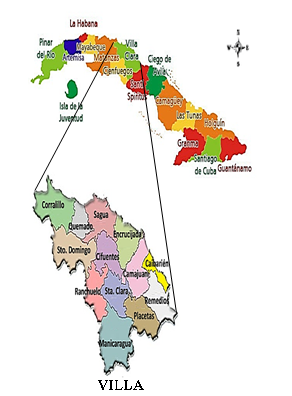
Source: Provincial Meteorological Center of Villa Clara, Cuba. Figure 1: Administrative political map of Cuba and Villa Clara province with its 13 municipalities.
The hot room has only one entrance in the shape of a canyon, located at a ground level (Figure 2). In this room the temperature fluctuates around 36°C and the relative humidity of the air varies between 98 and 100%, the walls of the cave remain wet and the floor is always moist and muddy. However, in the nearby galleries and halls the floor is dry and the air temperature is under 29°C, on the other hand the relative humidity of the air is usually around 80%.
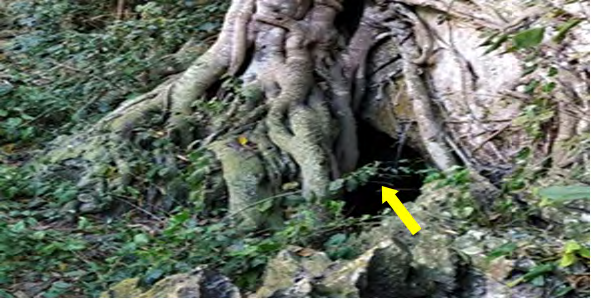
Source: Photo taken by Alejandro Michel Rodríguez González. Figure 2: The yellow arrow indicates the entrance to the Majaes cave.
Cave of the Coloradas: The cave is located in the Coloradas hill, Zulueta, municipality of Remedios. It opens in stratified limestones of the Coloradas Range, from the early Cretaceous. Like the Cave of the Majases, it is of vadose origin and is in its first phase. Access to it is carried out through two small dolinas, with a descending vertical of 6 meters. The final galleries are large and moderate temperatures prevail in them (29 - 34°C), with a relative humidity that oscillates between 70 and 85%. It is characteristic in this cave that the guano on the floor is dry.
Hypogea fauna of arthropods: For the capture of the artropofauna in the caves under study, passive methods were used, since they are the most frequently employed in cave environments. In this sense, fall traps with baits, fall traps to capture live animals, and wet leaf traps [24] were used. With these methods, a wide variety of arthropods was captured.
For the use of the fall trap with baits, a plastic container was completely buried and left at a ground level with a preserving liquid in the bottom (75-80% ethyl alcohol) and a small amount of liquid detergent to lower the surface tension and make the samples go straight to the bottom. The bait was placed in a way that did not contaminate the preserving liquid and prevented the animal from escaping. A rock was laid on top of the traps, leaving an opening for the animals to pass.
Another method used in the investigation was that of wet leaf traps, which consisted of filling a bag with wet leaves and placing it on the floor of the cave for a period of time, which allowed the invertebrates to use the material as shelter.
The necessary equipment for the biospeleological works was carried and safety measures were followed. In this sense, it was essential to use helmets, useful to protect the head from being hit when walking along small or narrow galleries with secondary formations or in case of possible falls. For vertical progression, ropes, harnesses, and blockers were used.
Other implements used were the light signals to indicate the path inside the cave, masks for the work in the hot rooms, as well as gloves, and flashlights.
As in other research works carried out in different “heat caves” in Villa Clara, arthropod fauna was also collected using other traditional methods [4, 25], like manual sampling. Immediate sampling was done, made with a fine brush or entomological tweezers according to the size and texture of the specimen, made throughout the cavity, where the different environments were observed in detail: walls and their cavities, soil, and water tanks. The captured arthropods were preserved in tubes with absolute alcohol and properly labeled, for later identification in the Zoology laboratory of the “Felix Varela Morales” campus at “Marta Abreu” Central University of Las Villas, Cuba. The collected species were fixed in 70% ethanol.
According to the criteria of Armas, et al. [26]; Ortuño [3], based on the proposals of the Schiner - Racovitza system [27], the identified species were classified into Troglobess, Troglophiless and Trogloxens.
Results and Discussion
Cave of the Majaes
In the cave of the Majaes, the hot room is well defined, since its thermal trap is very efficient, this is because there is a narrow corridor open at floor level. A large part of the cold zone of this cave is in darkness, due to the presence of three small dolinas. A large community of cockroaches is established in it, Periplaneta americana (Linnaeus, 1758) (Blattodea: Blattidae) and Byrsotria fumigata (Guérin- Méneville, 1857) (Blattodea: Blaberidae), dermaptera as is the case of Carcinophora americana (Beauvois, 1817) (Dermaptera: Anisolabididae), isopods such as moisture cochineals Metoponorthus pruinosus (Brandt, 1833), and tenebrionids Zophobas atratus (Fabricius, 1775). Both cochineals and tenebrionids inhabit the dry guano of the floor, but the other three aforementioned species are located on the walls of the cave. Hymenoptera such as Solenopsis germinate (Fabricius, 1804), the spider Corinna flavipes (Keyserling, 1891) and the Gymnetis lanius sternalis (Chevrolat, 1865) are also present. There is a small population of the spider Digueta spp (Araneae: Diguetidae), which lives on the walls where it embeds its tubular nests. It was significant that the maximum density of this species was 140 spiderwebs per m2 at the mouth of the cave.
Near the thermal trap, where the air temperature fluctuates around 29°C, the increase in populations of P. americana and Z. atratus becomes more evident, but the Metoponorthus pruinosus isopods decrease. At the very mouth of the passage that constitutes the thermal trap, with an air temperature around 30°C, P. americana, Z. atratus and S. germinata abound. However, about 10 meters ahead, inside the heat room, where the air temperature was 36°C, and the relative humidity varies between 98 and 100%, the populations of Z. atratus and M. pruinosus decrease considerably, so it makes it difficult to find one or two specimens of these species. Although ants here are as common as in cold salons, cockroaches are only represented by P. americana, which is less abundant than in the surrounding area of the thermal trap. The presence of several specimens of Pyrophorus noctilucus (Linnaeus, 1758), in its adult state was confirmed.
Arthropods exclusive of the hot room are Argasid Antricola spp. (Acarina: Argasidae) (hundreds of individuals), thrombiculides and hysterids.
Cave of the Coloradan
In this cave, although there are cold rooms, the low efficiency of the thermal trap, makes the temperature of the hot rooms not as high as in the cave of the bat. The relative humidity of the air is low (60 to 70%), as compared to other heat caves studied. This means that there are almost no differences in the composition of the arthropofauna of hot and cold rooms.
In the cold rooms and under the skylights, the numerically codominant species are P. americana and B. fumigata, this codominance had already been found also in the heat cave of the “Mogotes of Jumagua” Ecological Reserve, in the municipality of Sagua la Grande, Villa Clara province, Cuba.
In January 2017 at 5 pm, the presence of 50 individuals of B. fumigata and 22 of P. americana was observed in a small hole in the wall about 20 cm deep and 22 cm high. In this room, the air temperature was 24°C and the relative humidity of the air, 49%. In these rooms, it was observed that B. fumigata ascends through the walls to heights of 3 meters. This observation was very interesting since in the heat cave of the Ecological Reserve “Mogotes de Jumagua”, B. fumigata is almost absent from the walls and only a few specimens were detected at 0.10 cm high. Other arthropods observed were Carcinophora americana in a few tens, some individuals of Loxoceles on the walls, A. laevigatus in dry and not very abundant guano, some scorpions Rhopalurus junceus (Herbst, 1800) and Sphendononema guildingii (Newport, 1844) (Scutigeromorpha: Pselliodidae).
The hottest room has the floor covered with dry guano and is located on the second level. The air temperature was 29.8°C; that of the dry guano at 2cm deep was 29.6°C and the relative humidity was 60%. An excellent community of P. americana, B. fumigate, and tenebrionids A. laevigatus was detected on the dry guano on the floor. However, P. americana is less abundant in these rooms than in the cold zone. In addition to finding these two blasts on the walls, the presence of several specimens of R. junceus and small populations of the spider Diguetia spp and Loxoscele cubana (Gertsch, 1958) was observed, the latter with a maximum density of 5 individuals per m2. In addition, the presence of Nesticodes rufipes was detected (Lucas, 1846).
In this hot room no archaeids were found. However, several specimens of the Ornithodoros viguerasi (Cooley and Kohls, 1941), a parasite of bats, were collected and the presence of Evania appendigaster (Linnaeus, 1758) was detected. According to Vivanco (2013), Evanias (Evaniidae) are hymenoptera insects, which act as natural exterminators against cockroaches parasitizing their eggs. E. appendigaster or flag wasp is the most common species. However, about 400 species are known to be spread all over the world, except for the polar regions.
Some Considerations about the Artropofauna of these Spelunks
In relation to Antricola spp. and Parantricola marginatus (Banks, 1910), in both caves there is poverty of these archaeids in terms of population density and the cause in the authors’ opinion is given by the presence of microclimatic conditions in the hot salons and by the presence of predators, mainly of P. americana. Obviously this contrasts with the great diversity of these archaeids observed in the cave of the bat located on the S slope of the heights of Sinaloa, in Hoyo del Negro, Vueltas, municipality of Camajuaní in Villa Clara, where previous studies conducted by Armas, et al. [28], in which the main author of this research was present, revealed that the population density of these archaeids was 15,000 individuals per m2, but P. americana was not present.
It is noteworthy that in the case of P. marginatus, it was possible to observe in some individuals its maternal behavior, that is, carrying the larvae in the opisthosoma, an aspect that researchers had not observed before, and which was considered a unique adaptation derived from this genus. In this sense, we agree with Pienaar, et al. [29].
In the Cave of the Majaes, in the typically hot room, there is a population of P. americana, composed of hundreds of individuals. On the other hand, in the Cave of the Coloradas, the efficiency of its thermal traps is much lower, which assures that significant values of temperature and relative humidity are not obtained, not as high as those registered in the Cave of the Majaes. P americana and B. fumigata are present in the galleries and halls of both caves.
It should be noted that these two species of cockroaches are numerically codominant in the cave floor, but in the rooms where guano is not abundant, the presence of B. fumigata is very restricted. In the heat rooms where there is a large amount of guano, B. fumigata was found buried, unlike P. americana, which occupies the surface of the floor and walls. B. fumigata, is absent from the walls. These results coincide with those achieved by Silva [30], Ponce, et al. [31]; Simões et al. [32] and Armiñana, et al. [4] for this type of ecosystem. This species showed a remarkable versatility in the size and shape of male wings within the population, which is not different from that reported by Núñez-Bazán, et al. [33].
According to Armiñana, et al. [4], P. americana is considered a Trogloxen species, while B. fumigata is classified as Troglobes.
In relation to C. americana, a considerable population consisting mainly of adults was detected in hot rooms, under the stones, above the guano, and on the walls. It is considered a Troglophiles species according to Armiñana, et al. [4].
Loxocele cubana spider is typically found in dry places, usually located on the ground and on the walls of the threshold areas of the caves that have low humidity.
In the Cave of the Coloradas, L. cubana is distributed throughout all rooms, although never in greater density than 5 or 6 indiv / m2. According to Armas, et al. [34], in the Cave of the Cat, in Sagua la Grande, province of Villa Clara, it is possible to find some spiders in the hottest room at 330C.
R. junceus (redish scorpion or blue scorpion). Of this scorpion there is a small population in the Cave of Las Coloradas, composed of one or two tens of individuals They live in the cracks and small cavities in the walls of all the rooms, feeding on P. americana.
In Cuba, R. junceus poison has been researched for its antitumor activity, showing efficacy against some tumor cell culture lines of human epithelial origin [35].
In this regard, the Cuban company belonging to the Biological and Pharmaceutical Laboratory (LABIOFAM) produces the drug named Vidatox, a homeopathic product that is made with the aforementioned scorpion poison, which has efficient anti-tumor, analgesic and anti-inflammatory properties. This medicine contains, for every milliliter, 33% hydroalcoholic solution of the poison, rich in low molecular weight proteins. Studies carried out on people affected by this disease have demonstrated their impact on the quality of life of patients, since it has enabled them to recover body weight and desire for food, in addition, this favors the reduction of analgesic consumption [18].
According to Decou [36], P. noctilucus the cocuyo as it is commonly called in Cuba, although frequent in the Cuban caves, has no importance in the dynamics of the biocenosis of the caves.
Gymnetis lanius sternalis. In the twilight zone of the Cave of the Majaes, with an air temperature of 29°C and a relative humidity of 80%, some dozens of adults were found on the floor and walls. This subspecies has also been collected in the Cave of the Cat in Sagua la Grande [32, 34].
As a conclusion, it can be stated that from the climatic point of view, the heat caves studied in Villa Clara, differ in two main types. The cave of the Majaes has a typical hot room with an efficient thermal trap, in which the temperature generally ranges between 32 and 40°C and the relative humidity is above 97%. It is possible to find populations of archaeids here, as well as thrombiculid mites and other species restricted to this room; however, certain species present (and sometimes abundant) in adjacent rooms (B. fumigata, A. laevigatus, dermaptera, spiders, isopods) are absent or represented by meager individuals in the hot room. On the other hand, the Cave of the Coloradas and the Heat Cave in the “Mogotes of Jumagua” Ecological Reserve, the halls have inefficient thermal traps, because there is a more dynamic flow among the hot room and the contiguous ones. This keeps the temperature ranging between 27 and 34°C, while the humidity of the air rarely approaches saturation levels. These weather conditions favor a more equivalent distribution of trophylophilic arthropofauna in the cave, and make it impossible for others to establish (as in the case of archaeids) limiting the development of their populations.
Call these rooms “closed heat rooms” and “open heat rooms”. The hypogeal arthropofauna studied in these two “heat caves” is made up of arachnids, insects, and chilopods, and the species have been classified into troglobes, troglophiles, and trogloxen [28].
It is evident that the anthropic action in both caves has resulted in, like in other vulnerable underground ecosystems studied, the so-called demographic explosion of P. americana, mainly due to the extraction of the guano to be used as a natural fertilizer by the peasants living in the area. It is also noted that in the visits made to the Cave of the Majaes, several specimens of Chilabothrus angulifer, Cuban boa or Cuban tree boa, endemic species of Cuba, have been found slaughtered.
Below, shows the composition of the artropofauna in three “heat caves” in the province of Villa Clara (Table 1).
| Taxon | Heat Cave | Cave of the Majaes | Cave of the Coloradas |
|---|---|---|---|
| Cold zone | |||
| Periplaneta americana (Trogloxen) | A | A | A |
| Byrsotria fumigata (Troglobes) | A | A | A |
| Alphitbius laevigatus (Trogloxen) | VA | A | |
| Zophabas atratus(Trogloxen) | S | ||
| Carcinophora americana (Troglophiles) | S | S | S |
| Evania appendigaster (Trogloxen) | R | R | |
| Loxosceles cubana (Troglophiles) | A | S | |
| Nesticodes rufipes (Troglophiles) | A | A | |
| Diguetia spp. (Troglobes) | S | S | |
| Corinna flavipes (Troglophiles) | S | ||
| Rhopalurus junceus (Trogloxen) | R | ||
| Metopanartus pruinosus (Trogloxen) | A | ||
| Sphendononema guildingii (Trogloxen) | |||
| Hot zone | |||
| Periplaneta americana | A | A | A |
| Byrsotria fumigata | A | A | A |
| Alphitbius laevigatus | VA | VA | |
| Zophabas atratus | R | ||
| Carcinophora americana | S | ||
| Evania appendigaster | R | ||
| Histeridos | S | S | |
| Loxosceles cubana | A | A | |
| Nesticodes rufipes | S | R | |
| Diguetia spp. | S | ||
| Rhopalurus junceus | R | ||
| Parantricola marginatus (Troglophiles) | R | ||
| Antricola spp. (Troglophiles) | R | A | R |
| Trombiculidos | A | ||
| Metopanartus pruinosus (Trogloxen) | R |
Table 1: Most representative artropofauna in three heat caves in the province of Villa Clara.
They have been classified in VA, very abundant (thousands of individuals); A, abundant (hundreds); S, scarce (less than one hundred individuals) and R, rare (less than 20 individuals). Next to the name of the species, is the classification based on the Schiner - Racovitza system [27].
Conflict of Interest Statement
The authors declare that they have no conflict of interest.
Contribution
All the authors contributed substantially to the concrescence of the manuscript.
Financing
Freddy E. Zambrano Gavilanes, Ph.D., who covered the publication, costs of the article.
References
-
Ortuño VM, Gilgado JD (2010) Update of the knowledge of the Ibero-Balearic hypogean Carabidae (Insecta: Coleoptera): Faunistics, biology and distribution. Entomologische Blätterfür Biologieund Systematik der Käfer 106(1): 233-264.
-
Molerio LL, Balada PE, Astraín RP, Aldana VC, Fernández OR, et al. (2014) El mundo subterráneo. En: Universidad para todos, Editorial Academia. La Habana, Cuba, pp: 28- 31.
-
Ortuño V (2011) Diversidad de los insectos, y sus afines, en las cuevas: una visión ecológica para la conservación. En: La ciencia y el arte III. España. Ciencias experimentales y conservación del patrimonio., Chapter: Diversidad de los insectos, y sus afines, en las cuevas: una visión ecológica para la conservación. Publisher: Subdirección General de Publicaciones, Información y Documentación. Ministerio de Cultura, pp: 175-187.
-
Armiñana R, Fimia R, Olivera D, Quintero O, Iannacone J (2017) Artropofauna de una cueva de calor de una reserva ecológica de Villa Clara, Cuba. The Biologist (Lima) 15(2): 449-457.
-
Armas LF (2007) El mundo subterráneo. In: Polymita SA, Ciudad de Guatemala, et al. (Eds.), En: Biodiversidad de Guatemala, Cuba, pp: 330.
-
Silva TG (1979) Los murciélagos de Cuba. Editorial Academia, La Habana, Cuba, pp: 423.
-
Silva TG (1983) Interrelaciones en el subgénero Phyllonycteris (Mammalia: Chiroptera: Phyllostomatidae). Cien Biol 10(1): 117-121.
-
Morgan GS, Woods CA (1986) Extinction and zoogeography of West Indian land mammals. Biol J Liennean Soc 28(1-2): 167-203.
-
Morgan GS (1989) Fossil Chiroptera and Rodentia from the Bahamas, and the historical biogeography of Bahamian mammal fauna. In: Biogeography if the West Indies: past, present, & future (C. A. Woods, (Ed.)), Sandhill Crane Press, Gainesville, Florida, USA, pp: 685- 740.
-
Morgan GS (2001) Patterns of extinction in West Indian bats. In: Biogeography of the West Indies: patterns and perspectives. In: Woods CA, Sergile FE, et al. (Eds), 2nd(Edn.), CRS Press, Boca Raton, Florida, pp: 369-203.
-
Silva TG (1977) Algunos aspectos de la selección del hábitat en el murciélago Phyllonycteris poeyi Gundlach en Peters, 1861 (Mammalia: Chiroptera). Poeyana 168(1): 1-10.
-
Silva TG, Pine HR (1969) Morphological and the behavioral evidence for the relationship between the bat genus Brachyphyla and the Phyllonycterinae. Biotropica 1(1): 10-19.
-
Decou V, Negrea S, Fundora C, Racovitza G (1973) Algunas consideraciones sobre las estaciones terrestres estudiadas I. Expedición bioespeleológica cubano - rumana en Cuba (1969). Academia de Ciencias de Cuba, ser. espeleol. Carsol 50(1): 1-10.
-
Galan C, Herrera F (2006) Fauna cavernícola de Venezuela: una revisión. Boletín de la Sociedad Venezolana de Espeleología 40(1): 39-57.
-
Culver DC, Pipan T (2009) The biology of caves and other subterranean habitats. Oxford University Press, pp: 256.
-
Brusca RC, Brusca GJ (2016) Invertebrados. In: 4th (Edn.), McGraw-Hill-Interamericana, Madrid, Spain, pp: 966.
-
Armiñana R (2016) Los animales invertebrados, tomo II. En: formato electrónico. Universidad Central “Marta Abreu” de Las Villas. Villa Clara, Cuba, pp: 512.
-
Armiñana GR (2019) Temas seleccionados de Zoología de los no cordados (Vol 2). Editorial Académica Española (eae). Alemania, pp: 313.
-
Malek-Hosseini MJ, Zamani A (2017) A Checklist of subterranean arthropods of Iran. Subterranean Biology 21(1): 19-46.
-
Decou V (1981) Quelques aspects de la biospéologie tropicale résultant des expéditions biospéologiques cubano – roumaines á Cuba. En : Résultats des expeditions biospéologiques cubano - roumaines á Cuba. Editura Academiei Bucarest 3(1): 9-15.
-
Rodriguez G, Bosque C (1990) A stygobiont crab, Chaceus caecus n.sp., and its related stygophile species, Chaceus motiloni Rodríguez 1980 (Crustacea, Decapoda, Pseudothelphusidae) from a cave in the Cordillera de Perijá, Venezuela. Mem Biospéol 17(1): 127-134.
-
Kane T, Culver D (1992) Biological processes in space and time: Analysis of adaptation. In: Camacho, A. (Ed.). The Natural History of Biospeleology. Monograph Mus Nac Sci Nat, Madrid, Spain, pp: 377-399.
-
Vivanco JC (2003) Evania apendigaster.
-
Hunt M, Millar I (2001) Cave invertebrate collecting guide. Department of Conservation technical series 26: 1-29.
-
Grootaert P, Pollet M, Dekoninck W, Achterberg C (2010) Sampling insects: general techniques, strategies and remarks. Chapter 15. In: Eymann J, Degreef J, Häuser C, Monje JC, et al. (Eds.). (Vol 8) Manual on Field Recording Techniques and Protocols for All Taxa Biodiversity Inventories. Royal Belgium Institute of Natural Sciences (RBINS). Belgium, pp: 377-399.
-
Arredondo O, Varona LS (1974) Nuevos género y especie de mamíferos (Carnivora: Canidae) del cuaternario de Cuba. Poeyana 131: 1-12.
-
Trajano E, de Carvalho MR (2017) Toward a biological mean in full classification of subterranean organisms: a critical analysis of the Schiner-Racovitza system from a historial perspective, difficulties of its applications and implications for conservations. Subterranean biology 22(1): 1-26.
-
Armas LF, Armiñana R, Travieso JE, Grande LO (1990) Breve caracterización de la artropofauna de tres cuevas calientes de la provincia de Villa Clara, Cuba. Poeyana 394(1): 1-14.
-
Pienaar R, Daniel GK, John FP, Ben JM (2018) Notes on maternal behavior in soft ticks: Specifically observed in Argas (Argas) striatus Bedford, 1932 and Argas (Secretargas) transgariepinus White, 1846. NIH. Ticks Tick Borne Dis 9(4):889-895.
-
Silva TG (1988) Sinopsis de la espeleofauna cubana. 2nd (Edn.), Ed: Científico Técnica. La Habana.
-
Ponce G, Cantú PC, Flores A, Badii M, Barragán A, et al. (2005) Cucarachas: Biología e Importancia en salud pública. Revista Salud Pública y Nutrición 6(3): 21-26.
-
Simões MH, Souza-Silva M, Lopes FR (2015) Cave physical atributes influencing in Neotropics. Subterranean Biology 16(1): 103-121.
-
Núñez B, Sheyla Y (2021) Variación alar en los machos de la cucaracha cubana Byrsotria fumigata (Guérin- Méneville, 1857) (Blattodea: Blaberidae). Revista chilena de entomología 47(1): 1-4.
-
Armas LF, Alayón GG (1984) Sinopsis de los arácnidos cavernícolas de Cuba (excepto ácaros). Poeyana 276: 1-25.
-
García DA, Díaz ML, Herrera FY, Sánchez RH, Lorenzo CY, et al. (2013) In vitro anticancer effect of venom from Cuban scorpion Rhopalurus junceus against a panel of human cancer cell lines. Journal of Venom Research (National Library of Medicine) 4(1): 5-12.
-
Decou V (1983) Sur la bionomie de certaines especes d´animaux terrestres qui peuplent lrs grottes de Cuba. En Résultats des expeditions biospéologiques cubano - roumaines á Cuba. Editura Academiei, Bucarest 4(1): 9-17.
- Mitochondrial Bio-Logistics: Steering Co-Enzyme Q10 and Lycopene Synergies within the Science 4.0 Bio-OS Framework
- Hymenoptera Specimens from the Caño Negro Wetland, of the National Museum Collection, Costa Rica
- Science 4.0: Comprehensive Architecture of the Biological Operating System (Bio-OS) A Framework for Systemic Resilience and Industrialized Bio-Governance
- Rabbit on, or Hare Back? Understanding Climate Change
- Clinical Validation of Science 4.0: Flow Steering and Epigenetic Drift Inversion on a 76-Year-Old Hybrid System
- Seeds Planted by another Mind