
Reexamining Pseudoglaridacris confusus (Hunter, 1929) nom. nov. (Cestoda: Caryophyllidae) from buffalo fish, Ictiobus spp. in Arizona, USA
Specimens of Pseudoglaridacris confusus (Hunter, 1929) nom. nov. (Caryophyllidae) first described as Glaridacris confusus Hunter, 1929 and subsequently designated as Pseudoglaridacris confusa Oros, Uhrovič, Scholz, 2018 were collected and examined from 3 species of buffalofish, Ictiobus cyprinellus (Valenciennes), I. bubalus (Raf.), and I. niger (Raf.) in 2 Arizona lakes, Roosevelt and Apache lakes, on the Salt River, Arizona. We update our first and only 1969 redescription of this Arizona population, with new observations and measurements, compare with those in the original description, and assess the status of P. confusus in light of the recent taxonomic treatments of this species. The morphology of P. confusus is revisited using light microscopy revealing new features. Emphasis is placed on the morphological variability of its scolex. The re-examination of over 50 specimens from the Apache and Roosevelt lakes provided an opportunity to revise the taxonomy of the species and correct and update some old statements and concepts by other observers.
Introduction
Mackiewicz [1] reviewed the morphology, anatomy, development, zoogeography, and systematics of the Caryophyllidea van Beneden (Cestoidea) and indicated the existence of 89 species and 37 genera in these monozoic cestodes. Mackiewicz [2] provided perspectives on the evolution, biology and zoogeography of 128 species in 45 genera of caryophyllids from the Nearctic, Neotropical, Palearctic, Ethiopian, Oriental, and Australian regions. Mackiewicz [3] later recognized about 150 species in 41 genera worldwide (except for the Neotropical Region). Of these, 14 genera and 90 species belonging to 3 families were described from the Indo-Malayan region from catfishes (Siluriformes: Bagridae, Clariidae, Heteropneustidae, Schilbeidae and Siluridae), cyprinid, and cobitid fishes [3]. Ash, et al. [4, 5] invalidated a large number of inadequately described species from clariid and hetero-pneustid catfishes in India and neighboring countries. Most recently, however, Scholz, et al. [6] and Scholz, et al. [7] recognized only 117 species and 46 genera in order Caryophyllidea Carus, 1863 parasitizing teleost fish (Cypriniformes, Siluriformes, and some catfish). Chubb [8] reviewed the seasonal ecology of the Caryophyllidea in the various climate zones of the world.
The order consists of four families (Balanotaeniidae, Capingentidae, Caryophyllaeidae, Lytocestidae) [3]. Mackiewicz [1, 3] stated that “The caryophyllideans are exclusively intestinal parasites of freshwater teleosts with 85 species reported from cypriniform and 29 from siluriform fishes. Only few species of the Lytocestus with 2 species and monotypic Lytocestoides are known from mormyrids (Osteoglossiformes), characiform and cichlid (Perciforms) fishes, respectively.” Within families, 40 % of caryophyllideans parasitize North American suckers (Catostomidae), 26 % cyprinids, 10 % clariid catfishes and just a few caryophyllideans have been reported from 12 additional fish families” [7]. Freshwater annelids of the family Naididae, especially species previously placed in the Tubificidae (Tubifex tubifex, Limnodrilus spp.), serve as the only intermediate hosts [1].
Amin [9, 10, 11, 12] recognized 15 species in 8 families of caryophyllid cestodes mostly from suckers (Catostomidae) in lake and river systems in Arizona and Wisconsin (Table 1). These included Pseudoglaridacris confusus (Hunter, 1929) Oros, Uhrovič, Scholz, 2018 nom. nov. for Pseudoglaridacris confusa Oros, Uhrovič, Scholz, 2018. These latter authors redescribed the genus Glaridacris and created a new genus, Pseudoglaridacris with 2 additional species: Pseudoglaridacris laruei (Lamont, 1921) Oros, Uhrovič, Scholz, 2018, and Pseudoglaridacris oligorchis (Haderlie, 1953) Oros, Uhrovič, Scholz, 2018. See collections, following, for details.
| Parasite species | State | |
|---|---|---|
| Carpoides Cyprinus (LeSueur); quillback | Rowardleus pennensis Mackiewicz and Deutsch, 1976 | W |
| Catostomus clarkii Baird and Girard; desert sucker | Isoglaridacris hexacotyle (Linton, 1897) Mackiewicz, 1968 | A |
| Catostomus commersoni (Lacépède); white sucker | Biacetabulum biloculoides Mackiewicz and McCrae, 1965 | W |
| Catostomus commersoni (Lacépède); white sucker | Biacetabulum macrocephalum MacCrae, 1962 | W |
| Catostomus commersoni (Lacépède); white sucker | Biacetabulum sp. Hunter, 1927 | W |
| Catostomus commersoni (Lacépède); white sucker | Glaridacris catostomi cooper, 1920 | W |
| Catostomus commersoni (Lacépède); white sucker | Glaridacris laruei (Lamont, 1921) Hunter, 1927 | W |
| Catostomus commersoni (Lacépède); white sucker | Hunterrella nodulosa Mackiewicz and McCrae, 1962 | W |
| Catostomus commersoni (Lacépède); white sucker | Isoglaridacris folius Fredrickson and Ulmer, 1967 | W |
| Catostomus commersoni (Lacépède); white sucker | Monobothium hunteri Mackiewicz, 1963 | W |
| Catostomus insignis Baird and Girard; Sonora sucker | Isoglaridacris hexacotyle (Linton, 1897) Mackiewicz, 1968 | A |
| Cyprinus carpio Linn.; common carp | Atractolytocestus huronensis Anthony, 1958 | W |
| Cyprinus carpio Linn.; common carp | Khawia iowensis Calentine and Ulmer, 1961 (W) | W |
| Erimyzon sucetta (Lacépède); lake chubsucker | Pseudoglaridacris laruei (Lamont, 1921) Oros, Uhrovič, Scholz, 2018 | W |
| Erimyzon sucetta (Lacépède); lake chubsucker | Isoglaridacris agminis Williams and Rogers, 1972 | W |
| Erimyzon sucetta (Lacépède); lake chubsucker | Isoglaridacris multivitellaria Amin, 1986 | W |
| Ictiobus spp.; buffalofish | Pseudoglaridacris confusus (Hunter, 1929) Oros, Uhrovič, Scholz, 2018 | A |
Table 1: Caryophyllid cestodes collected from fish in Arizona (A) and Wisconsin (W) as reported in Amin.
In Arizona, Amin [9, 10] gave a new description of P. confusus as Glaridacris confusus from 3 species of buffalo fish, Ictiobus spp., in 2 lakes, Apache and Roosevelt lakes on the Salt River. Since its original description in Hunter (1930), it has been reported from hosts along the Mississippi River and the New York (Amin [9]). Buffalo fish appear to be the common usual hosts. Later reports list 8 species of fish hosts in wider geographical areas of the US and Canada [13, 14]. The southernmost distribution of P. confusus appears to be Oaxaca and Veracruz, Mexico from Ictiobus meridionalis (Günther) [15]. The number of true hosts of P. confusus appears to be considerably less than has been reported (Amin [9]). In his Ph.D. dissertation, Mackiewicz [16] reviewed reports that were based on its erroneous identification from various hosts confusing it with Pseudoglaridacris laruei (Lamont, 1921) Oros, Uhrovič, Scholz, 2018, Glaridacris catostomi Cooper, 1920, and Spartoides wardi Hunter, 1929. In addition to buffalo fish, P. confusus was also verified from Dorosoma cepediaum Lesueur (Gizzard shad) in Tallahatchie River, Mississippi by Hunter (1930) and from Carpiodes carpio Rafinesque (common carp sucker) and from I. cyprinellus in Lake Texoma, Oklahoma by Mackiewicz JS [17] and McAllister CT [18].
Materials, Collections and Methods
Although P. confusus has been reported in all the 4 impoundment lakes on the Arizona Salt River (Apache, Roosevelt, Canyon, and Sahuaro lakes), only the first two lakes appear to be significantly populated by this cestode. Apache Lake (33°34′43″N 111°15′48″W), the second largest of the 4 Salt River Project Reservoirs, is about 104 km northeast of Phoenix in Maricopa and Gila counties. Apache Lake, was formed by Horse Mesa Dam impounding the Salt River, which was completed in 1927. Apache Lake is located about 8 km downstream from Roosevelt Lake, the largest in Gila County, created in 1911 about 170 km from Phoenix by car; (47°57′22″N 118°58′50″W, at Grand Coulee Dam), and upstream from the smaller Canyon Lake and Saguaro Lake closest to Phoenix.
The 3 species of buffalo fish, Ictiobus cyprinellus (Valenciennes) large-mouth buffalo fish, I. bubalus (Raf.) small mouth buffalo fish, and I. niger (Raf.) black buffalo fish, inhabit Apache Lake (collected at Burnt Corral) whereas Roosevelt Lake is inhabited only by I. cyprinellus (collected at Tonto, Grape, Vine, and 3 Bar). Fish were captured by netting and boat shocking using current from 123-v, 2650-3000-w generator.
A total of 154 specimens were collected from 96 individuals of 3 species of buffalo fish examined (18.75%) from both lakes, Apache and Roosevelt lakes in 1966 and 1967. The zoo-plankton feeder with large terminal mouth, I. cyprinellus, from both lakes showed the lowest infection prevalence (12.12% and 7.14%) and intensity (0.24 and 0.09) in Roosevelt and Apache lakes, respectively. The small benthic invertebrate feeders with small fleshy subterminal mouths, I. bubalus and I. niger from Apache Lake, had considerably higher prevalence (38.46% and 75.00%) and intensity (4.00 and 11.25), respectively.
After capture and transfer to the laboratory in coolers on ice, the fish were dissected within a few hours after capture. Upon recovery, worms were placed at once in warm 70% ethanol then processed and stained with Semichon’s carmine. Worms were then processed in ascending concentrations of ethanol for dehydration reaching 100%. Worms were ultimately cleared in oil of winter green before whole mounting in Canada balsam. Measurements are in mm as noted in Table 2; the range is followed by the mean values between parentheses. Width measurements represent maximum width. Microscope images were created using 10X and 40X objective lenses of a BH2 light Olympus microscope (Olympus Optical Co., Osachi-shibamiya, Okaya, Nagano, Japan) attached to an AmScope 1000 video camera (United Scope LLC, dba AmScope, Irvine, California), linked to an ASUS lab top equipped with HDMI high-definition multimedia interface system (Taiwan-USA, Fremont, California). Images from the microscope were transferred from the labtop to a USB and stored for subsequent processing on a computer. We found microscope images to be considerably more informative than schematic line drawings as they depict the natural appearance of anatomical structures.
Results
Buffalo fish eggs (unknown species) were introduced in Roosevelt Lake in 1918 by the US Bureau of Fisheries [18, 19] and buffalo fish have been reported in all 4 lakes on the Salt River. Buffalo fish do not limit their feeding to any particular depth. Diet does not appear to be affected by fish size (age) but mouth position, feeding habits and diet are definitely related to their parasitic fauna (Amin [10] and others included therein).
Pseudoglaridacris confusus was the only species of caryophyllid cestode found in all 3 species of buffalo fish introduced to Arizona over 100 years ago. Mackiewicz [17], however, listed 8 species of Caryophyllidae in I. bubalus and I. cyprinellus from Lake Texoma. It is suggested that the parasite fauna of fish is reduced following introduction into new habitats because of the differential distribution of supporting intermediate hosts.
Amin [9, 10] redescribed Pseudoglaridacris confusus, as Glaridacris confusus, from the Arizona population collected from the 3 species of buffalo fish captured in Apache and Roosevelt lakes. He included 8 line drawings; one of a whole worm, 5 of scolex variations and 2 of immatures. We have restudied specimens in our personal collection. Measurements from about 100 specimens were made in 1967-1968 [9, 10] and new measurements and observations from an additional 50 specimens from the original collection were recently made and added to the earlier measurements creating composite measurements included in Table 2. We provide below a brief revised description of our qualitative morphological findings and a comparative morphometrical data (Table 2) high-lightening variations from the only other description of Hunter [20] which included line drawings of a scolex, reproductive system, and a few sections.
| Sources | Amin (1968, 1969 & present paper) | Hunter (1930) | |
|---|---|---|---|
| Hosts | Ictiobus Cyprinellus, I. bubalus, I. niger | Ictiobus sp. I. bubalus, Dorosoma cepedianum | |
| Geography | Roosevelt & Apache lakes on the Salt River, Arizona | N | Talahatchie River, Mississippi |
| Total length | 0.90 – 4.69 (2.150)* | 105 | 3.00 – 7.00; up to 20.00 |
| Pre-vitelline | 0.25 – 0.94 (0.560) | 83 | --- |
| Post-vitelline | 0.65 - 0.3.75 (1.590) | 83 | --- |
| Scolex length | 0.20 - 0.77 (0.473) | 70 | --- |
| Scolex width | 0.22 – 0.94 (0.598) | 70 | --- |
| Width below scolex | 0.18 – 0.65 (0.446) | 70 | --- |
| Testes number | 27 – 42 (35) | 25 - 35 | |
| Testes length | 0.10 – 0.21 (0.155) | 40 | 0.100 - 0.300 |
| Testes width | 0.08 – 0.14 (0.103) | 40 | 0.100 – 0.13 |
| Vitellaria diameter | 0.07 – 0.11 (0.098) | 35 | 0.067 – 0.135 |
| Width at male gonopore | 0.20 – 0.77 (0.461) | 81 | 0.20 - 0.80 |
| Width at uterine coils | 0.16 – 0.69 (0.474) | 81 | 0.20 – 0.80 |
| Cirrus sac diameter | 0. 04 – 0.14 (0.10) | 53 | 0.10 - 0.16 |
| Wings of ovary length | 0.23 – 0.0.364 (0.297) | 35 | 0.40 – 0.75 |
| Wings of ovary width | 0.10 – 0.21 (0.170) | 35 | 0.10 – 0.12 |
| Commissure diameter | 0.08 – 0.19 (0.115) | 30 | 0.030 – 0.12 |
| Ovoid egg Length | 0.035 – 0.045 (0.040) | 40 | 0.037 – 0.048 (0.042) (N=50) |
| Ovoid egg width | 0.025 – 0.032 (0.029) | 40 | 0.020 – 0.031 (0.025) (N=50) |
Table 2: Morphometric description of Pseudoglaridacris confusus collected from buffalofish, Ictiobus spp., in Arizona and Mississ
*Range (mean); all measurements in mm. Table 2: Morphometric description of Pseudoglaridacris confusus collected from buffalofish, Ictiobus spp., in Arizona and Mississippi.
Brief Morphological Description of Adults
Body small and broad, widest at scolex and dorso- ventrally flattened, covered with thin cuticle enclosing cortical parenchyma and inner longitudinal muscles. Measurements and counts in Table 2. Scolex oval at base, fanning anteriorly to widest point at middle then tapering to a dome-shaped apical end cut by 6 well-defined loculi separated by strong ribs. Testes round, relatively large, in 2 central parallel rows. Vitelline glands much smaller than testes, ovoid-elongate, in 2 lateral fields, extending posteriorly to anterior end of ovaries with few post-ovarian vitellaria usually in an open U-shape form. Vas deference detectable about middle of testicular field and ending dorsal and anterior to cirrus sac having strong muscular wall filling about half medullary parenchyma. Granular ovary dumb-bell-shaped, thick and short, and vagina opening in a receptaculum siminis anterior and dorsal to thick ovarian commissure. Uterine coils do not extend anterior to cirrus sac. Male and female genital openings separate. Posterior end bluntly obtuse with slight middle invagination where excretory pore drains. Egg round- ovoid, relatively thick-shelled, containing ovum and vitelline globules.
Discussion
The taxonomic status of Glaridacris confusus Hunter, 1929 has not been challenged until Oros, et al. [21] erected the genus Pseudoglaridacri_s Oros, Uhrovič, Scholz, 2018 and included 3 former members of _Glaridacris in it: Pseudoglaridacris confusa Oros, Uhrovič, Scholz, 2018, Pseudoglaridacris laruei (Lamont, 1921) Oros, Uhrovič, Scholz, 2018, and Pseudoglaridacris oligorchis (Haderlie, 1953) Oros, Uhrovič, Scholz, 2018. Oros, et al. [21] diagnosed the new genus, differentiated it from Glaridacris, provided systematic summaries and remarks but did not redescribe or measure these 3 species. Pseudoglaridacris was distinguished from Glaridacris in having compact rather than follicular ovary, bothrioloculodiscate rather than cuneiform scolex, genital atrium rather than well separated gonopores, lateral position of vitelline follicles rather than also having median follicles, and a smaller size body. We accept the designation of Pseudoglaridacris with qualifications based on our specimens from Arizona. In our specimens:
- The male and female gonopores ARE separate even though they may appear to be in a genital atrium depending on the state of contraction of the specimen.
- The scolex appeared dome-shaped apically in all our specimens (Figures 1-5), a shape not mentioned in Oros, et al. [21] who depicted a different bluntly-apically- pointed scolex (Figure 3A) with what appears to be additional smaller anterior loculi.
The scolex, however, appeared cuneiform (wedge-shaped) in Hunter’s [20], Figure
Morphometrically, our specimens from Arizona were considerably smaller than those of Hunter [20] (Table 2) from Mississippi but the ovary was shorter and wider (Figures 7-10) making the total mass of ovarian tissue about the same. The state of contraction of this and may be of other structures, could be related. All other structures were of comparable sizes. The scolex in our Arizona specimens characteristically was dome-shaped, apically (Figure 1-5), never wedge-shaped or pointed anteriorly. The arrangement of testes vs. pre-ovarian vitelline band is shown in a young specimen (Figure 6).
Quantitatively, infection parameters appear to be related to the anatomy and position of the buffalo fish mouth parts since all 3 species appear to have the potential of serving as definitive hosts. Ictiobus cyprinellus has a thin-lipped terminal mouth and feed by scooping the water for zoo-planktons. Ictiobus bubalus and I. niger, in another category, have small, thick-lipped sub-ventral mouth and they bottom feed mostly on benthic invertebrates including a larger concentration of intermediate hosts rendering them considerably more frequently and heavily infected than I. cyprinellus. Mixed infections of more than one species of caryophyllid cestodes in the same host do not appear to be uncommon. Up to 4 species of cestodes may be found in the same host individual but double infections are usually more common [16]. The argument that earlier infections may elicit immunological reactions preventing subsequent infections does not appear to be true for caryophyllid cestodes [16]. The absence of competition in the fish intestinal tract is an important factor in cases of multiple infections. Niche segregation might not only be of spatial nature but the mode of attachment may also be involved. Pseudoglaridacris confusus is weakly attached to mucosal folds and its lack of intimate mechanical and possibly physiological association with host tissue may be partially responsible for its wide range of host specificity in up to 8 host species. On the other hand, other caryophyllid cestodes like Monobothrium hunteri Mackiewicz, 1963 is firmly attached [16] and more host specific.
In P. confusus, allometric growth was observed to proceed at a considerably larger rate in regions containing reproductive structures posterior to first vitellaria compared to pre-vitelline region of scolex and neck. Hunter ([20], Tables 1&2, graphic chart 2) demonstrated this phenomenon from a study of 106 specimens in 7 length classes reaching 20 mm long worms. Hunter’s [20] pioneering concept applied also to other caryophyllid as well as pseudophyllid examples. Amin [10] also studied growth patterns in Isoglaridacris hexacotyle (Linton, 1897) Mackiewicz, 1968 from Catostomus insignis Baird & Girard in the lower Salt River, Tempe, Arizona, and demonstrated the acceleration of growth of the post -vitelline region, the region of reproductive activity, compared to the pre-vitelline region including the scolex and neck, as well as the growth in the scolex, cirrus sac, and in width at the common gonopore region. Fischthal, et al. [22] showed comparable growth of the post-vitelline region of Glaridacris laruei from the C. commersoni in New York. We have additionally observed the same phenomenon in non-tapeworm helminths also enhancing the increased reproductive potential of worms. Amin [10] also studied a total of 136 metacercariae of Clinostomum marginatum Rudolphi, 1819 collected from 17 C. insignis and 4 C. clarkii Baird & Girard in the Upper Salt River, Arizona, placed in 6 size classes ranging from 2.49 to 6.04 mm in length. The hind body posterior to the constriction at the level of the ventral sucker including the developing reproductive structures grew at a considerably faster rate than the forebody anterior to the ventral sucker.
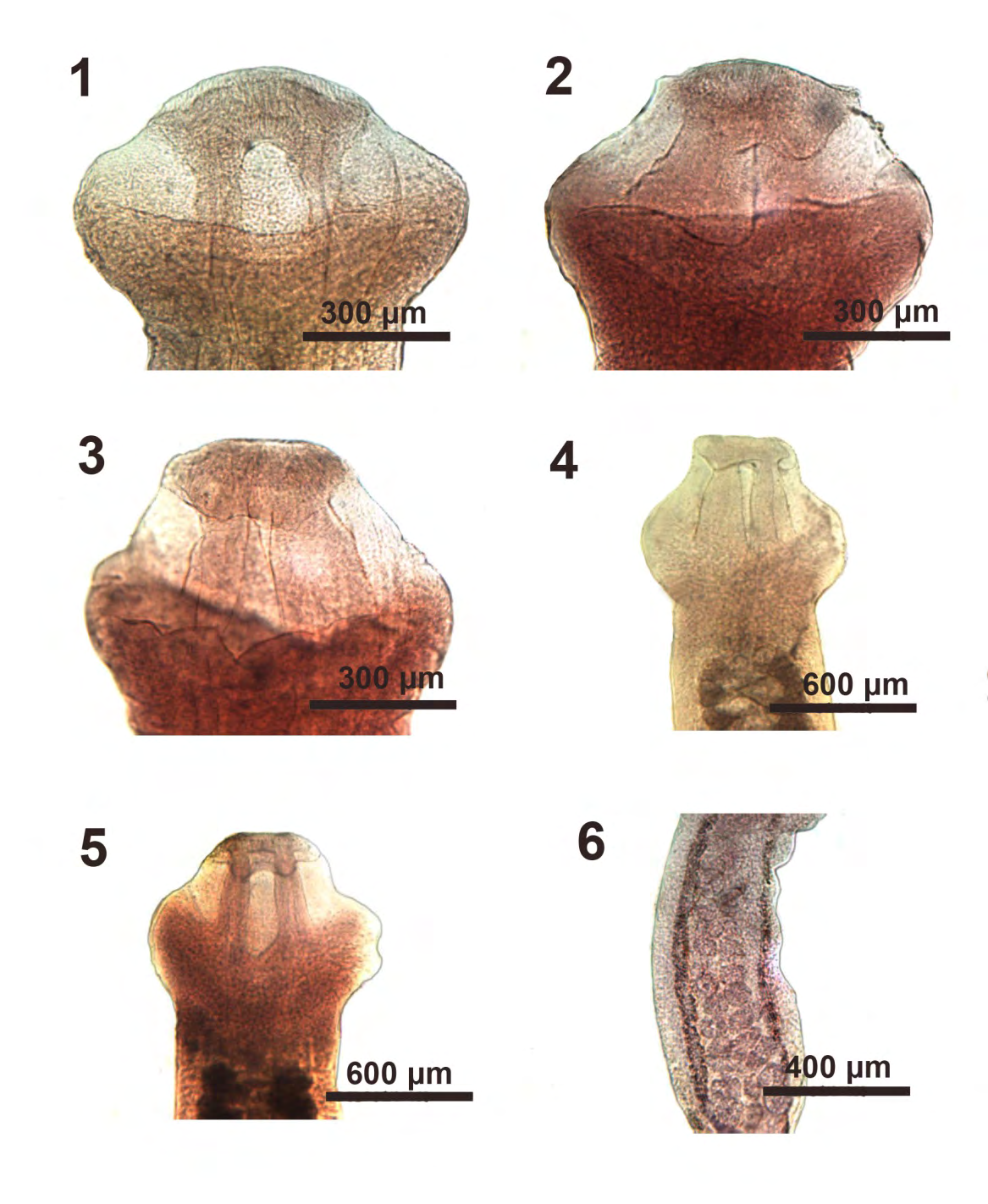
Figures 1-6: Microscope images of adult Pseudoglaridacris confusus from 3 species of buffalo fish in Apache and Roosevelt lakes, Arizona. 1-5. Variations in shape of scolex. Note the dome-shaped apical end, the wide middle and the well ribbed loculi. 6. Part of a young specimen showing the medullary testicular field and the vitelline bands confined to two lateral fields.
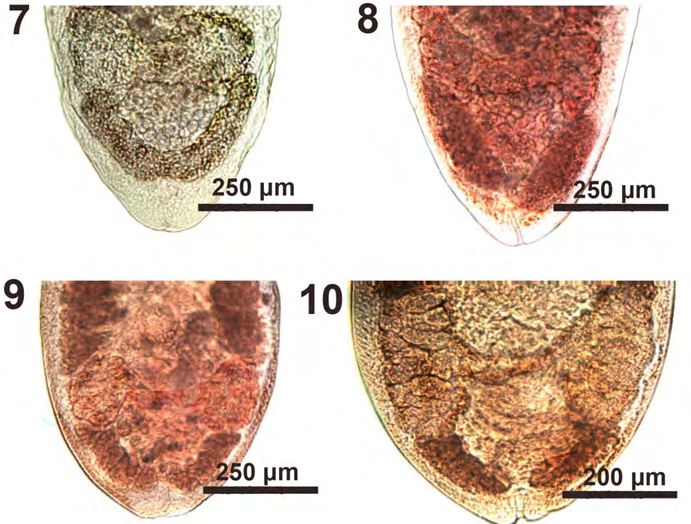
Figures 7-10: Microscope images of adult Pseudoglaridacris confusus from 3 species of buffalo fish in Apache and Roosevelt lakes, Arizona. The posterior portion of 4 specimens showing the thick and short ovarian arms and the open U-shaped post- ovarian vitelline characteristic of the Arizona population. Also note the unusual arrangement of the asymmetrical and unequal sides of the post-ovarian vitelline bands (Figure 8) and the cirrus sac (Figure 9).
Acknowledgments: This project was supported by an Institutional Grant from the Parasitology Center, Inc. (PCI), Scottsdale, Arizona.
Declarations
- Compliance with Ethical Standards
- Conflict of Interest: The authors declare no conflicts of interest or competing interests.
- Ethical Approval: The authors declare that they have observed all applicable ethical standards.
- Availability of Data: All presented and related data are available by contacting the senior author.
References
-
Mackiewicz JS (1972) Caryophyllidea (Cestoidea): a review. Exper Parasitol 31(3): 417-512.
-
Mackiewicz JS (1982) Caryophyllidea (Cestoidea): Perspect Parasitol 84: 397-417.
-
Mackiewicz JS (1994) Order Caryophyllidea van Beneden in Carus, 1863. In: Khalil LF, Jones A, t al. (Eds.), Keys to the cestode parasites of vertebrates. CAB Intern Wallingford UK, pp: 21-43.
-
Ash A, Scholz T, Oros M, Kar PK (2011a) Tapeworms (Cestoda: Caryophyllidea), parasites of _Clarias batrachus_ (Pisces: Siluriformes) in the Indomalayan region. J Parasitol 97: 435-459.
-
Ash A, Scholz T, Oros M, Levron C, Kar PK (2011b) Cestodes (Caryophyllidea) of the stinging catfish _Heteropneustes fossilis_ (Siluriformes: Heteropneustidae) from Asia. J Parasitol 97:899-907.
-
Scholz T, Kuchta R, Oros M (2021) Tapeworms as pathogens of fish: A review. J Fish Dis 44(12): 1-18.
-
Scholz T, Kuchta R (2017) A digest of fish tapeworms. Vie et milieu-Life and environment 67(2): 43-58.
-
Chubb JC (1982) Seasonal occurrence of helminths in freshwater fishes Part IV. Adult Cestoda, Nematoda and Acanthocephala. Adv parasitol 20: 1-292.
-
Amin OM (1968) Helminth fauna of Suckers (Catostomidae) of the Gila River System, Arizona. PhD Thes Ariz St Univ 202 Univ Microfilms. Ann Arbor, Michigan; Dissert Abstr 28: 3521.
-
Amin OM (1969) Helminth fauna of suckers (Catostomidae) of the Gila River System, Arizona. II. Five parasites from _Catostomus_ spp. Am Midland Nat 82: 429- 443.
-
Amin OM (1974) Intestinal helminthes of the white sucker, _Catostomus commersoni_ (Lacépède), in SE Wisconsin. Proc Helminthol Soc Wash 41: 81-88.
-
Amin OM (1986) Caryophyllaiedae (Cestoda) from lake fishes in Wisconsin with a description of _Isoglaridacris multivitellaria_ sp. n. from _Erimyzon sucetta_ (Catostomidae) Proc Helminthol Soc Wash 53: 48-58.
-
Mackiewicz JS (1961) A brief summary of the North American Caryophyllaeidae (Cestoidea) and their vertebrate hosts. Wiadomoici Parazytologiczne 7: 839- 842.
-
Hoffman GL (1999) Parasite of North American freshwater fishes. Comstock Publishing Assoc, Cornell Univ Press, Ithaca, New York, USA, pp: 539.
-
Scholz T, Pérez-Ponce de León G (2021) Caryophyllidean tapeworms (Cestoda), Nearctic parasites of fish in Mexico, including description of a new species of _Isoglaridacris_ and the first report of _Khawia japonensis_, an invasive parasite of common carp. Intern J Parasitol: Parasites Wildlife 15: 70-78.
-
Mackiewicz JS (1960) Studies on the Caryophyllaeidae (Cestoidea) of Catostomus commersoni (Lacépède), with emphasis on those fish near Ithaca, New York (Tompkins County), USA PhD thesis, Cornell Univ, Ithaca, New York, USA, pp: 391.
-
Mackiewicz JS (1964) Variations and host-parasite relationships of Caryophyllaeids (Cestoidea) from fish of Lake Texoma, Marshall County, Oklahoma J Parasitol 50: 31.
-
McAllister CT, Choudhury A, Cloutman DG, Trauth SE, Robison HW (2018) Parasites (Cnidaria, Trematoda, Cestoda, Nematoda, Crustacea) of select fishes (Lepisosteidae, Catostomidae, Hiodontidae, Cyprinidae, Ictaluridae) of Lake Texoma, Oklahoma Proc Okla Acad Sci 98: 90-100.
-
Lowe CH (1964) The vertebrates of Arizona Univ pf Arizona Press Tucson pp: 259.
-
Hunter IIIGW (1930) Studies on the Caryophyllaeidae of North America Illinois Biological Monographs 11: 186.
-
Oros M, Uhrovič D, Scholz T (2018) A new classification of _Glaridacris_ Cooper, 1920 (Cestoda: Caryophyllidea), parasites of suckers (Catostomidae) in North America, including erection of Pseudoglaridacris n gen J Parasitol 104(1): 60-69.
-
Fischthal JH, Carson DO, Vaught RS (1982) Size allometry of the caryophyllidean cestode _Glaridacris laruei_ from the white sucker. J Parasitol 68: 1175-1177.
- California Red-Legged Frog and Non-Listed Amphibians Response to Non-Native Fish Removal
- Industrial Standardization of the Bio-OS: Algorithmic Codification of Resilience Engineering Guidelines and Version V8 Architecture
- Climate Variability and the Sustainability of Snail Farming in Nigeria: Past Trends, Present Challenges and Potential Outlook
- The Evaluation of the Surveillance System of Anthrax in Gilgit-Baltistan, Pakistan, 2018
- Natural Decline to Extinction of A New Zealand Rabbit Population
- Mitochondrial Bio-Logistics: Steering Co-Enzyme Q10 and Lycopene Synergies within the Science 4.0 Bio-OS Framework