
Practical Considerations in the Design of Antivirals
There is evidence that viruses have been around for many years. Much is even known about their biology, their structural and physicochemical characteristics, but how to combat them through an appropriate design of antivirals is a pending challenge. Although the comparison with antimicrobials is tedious, it should be mentioned that an antimicrobial is designed or has as its target mechanism of action some bacterial structure that does not exist in viruses. Therefore, the design of an antiviral involves knowing the structure and the viral cycle of a particular virus. Today, this issue takes on an important role that has been relegated to a rearguard position due to the existence of vaccines against SARS-CoV-2 viruses and in the case of monkeypox, it should become important even though human smallpox has been eradicated of the planet, according to the WHO, at the beginning of 1980.
Introduction
In medicine today there is a particular paradox: the simplest of organisms is the most difficult to control. The foregoing is understood knowing that thanks to the discovery of antibiotics, great advances have been made in the control of complex organisms such as bacteria and associated infectious diseases. One of the main barriers to overcome in the design of an antiviral is the different chemical structure present in the latter. There are currently only a few proven antiviral drugs. Another existing barrier is the distinction between viral replicative mechanisms and host replicative processes. However, in the last two decades progress has been made in the discovery of the molecules necessary for viral replication, including the characterization of the mechanisms involved and the development of antiviral agents that inhibit them. On the other hand, on more than one occasion -and on the occasion of a vaccination campaign- we have heard the phrase: «...remember, it is a viral condition, do not fight it with antibiotics...» or perhaps simply «it is viral
- «. This reiterative phrase applies even in cases where the etiology of a disease is not completely known.
- Characteristic
- Bacteria
- Viruses
- Structural unity cell virion
- Nucleic acid
- DNA and RNA
- DNA or RNA
- Proteins
- Abundant
- Scarce
- Lipids and carbohydrates
- Abundant
- Scarce
- Enzymes
- Abundant
- Scarce
- ATP genera ting capacity
- Yes
- No
- Ribosomes
- Present
- Absent
- Binary fission
- Yes
- No
Table 1: Main differences between bacteria and viruses.
That phrase constitutes a broad umbrella, a comfortable bodyguard. These phrases are spontaneously related to the inability of antimicrobials to deal with something against which they were not designed, since in general, for their design, the structural unit of bacteria is used as the basis: the cell, which is far from be the structural unit of viruses: the virion (Table 1).
Material and Methods
From the outside of the viral structure, there is -in the case of enveloped viruses- an external envelope composed mainly of glycoproteins and lipids, then -and always-there is a protein structure -the capsid- that protects the viral genome, which is found inside, which consists of a single type of nucleic acid, that is, only RNA or only DNA (never both), which can be associated with proteins (constituting the nucleocapsid), so the design of antiviral agents You should make use of this feature as a starting point, since dealing with an RNA virus (Ribovirus; HIV and SARS-CoV-2 virus) is not the same as dealing with a DNA virus (Deoxyribovirus; Herpes and Poxvirus) [1, 2]. Knowing this characteristic necessarily leads to knowing the infective cycle of the virus and therefore the vulnerable sites, possible targets of action in the design of antivirals. In general, it is possible to visualize at least 6 stages in the infective cycle of viruses: Adsorption of the virus to the host cell, penetration of the virus into the cell. Stripping or exposure of the viral genome. Viral replication or synthesis of new copies of the viral genome. Viral Progeny Formation: which involves assembly. Virion output: for example, by cell lysis [3]. These are the key points in the development of therapies that include the use of antivirals and the proposed agents have been proposed for their ability to interfere in some of the stages of viral replication in cell cultures. These tests should include cell toxicity controls, to choose an antiviral that inhibits viral replication directly and not only for its toxic effects on host cells. The best targets for antiviral inhibition are those molecules with a function unique to the virus, without a counterpart in the host cell.
Results and Discussion
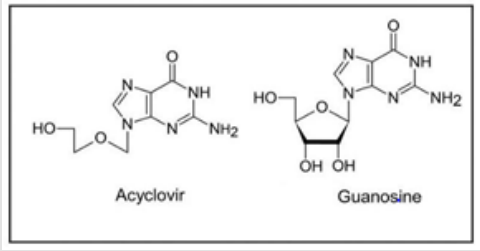
Thus, in the case of herpes simplex virus, the antiviral acyclovir has been used, which is an analog of guanosine (one of the nucleosides used in DNA synthesis by the enzyme DNA polymerase), where this analog is incorporated efficiently into viral DNA only in infected cells The incorporated base that lacks ribose (unlike its normal counterpart) thus prevents DNA chain elongation This action is at two levels: it prevents DNA elongation and also it is a better substrate for viral enzymes than for cellular one’s (Figure 1).
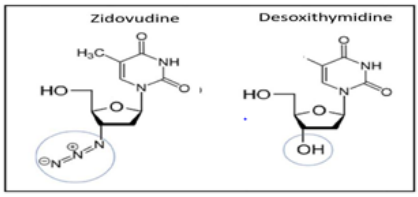
AZT is converted to triphosphate (TP) by cellular enzymes, and thus the AZT TP is incorporated into the new strand of DNA much more efficiently by viral reverse transcriptase than by cellular DNA polymerase. Thus, the elongation stage is inhibited, since the AZT TP does not contain the -OH group in position 3 necessary to continue adding nucleosides. An honorable mention goes to the strategy called antisense therapy, which is related to the use of DNA sequences, which will give rise to an RNA complementary to the messenger RNA, thus preventing the next phase: the synthesis of viral proteins. Let us remember that for a protein to be synthesized, the DNA sequence (deoxyribonucleic acid) that specifies its composition must be transcribed - that is, copied - that is, the corresponding gene – into an RNA molecule called messenger. This messenger RNA must then be read by the ribosomes - a process called translation – to give rise to the sequence of amino acids that will form said protein. Since the nucleotide sequence of messenger RNA determines the amino acid ordering of the protein, that RNA sequence is said to make sense.
Another case that deserves mention in humans is the infection by the human immunodeficiency virus: HIV, where AZT (zidovudine) has been used, which is a synthetic analog of deoxythymidine, another nucleoside used in DNA synthesis (Figure 2) and inhibits the replication of retroviruses.
By contrast, an RNA sequence that is the mirror image of messenger RNA— that is, a complementary chain will be a nonsense molecule or, perhaps more appropriately, antisense since it does not carry the correct information for the synthesis of the protein. To design these antisense molecules, the ability of the bases to pair specifically: an A joins a U and a G joins C. Thus, if the `sense’ sequence is, for example, AACGGUCU, the antisense sequence will be UUGCCAGA. messenger, forms a duplex and prevents its reading by the ribosomes and, therefore, the synthesis of the protein, since the RNA must be single-stranded or single- stranded to be ‘translated’.
An antiviral strategy not yet addressed in antiviral therapy and that also targets the viral replication stage, but not the elongation phase -like all those mentioned- but rather to achieve the inhibition of the initiation phase of the synthesis of the viral DNA. I am referring to the use of oligonucleotides with a sequence analogous to the viral origin of replication (ORI). In theory, there would be a competition kinetics between the authentic on site and the added synthetic on, by the protein (UL9 or similar) that binds early to the DNA to initiate the duplication of the genomic material of the virus.
Conclusion
Perhaps there are other strategies based on the stages of the infection cycle that have also been explored, until now viruses have successfully faced all attempts made by man - except for the smallpox virus- to achieve their eradication from the planet, which It will undoubtedly lead researchers to develop new strategies to deal with this remarkable adversary.
Acknowledgment
We thank the Dr. Aron Mosnaim, from Wolf Foundation, Illinois, USA (since 2020).
References
-
Murphy FA, Fauquet CM, Bishop DH, Ghabrial SA, Jarvis AW, et al. (1995) Virus taxonomy: classification and nomenclature of viruses. Sixth Report of the International Committee on Taxonomy of Viruses, Virology Division, International Union of Microbiological Societies 10: 586.
-
ICTV (2022) International Committee of Taxonomy on Viruses.
-
(2016) Fenner’s Veterinary Virology. In: 5th (Edn.).
- California Red-Legged Frog and Non-Listed Amphibians Response to Non-Native Fish Removal
- Industrial Standardization of the Bio-OS: Algorithmic Codification of Resilience Engineering Guidelines and Version V8 Architecture
- Climate Variability and the Sustainability of Snail Farming in Nigeria: Past Trends, Present Challenges and Potential Outlook
- The Evaluation of the Surveillance System of Anthrax in Gilgit-Baltistan, Pakistan, 2018
- Natural Decline to Extinction of A New Zealand Rabbit Population
- Mitochondrial Bio-Logistics: Steering Co-Enzyme Q10 and Lycopene Synergies within the Science 4.0 Bio-OS Framework