
Modern Status of the Wild Reeindeer on the Northern Part Of Novaya Zemlya Archipelago
The Novaya Zemlya Wild Reindeer is an isolated insular group that has the status of subspecies Rangifer tarandus pearsoni Lydekker, 1903
Editorial
The Novaya Zemlya Wild Reindeer is an isolated insular group that has the status of subspecies Rangifer tarandus pearsoni Lydekker, 1903.
The subspecies is currently listed in the Red Book of the Russian Federation (population of the Severny Island) and the Red Book of the Arkhangelsk Region. It inhabits both large islands - South and North up to Cape Zhelaniya, and most of the small islands of the archipelago [1, 2].
The total number is currently unknown. Archival data on the number of skins exported from the island make it possible to estimate the volume of fishing at no less than 3 thousand individuals in some years. As a result, in the early 1920s there was a sharp drop in numbers. Complete counts for both islands have never been carried out. The main livestock is kept on the South Island, but on the North Island traces of stay (horns, remains, droppings), as well as small groups of 2-10 animals can be found on the entire coast and adjacent small islands [3]. The issue of breeding of R.t. piarsoni on the northern edge of the range was unclear until recently, but in the summer of 2022, a herd consisting of females with three yearlings was found in Ivanov Bay. Thus, the information of the 1930s was confirmed that reindeer could breed right up to Cape Zhelaniya in the archipelago. Results of these observations change the previous status of wild reindeer as “migrated species” on Northern Island on the “breeding” one. To further clarify the ecology of the species, it is necessary to continue field studies during the birth of calves, namely in late May-early June, in order to map the places where this occurs [4, 5].
The number of reindeer on Novaya Zemlya is strongly affected by weather conditions - a sharp reduction in available food resources due to periodic spring sleet and snow compaction under the influence of strong winds. Reindeer have no natural enemies (wolf, wolverine) on the islands. Reports about preying of polar bear, as it knows on Svalbard, are not available now. Therefore, fluctuations in abundance, as well as the general condition of the subspecies, are primarily determined by abiotic factors.
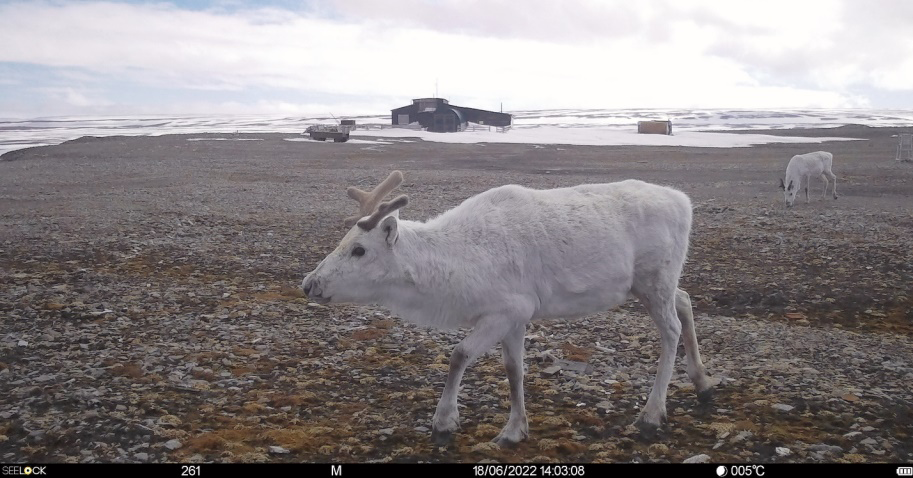
The question remains about the degree of influence of the domestic form of reindeer on R.t. pearsoni, and about the coexistence of the native and mixed genetic forms in the archipelago. In 1896, 18 domestic reindeer were brought to the South Island, and from 1928 to 1936, 604 domestic reindeer were brought here for breeding. Since 1937, for various reasons, domestic reindeer husbandry on the island ceased to exist. Most of the domestic reindeer scattered across Novaya Zemlya and mixed with wild ones or die. The issue of the presence on the archipelago of two groups of deer different in size and color, belonging respectively to hybrid and native animals, is actively discussed in the literature. However, reliable information does not exist, all animals noted in the north of the range have a “normal” tundra appearance, similar to the animals of Taimyr. In June 2021 and 2022, reindeer were photographed at Cape Zhelaniya with much lighter fur (Figure 1). Thus, the question of the morphology of the Novaya Zemlya reindeer remains not entirely clear.
References
-
Holand O, Mizin I, Weladji RB (2022) Reindeer Rangifer tarandus (Linnaeus, 1758). In: Hackländer K., Zachos FE (Eds.), Handbook of the Mammals of Europe. Handbook of the Mammals of Europe. Springer, Cham pp: 1-30.
-
Mizin IA, Sipko TP, Davydov AV, Gruzdev AR (2018) The Wild reindeer (Rangifer tarandus: Cervidae, Mammalia) on the Arctic islands of Russia: a review. Nature Conservation Research 3(3): 1-14.
-
Kvie KS, Heggenes J, Anderson DG, Kholodova MV, Sipko T, et al. (2016) Colonizing the High Arctic: Mitochondrial DNA Reveals Common Origin of Eurasian Archipelagic Reindeer (Rangifer tarandus). PLoS ONE 11(11): e0165237.
-
Kluge GA (1936) Biological work at the polar station of Cape Zhelaniya in 1934/35 // Bulletin of the Arctic Institute of the USSR. No. 4-L, pp: 170-172.
-
Zubkov AI (1935) Wild reindeer of the Novaya Zemlya. Proceedings of Arctic Institute 22: 55-61.
- California Red-Legged Frog and Non-Listed Amphibians Response to Non-Native Fish Removal
- Industrial Standardization of the Bio-OS: Algorithmic Codification of Resilience Engineering Guidelines and Version V8 Architecture
- Climate Variability and the Sustainability of Snail Farming in Nigeria: Past Trends, Present Challenges and Potential Outlook
- The Evaluation of the Surveillance System of Anthrax in Gilgit-Baltistan, Pakistan, 2018
- Natural Decline to Extinction of A New Zealand Rabbit Population
- Mitochondrial Bio-Logistics: Steering Co-Enzyme Q10 and Lycopene Synergies within the Science 4.0 Bio-OS Framework