
Stock Status of Green Tiger Prawn (Penaeus semisulcatus de haan, 1844) in Bombana and Adjacent Waters, Southeast Celebes, Indonesia
The high market demand for green tiger prawn (Peneus semisulcatus de Haan) has caused intensive fishing for this resources and tended to threaten their sustainability. Studies of stock status are the main foundations for formulating a management for sustainable utilization. The purpose of this study was to determine the stock status of green tiger prawn in the Bombana and adjacent waters, South-east Celebes. The study was conducted from April to November 2021 using a survey method. The study results revealed that the green tiger prawn growth pattern was negative allometric and that the ratio of males and females was imbalanced. Based on total length measurement, length at first capture (Lc) and length at first mature (Lm) were 37.42 cm and 38.72 mm respectively. While growth rate (K) and maximum total length (L∞) valued 1,7 per year and 58.9 mm respectively. The estimate total mortality rate (Z) was 2.57 per year, the fishing mortality rate (F) and natural mortality rate (M) were 1.12 per year and 1.45 per year, respectively. Recruitment pattern occured throughout the year with one peak in June. The exploitation rate (E) was 0.44 per year, therefore the stock status was categorized as fully exploited. In order to ensure the sustainability of the green tiger prawn, precautionary approach such as increasing fishing effort by 10 % of the current situation is strongly needed to be applied.
Introduction
Tiger prawn (Penaeus semisulcatus) is one of important fisheries products having high economic value in Bombana waters [1]. The tiger prawn is a member of the family Penaeidae and ordo of Decapoda [2]. Typical of this tiger shrimp has an adrostral crest extending behind last postrostral tooth, postrostral crest distinctly grooved and hepatic crest extending well behind antennal crest. Distribution of tiger prawn in the world is quite wide, covering Indo-West Pacific from eastern Africa and the Red Sea east to Indonesia and northern Australia [2]. While in Indonesian waters, the tiger prawn can be found in Sundanese Exposure and Sahul Exposure waters.
The utilization of tiger prawn in Bombana waters has been quite intensive due to high market demand of the resource from year to year. Very high level of the rate of exploitation would threat to the stock sustainability. Therefore comprehensive research is needed to reach rational utilization in order to maintain sustainability of the stock for prosperity purpose in the future [3].
There was no enough data about stock status of tiger prawn in Bombana waters. Therefore this research hopefully can be used as important information in order to manage the sustainability of tiger prawn in Bombana waters.
Materials and Methods
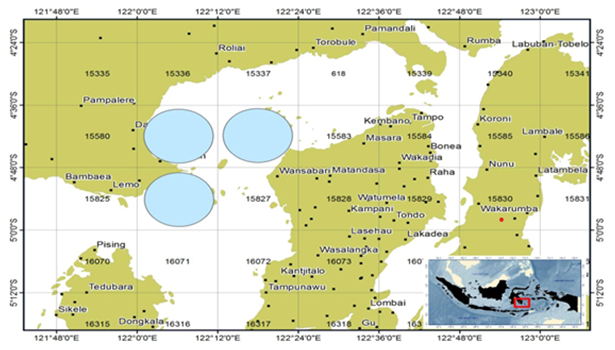
This research was carried on in Bombana waters from April 2021 until November 2021 using several survey methods. Monthly data collection was done by placing several enumerators in research areas (Figure 1).
The biological aspects observed were carapace length, weight, sex, and gonad maturity. Relation of total length and weights bodies follow to the equation of W = a Lb [4], where W is the fish body weight (gram), L is a total length of fish (cm), a is a constant value and b is the exponential value. The average length of length at first capture (Lc) is obtained by logistical function’s approach with the equation of Sparre, et al. [5].
1 1 * exp CL S a b CL = + −
( ) In which: is selectivity fishing gear, a and b are in constant , CL is carapce length and value of Lc obtained from a / b.
While the length at first maturity (Lm) would be counted based on calculation method introduced by Udupa [6].
{ } 2 k i X m X X p = + − ∑
± − ∑
p xq anti m X n
2 log 1,96 1 i i
i Where: m is the Lm logarithm value with Xk is logarithm of mean value when 100% mature, X is the logarithm of mean value, pi is the proportion of mature fish in class i where pi =ri/ni; ri is the amount of mature prawn in class i, and ni is the amount of sample in class i, qi = 1-pi.
Growth parameter was predicted using von Bertalanffy growth model Sparre, et al. [5].
( ) 0 1 k t t tL L e − − ∞ = −
Where: Lt is total length of prawn at age t year, L∞ is a theoretical of maximum length, k is the growth rate, and t0 is a theoretical age when zero length of prawn.
The theoretical of maximum length (L∞) and growth rate (k) were analyzed by using ELEFAN I and FISAT II methods [7]. While the value of t0 was predicted based on eqution introduced by Pauly [8].
Log (-t0) = (-0.3922) – 0.2752 log CL∞ - 1.038 log K
Value of natural mortality (M) was calculated using Pauly equation based on average sea water temperature [8].
Log M = (-0.0066) - 0.279 log CL∞ + 0.6543 log K + 0.4634 log While value of total mortality (Z) was counted based on length converted catch curve assessment on FISAT II program. In addition, fishing Mortality (F) and exploitation rate (E) was assessed an equation introduced by Sparre, et al. [5].
F = Z-M; and E = F/Z
Results
Population Dynamics
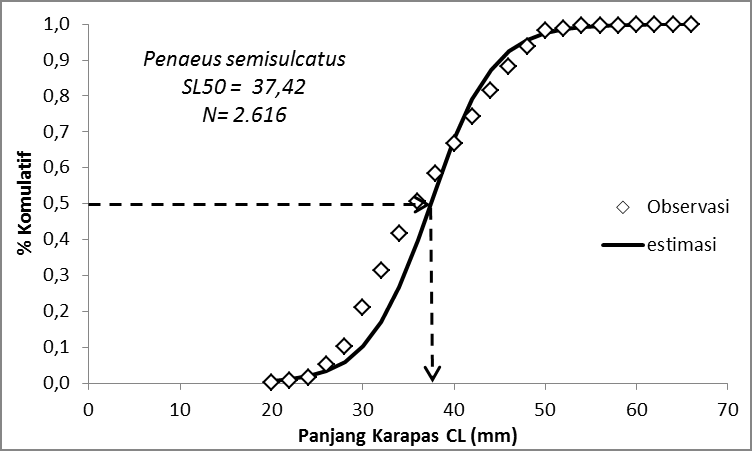
Length Weight Relationship and Sex Ratio: Green tiger prawn found during the survey had carapace length ranging from 20 mm to 66 mm with dominant number in carapace length 31mm. Length weight relationship analysis illustrated that the tiger prawn had allometric negative with b = 2.5046. It meant that the increase of shrimp carapace length was faster than that of shrimp weight. Another analysis about sex ratio indicated that comparison between male and female was 1.0 : 0.8. Based on chi-square analysis, it was discovered that the sex ratio was unbalance. Length at first capture (Lc) and Length at first mature (Lm): Based on the result, it was obtained that length at first capture (Lc) of green tiger prawn in Bombana waters was about 37.42 mm in carapace length (Figure 1).
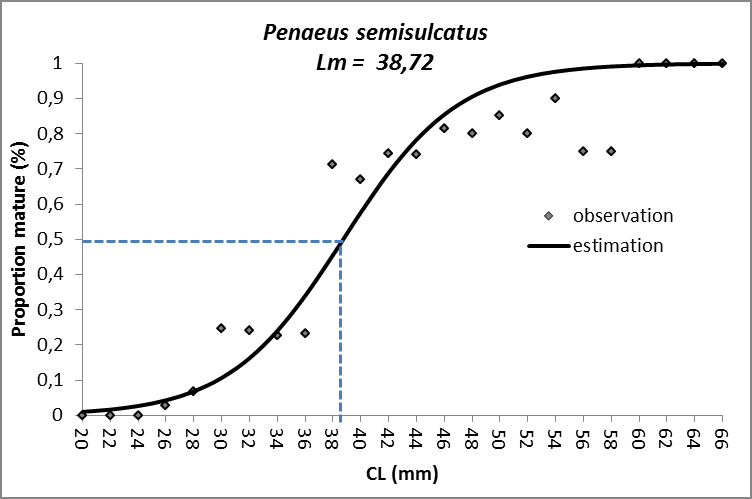
The continue analysis found that length at first maturity (Lm) of tiger prawn in Bombana waters was 38.72 mm in carapace length (Figure 2). It meant that value of Lc was smaller than that of Lm. This condition indicated that most of the tiger prawn have been caught not in their best time to spawn.
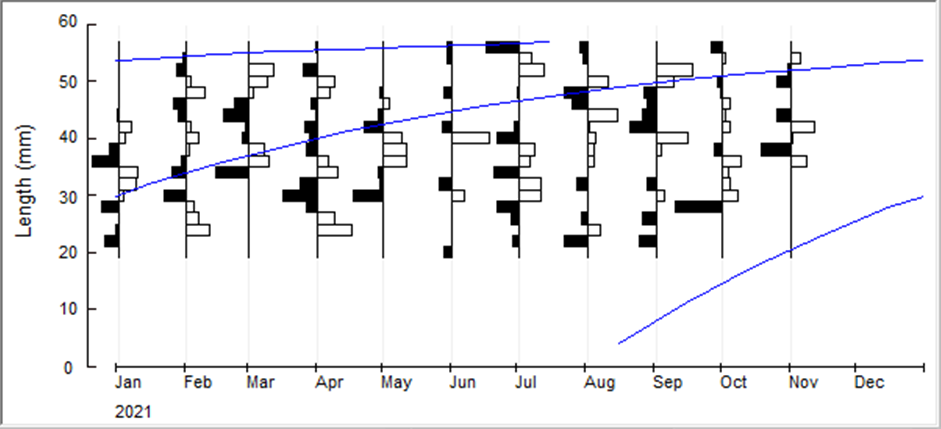
Based on length frequency data, it was obtained that the growth rate (K) the tiger prawn was 1,7 per year and length infinity (L∞) reached about 58.9 mm in carapace legth (Figure
3). Therefore equation of von Bertalanffy growth curve was: Lt=58.9 [1-e -1,7(t + 0.127)].
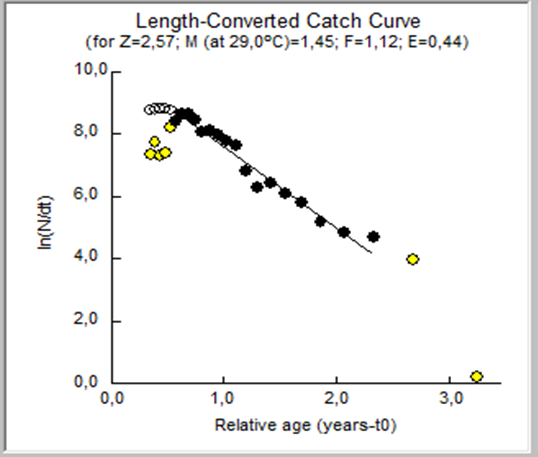
By using the tiger prawn growth parameters calculation (K = 1.7 per year, L∞ = 58.9 mm), catch curve can be performed. It was obtained that estimated values of Z, M, and F were 2.57, 1.45, and 1.12 per year respectively (Figure 4). Another estimation can be illustrated based on value of fishing mortality (F) and total mortality (Z). Value of exploitation rate (E) was estimated to be about 0.44 per year. This condition showed that exploitation of the tiger prawn reached fully-exploited.
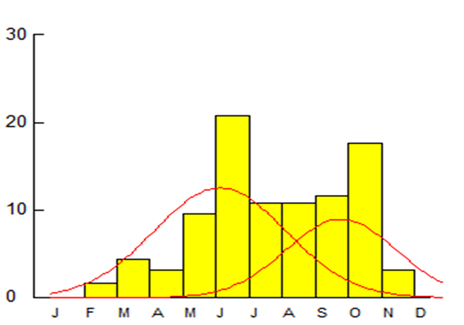
While recruitment pattern indicated that spawning activity of tiger prawn was taken place throughout the year with two peaks occurred in June and October (Figure 5).
Discussion
Length weight relationship analysis is used to determine the growth pattern of green tiger prawn in Bombana waters. The results of the t test has been found that the characteristic of green tiger prawn’s growth is a negative allometric. The pattern of green tiger prawn’s growth shows that the growth of body length is faster than the growth of weight. This result is the same as that obtained in the waters of Kuwait especially in the Gulf War [9], but different with data obtained in the Mandapam Camp, India [10]. The isometric growth pattern shows that the speed of weight and total length gains in a balanced state. The existence of these differences is because individual growth models depend on food availability and water temperature [11]. Differences in long growth can also occur due to differences in external factors and internal factors. According to Effendie [12], internal factors are factors that are generally difficult to control such as heredity, gender, age, and disease. Meanwhile, the main external factors affecting fish growth are temperature and food.
The sex ratio of green tiger prawn in Bombana water showed unbalanced condition, where female of green tiger prawn is more dominant. The same phenomenon was also found in the Gulf of War, Kuwait [9]. Meanwhile, different things are found in the Mandapam Camp, India, where the sex ratio between males and females is in a balanced state [10]. According to Ball, et al. [4] in normal waters the sex ratio is 1.0: 1.0 and differences occur because behavior is clustered between males and females. The causes of differences in sex ratios can also occur due to influenced by arrest pressure and migration factors [13].
The size of green tiger prawn at maturity is important in fisheries management. It meant that exploitation must allow a certain number of adult of green tiger prawn, which have the same size or more than the size when reaching maturity to be escaped [14]. The length at first maturity(Lm) matured for at Bombana waters is 38,72 mm and looks larger when compared to the length at first capture (Lc) which is 37.42 mm. The length at first maturity (Lm) in various waters is influenced by food availability and other environmental conditions, such as temperature and salinity. According to Udupa [6], the size at the time of maturity varies between species and within the same species. Meanwhile the Lc difference shows that there are differences in the depth of the waters and habitat. The phenomenon of the value of Lc which is smaller than the value of Lm will disrupt the sustainability of green tiger prawn in the long term, because it does not give the parent of green tiger prawn the opportunity to spawn for the guarantee of new additions.
According to Sparre, et al. [5] the lower the growth coefficient (K), the longer the species takes to approach the asymptotic length. Conversely, the higher the growth coefficient, the faster the time needed for the species to approach the asymptotic length. The value of growth rate (K) of green tiger prawn in Bombana waters is 1,7 per year and L∞ is 58,.9 mm and this indicates that the growth rate is relatively fast. This phenomenon is different when compared to the results of research in the Gulf War, uwait which gets K values as 1.6 per year and L∞ as 36,6 mm. In the Arabian Gulf finds a K value of 1.77 per year and the L∞ value as 51.5 mm for male and for female finds a K value of 1,16 per year and the Loo value as 62,9 [15], as well as in Bushehr coastal water, Persia Gulf with K values as 1.6 per year and Loo values as 38 mm for male and for female K values as 2.2 per year and Loo as 50.4 mm [16]. Differences in growth parameters can be caused by differences in the maximum length of samples taken and differences in location of waters. Knaepkens, et al.
[17] and Effendie [12] state that differences in the values of K and Loo are caused by internal/intrinsic factors and external factors. These influential internal factors include offspring, parasites and diseases, while external factors include food temperature and availability.
The total mortality rate (Z) is a combination of the natural mortality rate (M) and the rate of death due to arrest (F). The M value of green tiger prawn in Bombana waters looks smaller than the F value, and this shows that most of the green tiger prawn in Bombana waters died due to capture. Furthermore, by using the F value which is an illustration of capture pressure and Z value which is a picture of total mortality, the green tiger prawn utilization rate (E) is 0.44 per year. When compared with the criteria from Pauly, et al. [18] which states that the optimal rate of exploitation is 0.44, then the level of utilization ofgreen tiger pran in Bombana waters has exceeded the fully rate. This shows that the utilization rate of green tiger pawn has reached 88 %, which means that it is already fully exploited. In order to maintain the source of green tiger prawn in Bombana waters, the increase of fishing efforts must be carried out by around 10% of the current efforts. In general, green tiger prawn make new additions throughout the year with two peaks peak in June and October. This shows that in that period there was a significant increase in the population of baung compared to the previous population [1]. By looking at the peak period of the new addition, it appears that green tiger orawn make new additions the highest in the transition season from the rainy season to the dry season. During this period the conditions of the aquatic environment were clear and the temperature was relatively cold, which spurred the green tiger prawn to reproduce optimally.
Recommendation
To ensure the sustainability of green tiger prwn resources in the waters of Bomabana and adjacent water, South-East Celebes, the catch must be increased by around 10% of the current catch. In addition, the size of the net must be increased in the cultivation of green tiger prawn, so that the green tiger prawn caught later will have spawned. The closing area of shrimping ground must be done in June and October when the peak of recruitmen of greentiger prawn in this waters.
Acknowledgement
This paper is a contribution from the research activities of the Research Institute for Marine Fisheries (RIMF), Ministry of Marine and Fisheries Affairs Jakarta on the topic: Study of biology and characteristic of fish Resource and its characteristic Fisheries in Fisheries Management Area (FMA) 714 Year 2021.
References
-
Research Institute for Marine Fisheries (2021) Study of fishery biology characteristic, resource habitat and potential yield of fishery resources in Fisheries Management Area (FMA) 714, Research Institute for Marine Fisheries-Research and Development Center of Fisheries-Agency for Marine and Fisheries Research and Developpment, Ministry of Marine and Fisheries Affairs, Jakarta- Indonesia.
-
Dall W, Hill BJ, Rothlisberg PC, Staples DJ (1990) The biology of the Penaeidae. In: Balxter JHS (Eds), Marine Biology, Academic Press. London, UK, 27: 489.
-
Suman A, (2004) Management pattern of endeavour shrimp (_Metapenaeus ensis_ de Haan) in Cilacap and surrounding waters and its management alternative pattern, IPB, Bogor, Indonesia.
-
Ball DV, Rao KV (1990) Marine Fisheries. Tata Mc. Graw- Hill Publishing Company Limited, New Delhi, India pp: 5-24.
-
Sparre P, Venema SC (1992) Introduction to tropical fish stock assesment. Part I, Manual. FAO Fish Tech.
-
Udupa KS, (1986) Statistical method of estimating the size at first maturity of fishes. Fishbyte 4(2).
-
Gayanilo FC, Sparre P, Pauly D (2005) FAOICLARM Stock Assessment Tools II (FiSAT II). Revised version.User’s guide. FAO Computerized Information Series (Fisheries). Revised version. FAO Rome, Italy, pp: 168.
-
Pauly D (1983) Some Simple Methods for the Assessment of Tropical Fish Stocks. FAO Fisheries Technical Paper.
-
Mohammed HMA, Bishop JM, Xu X (1996) Population characters of green tiger prawn, _Penaeus semisulcatus_ in Kuwait waters especially in the Gulf War.
-
Thomas MM (1974) Reproduction, fecundity and sex ratio of green tiger prawn, _Penaeus semisulcatus_ de Haan. Indian Journal of Fisheries 21(1).
-
Fauzi M, Prasetyo AP, Hargiyatno TI, Satria F, Utama AA (2013) The relationship and condition factor of spiny lobster (_Panulirus penicillatus_) in waters of Gunung Kidul and Pacitan. Journal Bawal 5(2): 97-102.
-
Effendie MI (2002) Fishery Biology, Yayasan Pustaka Nusatama, Yogyakarta, Indonesia, pp: 136.
-
Suman A, Satria F, Nugraha B, Priatna A, Amri K (2018) Stock status of fish resources in Indonesian Fisheries Management Area (FMA-RI). Indonesian Fisheries Policy Journal (10)2.
-
Sudjastani T (1974) Population dynamic of mackerel fish in Java Sea. The Report of Marine Fisheries Research.
-
Alrashada YN, Tharwat A and Boqursain A (2019) Population dynamic of green tiger prawn, _Penaeus_ _semisulcatus_ de Haan in Sandiara Coast, Arabian Gulf. Indian J Anim Res.
-
Niammandi N, Arshad AB, Daud SK, Saed RC, Kiabi B (2019) Length weight relationship and condition factor of greeen tiger prawn, _Penaeus semisulcatus._ 86(2-3).
-
Knaepkens G, Knapen D, Bervoets L, Hanfling B, Verheyen E, et al. (2002) Genetic diversity and condition factor: a significant relationship in Flemish but not in German populations of the the European bullhead (_Cottus gobio_ L). Nature 89: 280-287.
-
Pauly D, Ingles J, Neal R (1984) Application to shrimp stocks of objective methods for the estimation of growth, mortality and recruitment related parameters from length frequency data (ELEFAN I and II). In: shrimp P (Ed.), Fishing News Book Limited. Farnham, Surrey, England, UK.
- California Red-Legged Frog and Non-Listed Amphibians Response to Non-Native Fish Removal
- Industrial Standardization of the Bio-OS: Algorithmic Codification of Resilience Engineering Guidelines and Version V8 Architecture
- Climate Variability and the Sustainability of Snail Farming in Nigeria: Past Trends, Present Challenges and Potential Outlook
- The Evaluation of the Surveillance System of Anthrax in Gilgit-Baltistan, Pakistan, 2018
- Natural Decline to Extinction of A New Zealand Rabbit Population
- Mitochondrial Bio-Logistics: Steering Co-Enzyme Q10 and Lycopene Synergies within the Science 4.0 Bio-OS Framework