
The Status of Snow Leopards (Panthera uncia) Conservation in Jigme Khesar Strict Nature Reserve at Haa, Bhutan
Study of Snow Leopard (Panthera uncia, Schreber, 1775) using infrared camera traps along actively used tracks, scent-sprayed rocks, scats and scrape sites was conducted in the mountains of Jigme Khesar Strict Nature Reserve, Haa, Bhutan between October and December 2015 and it is still being continued. A total of 17 grids, each measuring 16km2 were sampled covering a total area of 272 km2. Thirty-four camera traps were stationed in 17 grids and in a total of 60 trap nights, 215 images of Snow Leopard were captured out of which 163 images were considered for analysis. Using the pelage patterns on the body parts such as forelimbs, face, flanks and dorsum of the tail of the captured individuals, a total of ten different individuals were identified including the one that was recorded during the extended period trapping for a month. Capture history of camera trap station G9 (Kampula) indicated that it had the highest concentration of the species as individuals JKSNR 3, 4, 8 and 9 were all captured at the same station. The capture timing of the species confirms its crepuscular nature as most of them were recorded between dawn and the dusk. Our results suggest that the species can be well monitored and conserved using camera traps. The Reserve can focus on patrolling and monitoring of the species in the identified high-density areas for maintaining the moving population to perpetuity.
Introduction
Background and Research Aims
Jigme Khesar Strict Nature Reserve (JKSNR) is the only Strict Nature Reserve in Bhutan, the rest of the protected areas in the country being either a National Park or Wildlife
Sanctuary. It has a total area of 609.5 Km2 and is composed of many high-value medicinal, globally endangered, rare, and endemic species of plants and animals plus the spectacular sceneries, and unique culture [1]. The Reserve has the strongest representation of pristine temperate and alpine eco-systems in the country [1]. It is the only protected area in Bhutan that is part of the trans-boundary conservation landscape, under Kanchenjunga, which is also the part of Sacred Himalayan Landscape of Eastern Himalayas [2] popularly known as “Snow Leopard Landscape”, forming part of Himalaya Biodiversity hotspots [3]. Further, the Reserve also is an involuntary part of the two of the WWF Global 200 ecoregions [4]. As the area name suggest, the Reserve is home to a good number of important flora and fauna including the elusive Panthera uncia.
The Snow Leopard (Panthera uncia) is now considered a Vulnerable species but until September 14, 2017 was considered a globally endangered wild cat by International Union for Conservation of Nature (IUCN) and is still listed under Appendix I of the Convention on International Trade in Endangered Species of Wild Fauna and Flora (CITES). As such, trade and transport of any part of the body of the species is strictly forbidden [5]. In Bhutan it is listed in Schedule I of Forest and Nature Conservation Act of Bhutan 1995. Geographically, this magnificent cat is found in 12 Asian countries namely Afghanistan, Bhutan, China, India, Kazakhstan, Kyrgyzstan, Mongolia, Nepal, Pakistan, Russia, Turkmenistan and Uzbekistan [6]. In Bhutan it is found in Jigme Dorji National Park (JDNP), Jigme Khesar Strict Nature Reserve (JKSNR), Wangchuk Centennial National Park (WCNP) and Paro Territorial Forest Division. Quite recently newspaper sources [7] and personal communications confirmed its presence in Jigme Singye Wangchuk National Park and Bumdeling Wildlife Sanctuary (Tshering Dendup pers. com). However, other than the presence report, there are no reliable studies (abundance, population, etc.) conducted on the species throughout its range [8] and Bhutan is not an exception. As such, conservation of the species remained confined to the presence absence confirmation in its range thus far, compelling the conservationists in Bhutan to pursue further study of the species. The main problem faced managing the species is knowledge on abundance of the species in particular habitat or region. Bhutan does have information on the presence of the species but lack the exact points where they are located and on what they survive.
Therefore, the Reserve officially embarked on the Snow Leopard Survey along with the national level survey in the identified habitats to assess population and distribution of the species initially with the investigation of signs and evidences of prey species such as Blue Sheep (Pseudois nayaur), Himalayan Marmot (Marmota himalayana), pheasants and domestic preys including gathering of information from the residents of the Reserve (migratory cattle herders) with effect from December 2014. The actual camera trapping exercises began from October until December 2015 with camera installations, monitoring and retrieval exercises being carried out with the minimum of 60 trap nights within the given schedule in the study area. Today, the study is being continued to maintain the status quo along with an aim to further strengthen the conservation of the vulnerable species.
Thus, the main objective of this study is to confirm the number of species occurring in JKSNR using camera traps so that appropriate conservation management plan can be developed. This research is to also identify exact places where the snow leopard occurs and recommend appropriate management schemes.
Study Area
JKSNR covers two Districts Haa and Samtse and lies between 27034’ and 27011’ latitude and 88054’ and 89010’ longitude of which almost 98 percent of the area falls under Haa (Figure 1).
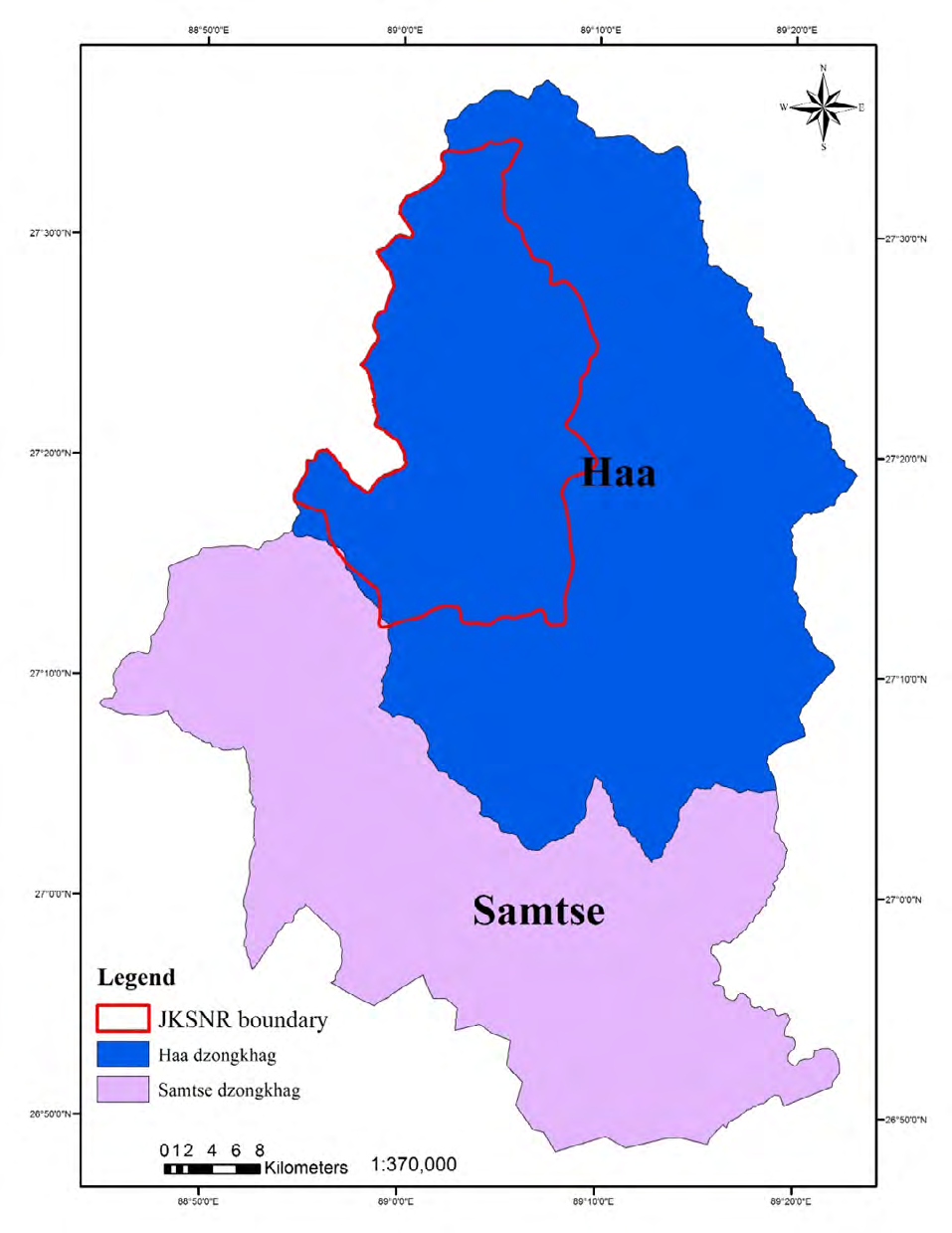
However, the study focused on the north and central part of the Reserve which has proven Snow Leopard presence. It
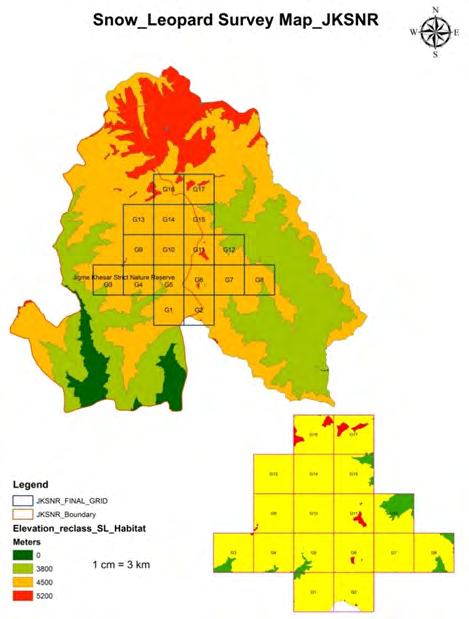
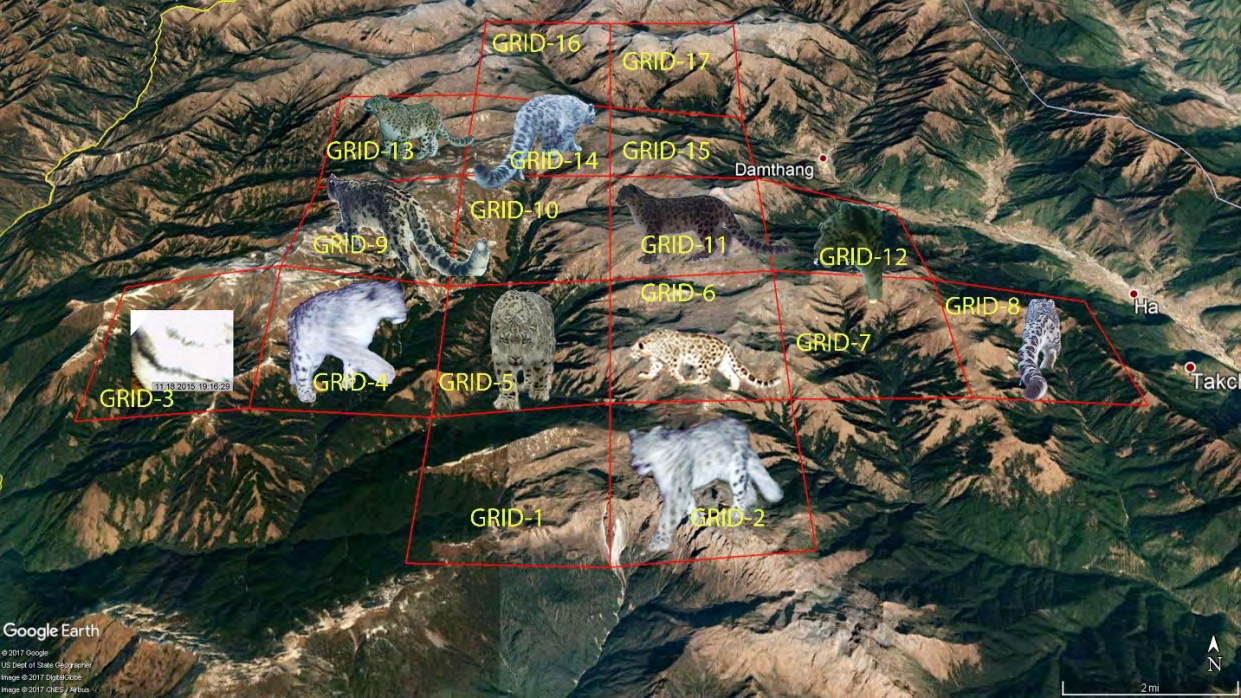
is the only protected area in the country which is virtually uninhabited and boasts of pristine temperate and alpine vegetation, home to several high-altitude wild animals besides Panthera uncia. The study was confined to areas which are mostly below 5200masl and above 3500masl. Most of the areas at 5200masl could not be covered because of topographic reasons and international border security issues. Therefore, most of the data obtained are from the grids laid over the map in Figure 2. While it is considered uninhabited permanently, the study includes the seasonal migratory yak herders from Haa valley who live in harmony with wildlife.
Materials and Methods
Sign and evidence survey of prey-base was conducted from November 2014 till February 2015 with at least two surveys carried out within the period. Availability of dung pellets of prey species, direct sightings and other indirect signs like hoof marks, wallowing areas and feeding area routes were thoroughly looked into and appropriate conclusions drawn accordingly. Data on availability of signs such as scats, scrapes, scratches of Snow Leopards in the field were collected by trained staffs of JKSNR. After the completion of sign and prey base surveys for both preys and the predator, camera traps were installed on promising sites where the species could be captured and explained in detail in the following sub-sections.
Camera Trap Installation Site Selection Process
Spatial Capture Recapture (SCR) method [9, 10] which is in vogue in recent times is expected to produce robust estimation of population and abundance [11] enabling conservationists to identify individual species of elusive large predators [12]. Based on the same principles postulated by experts above, potential ecological zone of the species was identified using the biological information of species (home range, prey base, breeding characters, etc.) in and around the Reserve. The results of signs and evidences surveys were used to identify the potential areas where the species could be found most probably. Having identified the habitats in the field, Google Earth Map was used to develop grids for installing camera traps. At least 17 square grids, each of size 4km by 4km covering 272 km2 area was laid on the identified habitat on Google map and subsequent field truthing (ridgeline crests and saddles, bases of rock cliffs, trails, and base of prominent isolated rock boulders) using GPS was done for the coordinates provided by Google by the surveyors. After locating the potential sites from here on referred as camera stations (Table 1), camera traps were installed physically keeping in mind the grids. Better alternative camera trap sites were chosen within the grid and cameras were set up ensuring that the distances between the cameras were not too close to each other. Specialized cameras, Scourt Guard (SG560C), Uway (VH2008) and RECONYX cameras fed with rechargeable batteries that can last more than three months with eight and four GB memory cards were used.
| Grid ID | Camera ID: R | Camera ID: L | Remarks | ||
|---|---|---|---|---|---|
| Latitude (N) | Longitude (E) | Latitude (N) | Longitude (E) | ||
| G1 | 27° 19’ 14.5” | 089° 08’ 22.6” | Near Tshona lake | ||
| G2 | 27° 19’ 53.9” | 089° 09’ 06.4” | 27° 19’ 56.7 “ | 089° 09’ 19.8” | Tshonatop |
| G3 | 27° 21’ 56.9” | 089° 03’ 25.3” | 27° 21’ 59.4” | 089° 03’ 13.7” | Tshabjola |
| G4 | 27° 22’ 02.6” | 089° 03’ 41.1” | 27° 22’ 00.7” | 089° 03’ 41.2” | Jichhila ridge |
| G5 | Not potential site (replaced new grid at Gebla after the first monitoring) | ||||
| G6 | 27° 21’ 32.3” | 089° 09’ 55.5” | 27° 20’ 56.2” | 089° 09’ 39.2” | Jo-shokupede |
| G7 | 27° 22’ 32.6” | 089° 11’ 03.0” | 27° 22’ 32.6” | 089° 11’ 03.0” | Tsang ridge |
| G8 | 27° 21’ 23.3” | 089° 13’ 30.4” | 27° 22’ 22.3” | 089° 13’ 05.3” | Pamling |
| G9 | 27° 24’ 02.2” | 089° 04’ 21.0” | 27° 23’ 44.9” | 089° 04’ 09.7” | Kampula |
| G10 | 27° 23’ 51.2” | 089° 07’ 59.7” | 27° 23’ 46.3” | 089° 08’ 04.7” | Jaadoten |
| G11 | 27° 23’ 45.9” | 089° 09’ 44.2” | 27° 24’ 09.1” | 089° 09’ 52.6” | Chhuzom-se top |
| G12 | 27° 22’ 51.0” | 089° 12’ 23.0” | 27° 22’ 49.6” | 089° 12’ 28.9” | Tshosheykha top |
| G13 | 27° 26’ 11.1” | 089° 05’ 23.8” | 27° 26’ 21.1” | 089° 05’ 19.2” | Jazagortab |
| G14 | 27° 25’ 08.5” | 089° 05’ 45.1” | 27° 25’ 15.5” | 089° 05’ 56.1” | Tshosheylaa |
| G15 | 27° 25’ 46.7” | 089° 08’ 37.7” | 27° 26’ 07.8” | 089° 08’ 15.0” | Haalaa |
| G16 | 27° 29’ 24.5” | 089° 05’ 56.9” | 27° 29’ 24.5” | 089° 05’ 56.9” | Nichulaa |
| G17 | 27° 28’ 09.6” | 089° 10’ 01.5” | 27° 28’ 09.6” | 089° 10’ 01.5” | Tshala army camp top |
| Gebla | 27° 28’ 14.1” | 089° 05’ 17.4” | 27° 28’ 16.6” | 089° 05’ 05.2” | Geblaa |
Table 1: Camera station information.
Stationing Camera Traps
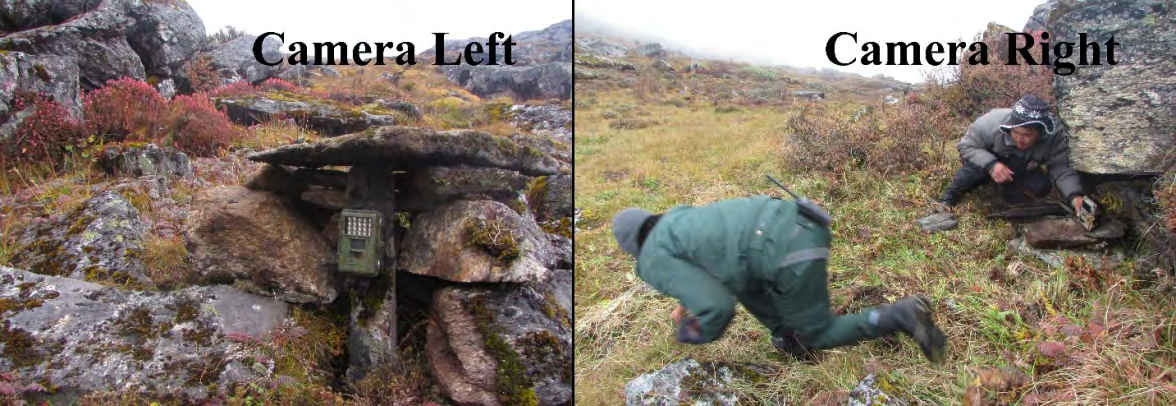
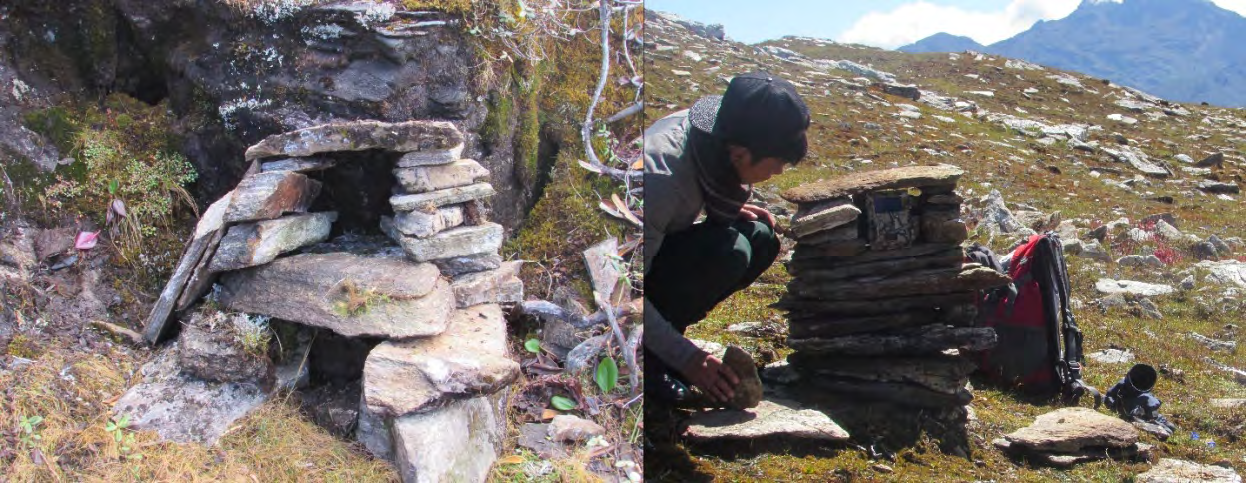
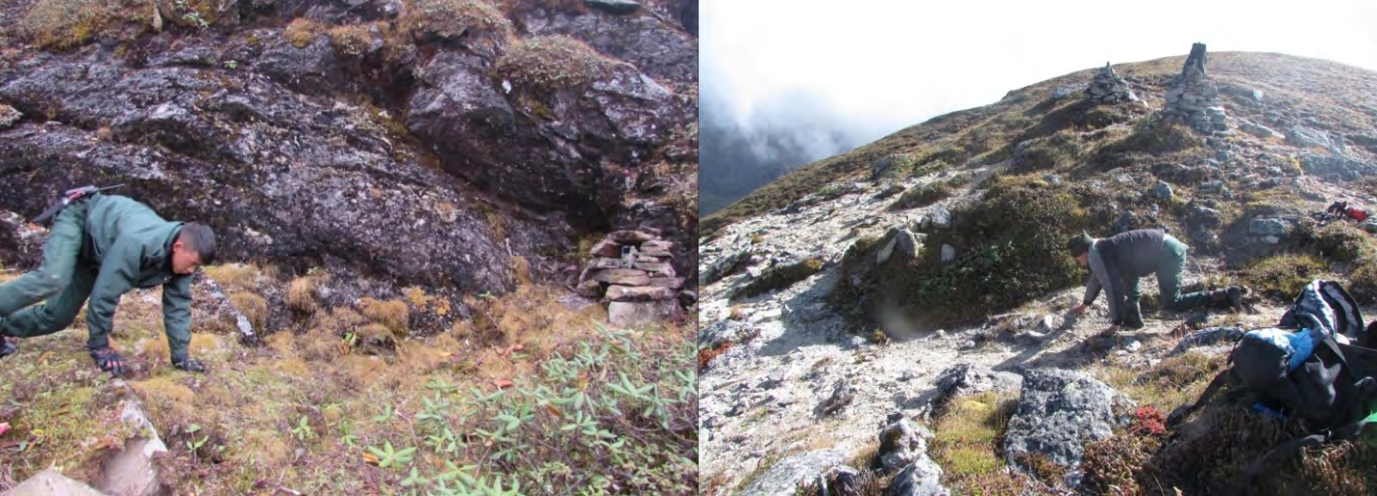
In each selected survey grid, two cameras were placed facing in opposite directions to capture the hind (tail) and front (face and forelimbs) portions of Snow Leopard assigning camera codes such as Grid 10 Right (G10 (R)) and Grid 10 Left (G10 (L)) for instance (Figure 3). Using the clue for camera trap setting from the guideline [13], topographical features of the landscape were used to station the cameras. A total of 34 cameras were stationed in 17 grids using locally available stone slabs to protect the cameras from rain and sun (Figure 4). To ensure that the cameras could capture best images, team members mimicked Snow Leopards in front of the cameras to check if the cameras were placed at optimal heights and distances on the Snow Leopard trails (Figure 5). No camera lens faced the sunlight directly. Post installation, data sheets (Appendix I and II) were used to record way points, coordinates and altitudes of the trap sites (Table 1). Scats were collected on the way to supplement and confirm the species presence, beside camera traps.
Monitoring of Camera Traps
Camera traps once laid in the field were monitored on monthly basis as per the fixed schedule (Table 2). Every time the monitoring teams were on the camera spots, the cameras were switched off to replace the memory cards so that the earlier card could be checked for images of the animals.
Memory cards of the different camera of different grids were properly labelled and taken back to office for analysis. The status of batteries of each camera were checked during every visit and those needing replacement replaced. Cameras that did not record any animals were relocated to a new position within the grid and coordinates were recorded.
| Sign and Evidence Survey | Camera Installation | Camera Monitoring | Camera Retrieval | Scat and DNA Analysis | |
|---|---|---|---|---|---|
| 1 | Nov-Dec, 2014 | Sep-Oct 2015 | Oct-Nov 2015 | Dec 2015-Jan 2016 | May-16 |
| 2 | February,2015 | Dec 2015 to Jan 2016 | Feb – March 2016 | Jun-16 |
Table 2: Monitoring Schedule.
Installation of camera traps into 17 sampling grids were carried out in September-October 2015 and subsequent Phase I monitoring of camera traps undertaken from October- November 2015. The Phase II monitoring was carried out in between December and January 2016 considering a total of 60 traps nights of monitoring period. The standard 60 trap nights were adopted as suggested Jackson RM [14] who carried out camera trapping of Snow Leopards in Hemis National Park, Ladakh, India.
Encouraged by the images captured, the camera trap exercise was extended a month for another 30 trap nights which calculated to 90 trap nights. The extended trap nights produced an interesting result when a new member showed up in Grid 10.
The monitoring of camera traps, retrieval and adding of cameras along the identified trap sites continues and the Reserve expects better results.
Data Analysis-Identifying Individual Snow Leopards
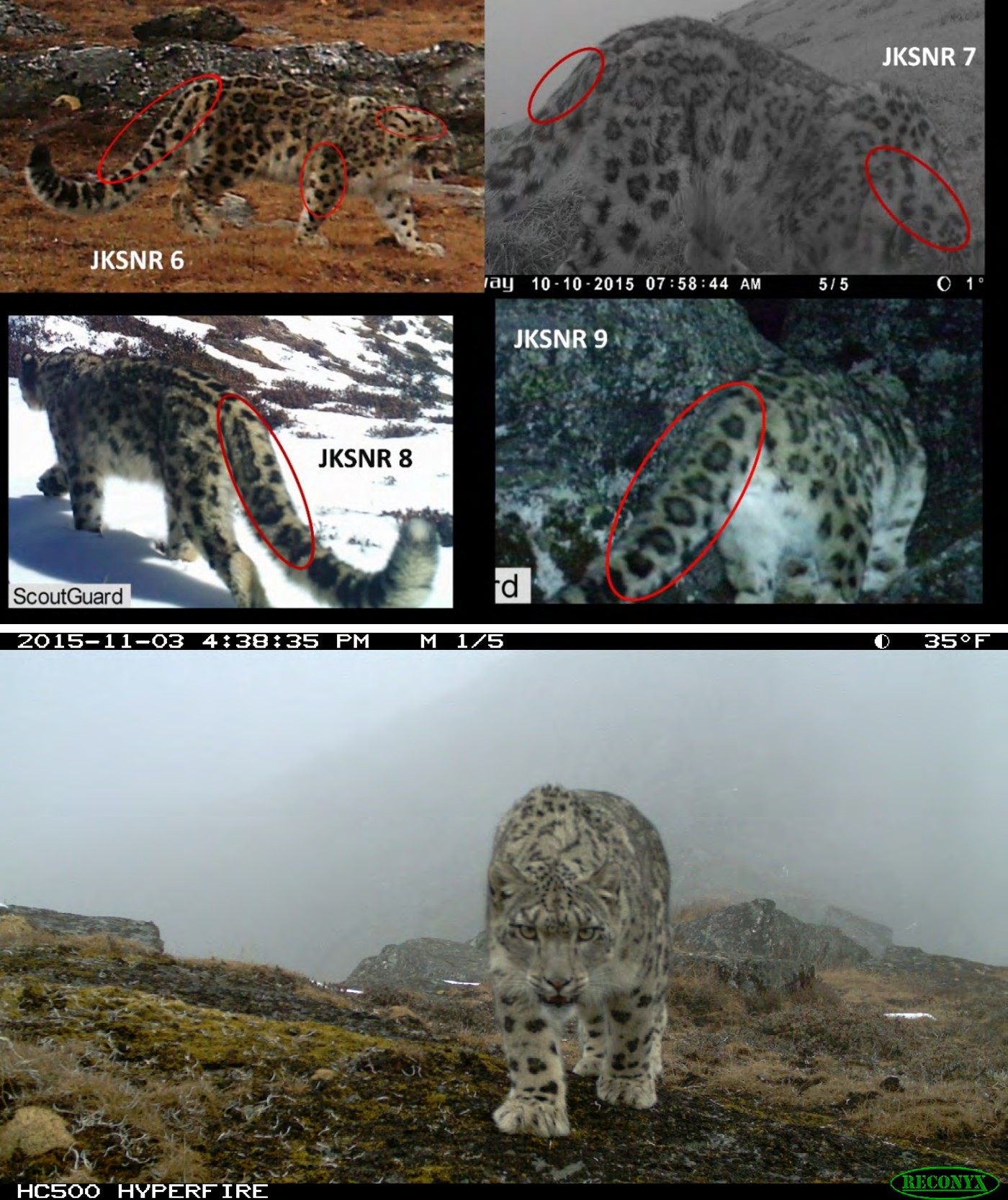
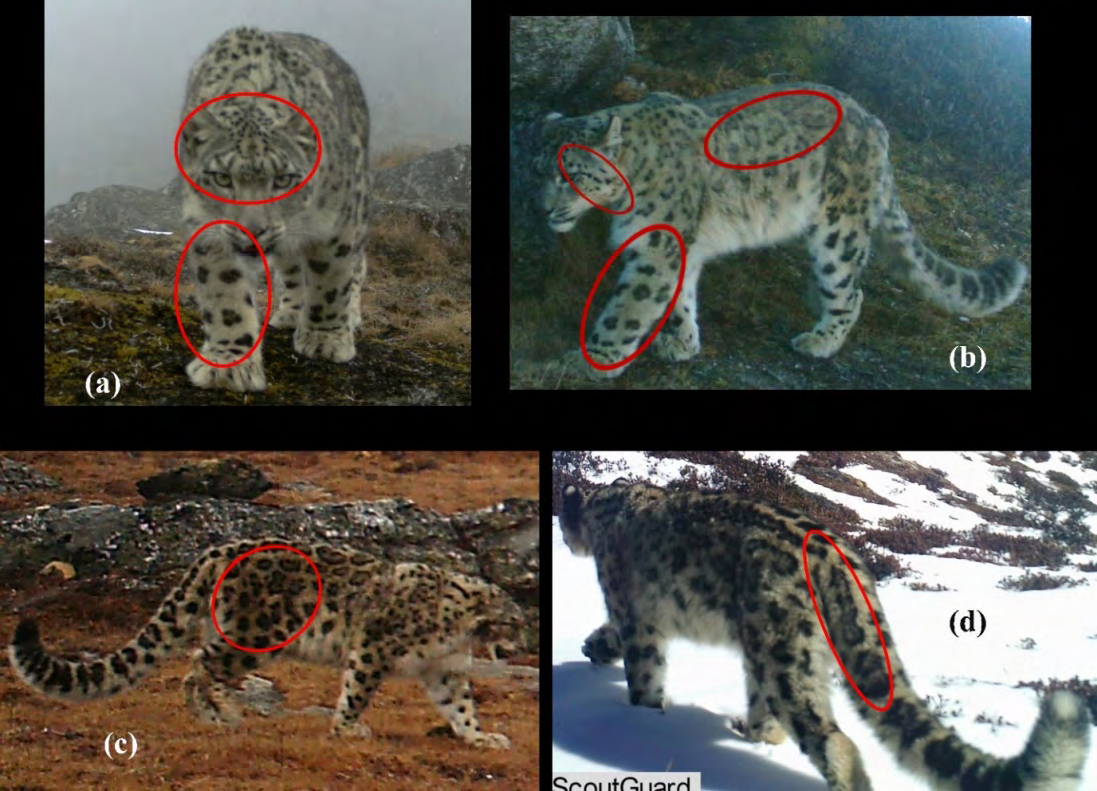
After the retrieval of cameras, all memory sticks were scanned for the species photos. Of the many photos captured, clear images that prominently showed facial parts, forelimbs, flanks and tail parts was selected for individual identifications. Idea used and proposed, to identify individual Snow Leopards [6] were put into practice by comparing the rosette and spot patterns along each flank or side of the body. As such, individual Snow Leopards were identified based on unique pelage patterns the method for which is well prescribed [14]. Example from our study of identifying two separate individuals is as shown (Figure 6) where pelage patterns on the fore-and-hind limbs differ significantly.
Results and Discussions
A British Naturalist reported the presence of Panthera uncia in Bhutan in the Journal of Bombay Natural History Society [15]. Therefore, there is no argument about its presence in Bhutan. But further study to confirm its presence localities was important to ascertain and authenticate the oral and print reports that were based on hearsay. Thus, the results of the sign and evidences survey of the prey species confirmed the presence of the cat in JKSNR [16], while this camera trap study further authenticated the presence of 10 individuals (Figures 7-16).
Figures 7: JKSNR 1.
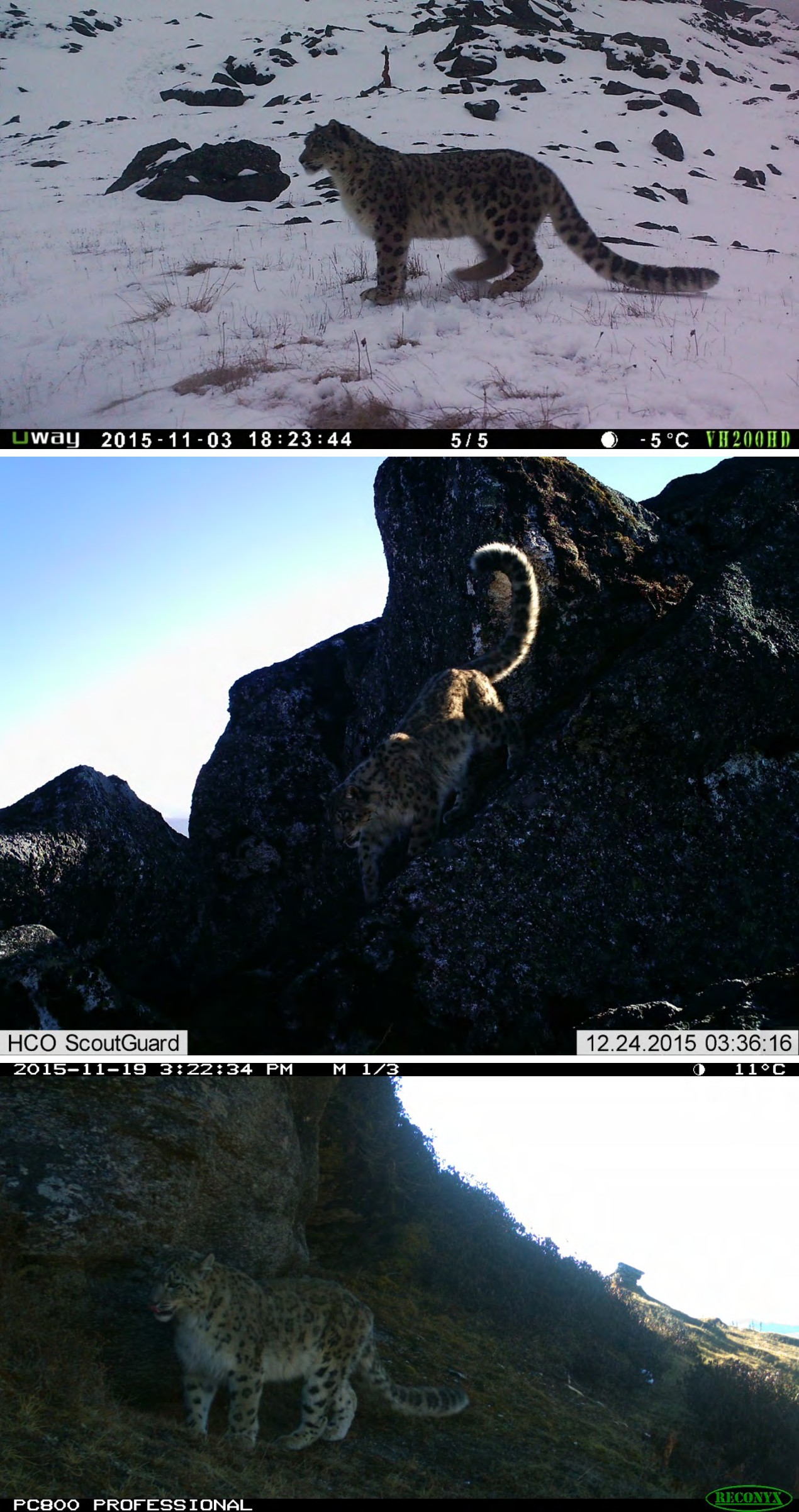
Figures 8: JKSNR 2.
Figures 9: JKSNR 3.
Figures 10: JKSNR 4.
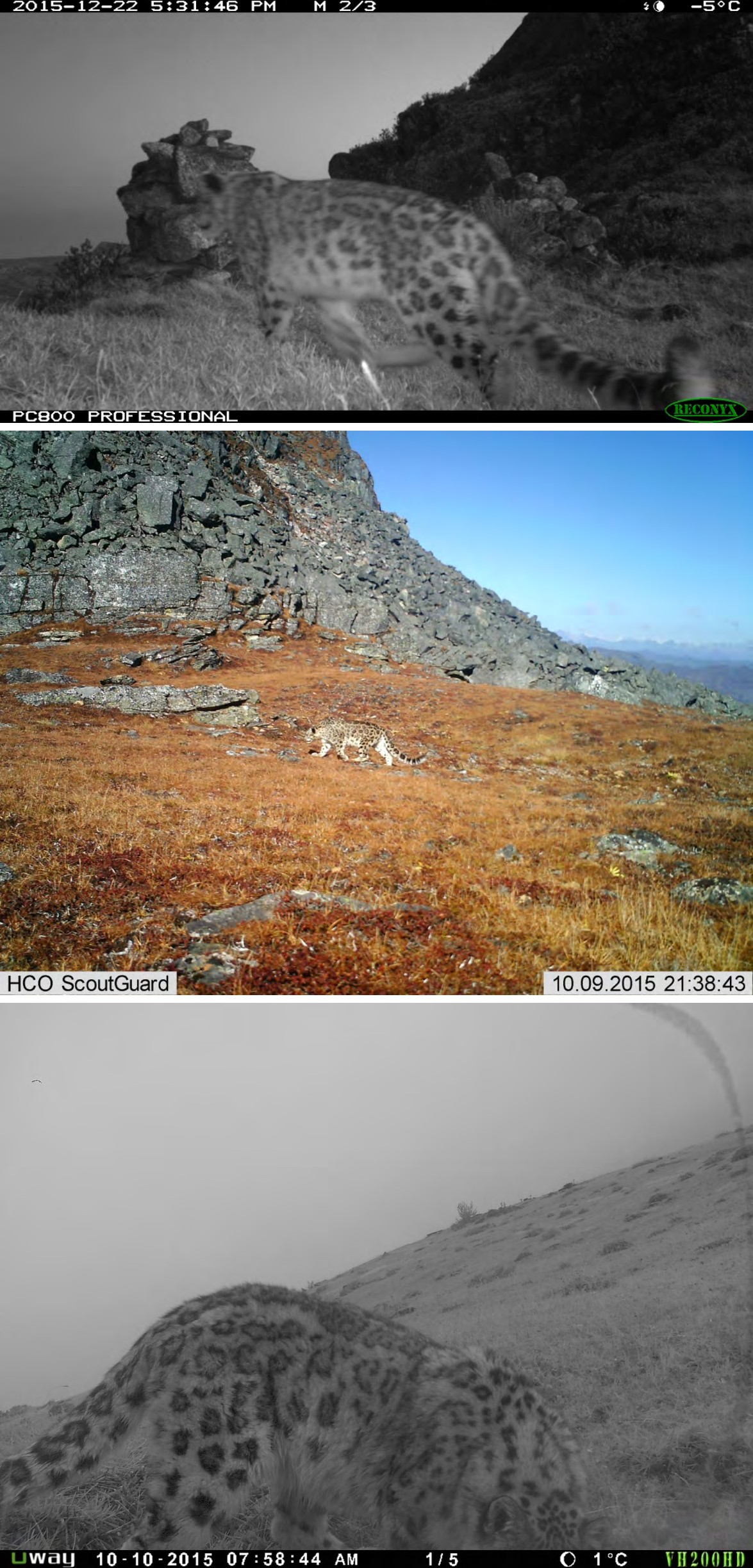
Figures 11: JKSNR 5.
Figures 12: JKSNR 6.
Figures 13: JKSNR 7.
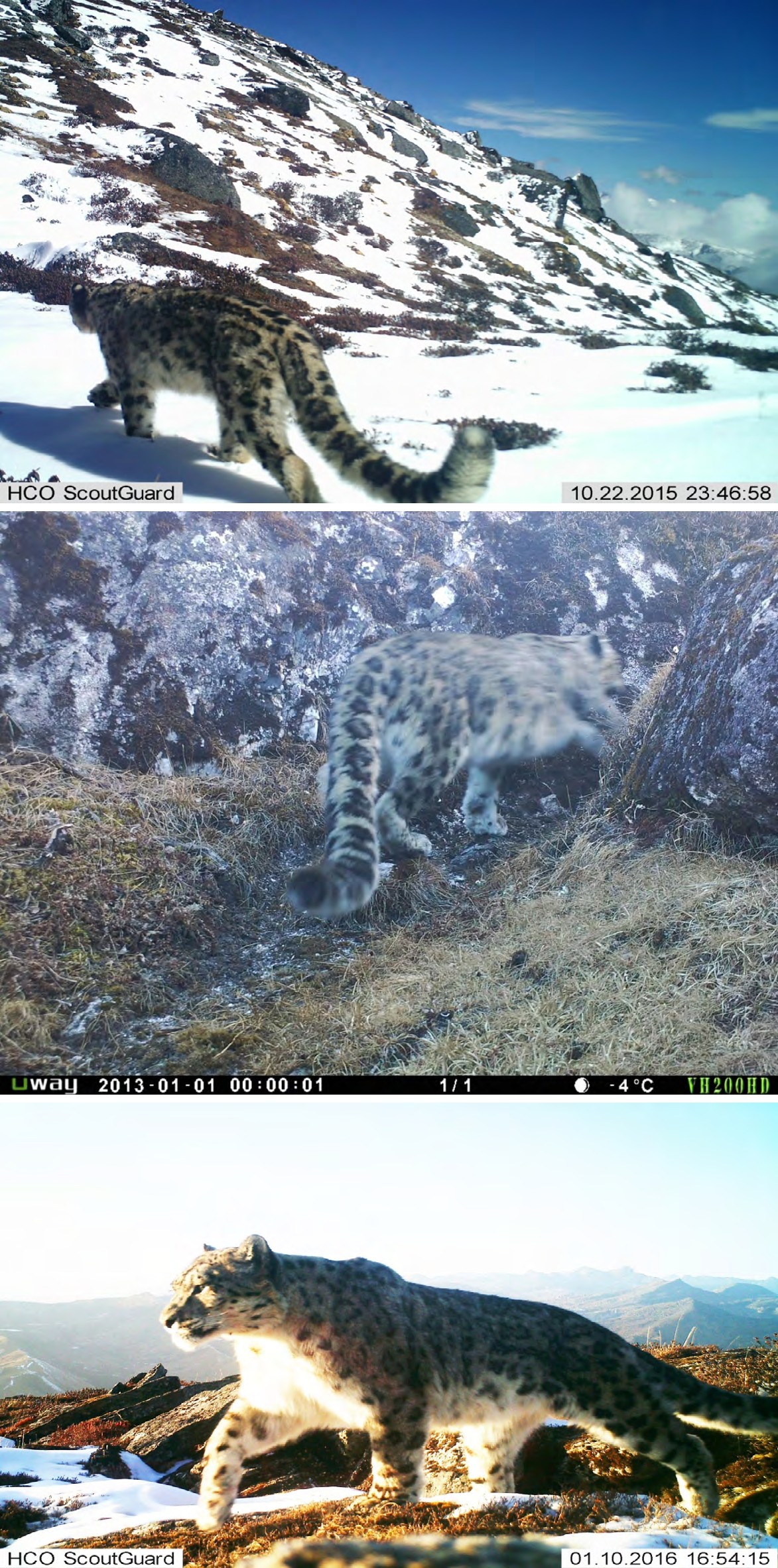
Figures 14: JKSNR 8.
Figures 15: JKSNR 9.
Figures 16: JKSNR 10.
Snow Leopards being at the top of the food chain of their habitat, harboring a good number of prey species is vital for conserving the species. Therefore, understanding the prey base is very crucial. Our study found Blue sheep as a very important species of prey supported by species like Himalayan Marmot, Musk Deer and birds like Tibetan Snow Cock similar to what studies in Mongolia by Snow Leopard Trust found.
The ridgelines of the mountains of Snow Leopard habitat showed a lot of evidences of scats, and on lucky days, pug marks on the snows sometimes were very fresh. Scrape evidences on the rocky outcrops, trails and prominent places were also observed during the field surveys. Cameras laid in areas with scrapes, scat and other signs evidences, ridgelines or Saddles, trails passing through narrow area with less wind (to avoid trapping of ghost images) yielded good results.
This study also found that the quality of photos depended on the type of camera traps. So far, Reconyx Hyperfire produced best type of images in JKSNR habitats. However, the study (which we also consider ongoing) is yet to capture cubs or young ones. As of now, cruising through scrape marking and scent marking images of Snow Leopards tops the list of best images captured by the camera traps.
The standout package/highlight of this study however, is the usage of area by good number of individuals. According to the study conducted by the Snow Leopard trust in Mongolia using GPS and research cameras traps over a long period of time, a male Snow Leopard uses an average area of 200 km2 while females use an average home ranges of 130 km2 without any overlap between individuals of same sex. Therefore, average home range of any Snow Leopard (both sexes) is 165km2. However, our result of 10 individuals in an area of just 272km2 is quite amazing which equals to just 27.2 km2 per individuals. Hence, we assume that most of them are non-residents but travelling individuals either for social activities or hunting for food. Such high density of Snow Leopards in such a small area makes JKSNR as unique habitat for the species and glorifies its already unique status of being a Strict Nature Reserve.
Results of the Photographic Analysis
Of the 215 images of Snow Leopards recorded by the camera traps laid in 10 grids over the period of 60 trap nights, 163 images (76%) could be used for individual identification while rest of the images (24%) were not usable for individual identification. We do not include the individual JKSNR 10 since it was captured outside the standard capture period of 60 days. However, we mention in this report about how important it is to extend the extension of trap nights from 60 to 90. More than/the number of capture nights, better the results.
JKSNR’s first Snow Leopard after the instalment of cameras traps was captured at grid number 2 (Nub Tshonapata Top) at 08.11pm on 1st October 2015 at an altitude of 4384masl. The camera trap stationed has alpine grassland with Rhododendron scrubs facing South East aspect at the geo-coordinates of 27°19’54.95”N and 89° 9’3.99”E.
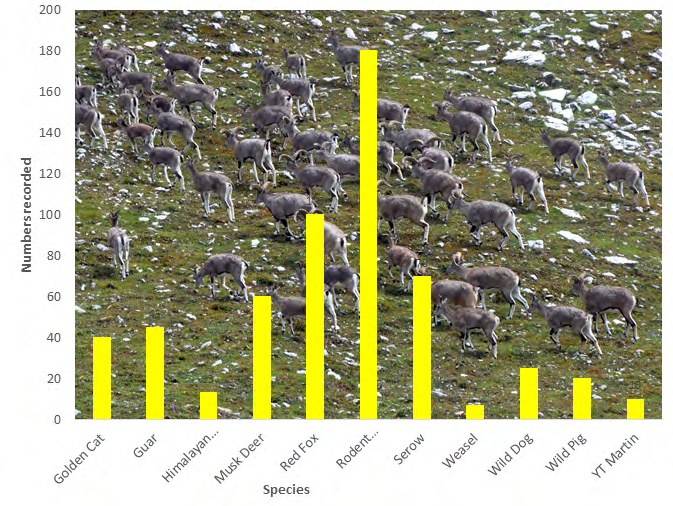
Records of individual’s forelimbs, facial portion, flanks and dorsal surface of the tail, torso and other possible angles as used based on the guideline [14] enabled establishing individuals (Table 3). Many false images triggered by infrared light, snow fall, movement of clouds and movement of grasses by wind were captured in the cameras which had to be discarded. Non-target species like Blue Sheep (Pseudois nayaur), the main natural prey of Snow Leopard in Bhutan was also captured (41%) while few images of other carnivores like Wild Dog (Cuon alpinus) 0.8% and Red Foxes (Vulpes vulpes) made 5.3% of the total captures. The suspected Tibetan Wolf (Canis lupus chanku) and Woolly Hare (Lepus oiostolus) were not trapped in any cameras while images of Asiatic Golden Cat (Pardofelis temminckii), Himalayan Serow (Capricornis sumatraensis), Wild Pig (Sus scrofa) and the most unsuspected species Gaur (Bos gaurus) were trapped conspicuously. Musk Deer (Moschus chrysogaster), Himalayan Black Bear (Ursus thibetanus), Weasel (Mustela sp.) and Yellow Throated Marten (Martes flavigula) made their presence felt while birds like Tibetan Snow Cock (Tetraogallus tibetanus), Snow Partridge (Lerwa lerwa), Blood Pheasant (Ithaginis cruentus), Satyr Tragopan (Tragopan styra), Himalayan Monal (Lophophorus impejanus) and other bird species (18.4%) also showed up in most of the cameras traps as analyzed in Figure 17.
- a. Total number of images used for individual identification:
- 163 b. Total number of images not usable for individual identification:
- 52
- Total number of snow leopard images (a+b):
- 215
- Body parts (based on a and b)
- No. of images
- Facial angle
- Not visible
- 84
- Looking toward camera (45)
- 55
- Looking away from camera (≥ 90)
- 11
- Looking sideways to camera (approx. 90)
- 62
- Extent of torso visible
- Not visible
- 52
- Fully visible
- 84
- Visible (approx. 75%)
- 25
- Visible (approx. 50%)
- 15
- Visible (≤ 25%)
- 31
- Number of limbs visible
- 67
- 1
- 19
- 2
- 41
- 3
- 52
- All limbs
- 28
- Extent of tail visible
- Not visible
- 71
- Completely visible (dorsal surface)
- 49
- Completely visible (lateral surface)
- 52
- Visible (approx. 50%)
- 26
- Visible (≤ 25%)
- 51
Table 3: Proportion of snow leopard body parts visible from camera trap images.
Of all the captured images besides Panthera uncia, Bos gaurus captured from 4500 masl above the legendary lake Nub-Tshonapata in grid 1 near Tshona beat other images as the species is classified as Vulnerable by IUCN and is protected in Bhutan as schedule I animal of FNCA 1995. The record of this species at such an altitude is first of its kind in Bhutan.
An interesting field knowledge is added with the capture of individual JKSNR 10 in 90 trap nights. The standard 60 trap nights may need to be reconsidered, because after the retrieval of cameras traps from December 2015-January 2016, some were monitored while others were retrieved. The final retrieval of all the remaining Cameras traps was done in between February and March 2016 during which an additional member which we named JKSNR 10 was photographed in Grid 10. It is noteworthy that no Snow Leopards were photographed from Grid 10 during the two earlier phases. Thus, this indicate that 60 trap nights is not enough to completely enumerate its population. To reconfirm the authenticity of the individual JKSNR 10 captured, repeated comparison with those already captured individuals was done. Scat and DNA collection survey was carried out two times in May and June 2016 and materials have been submitted to Nature Conservation Division (NCD) for analysis. While the result is awaited, JKSNR considers it to be a separate individual based on its rosette pattern and other features being different from others.
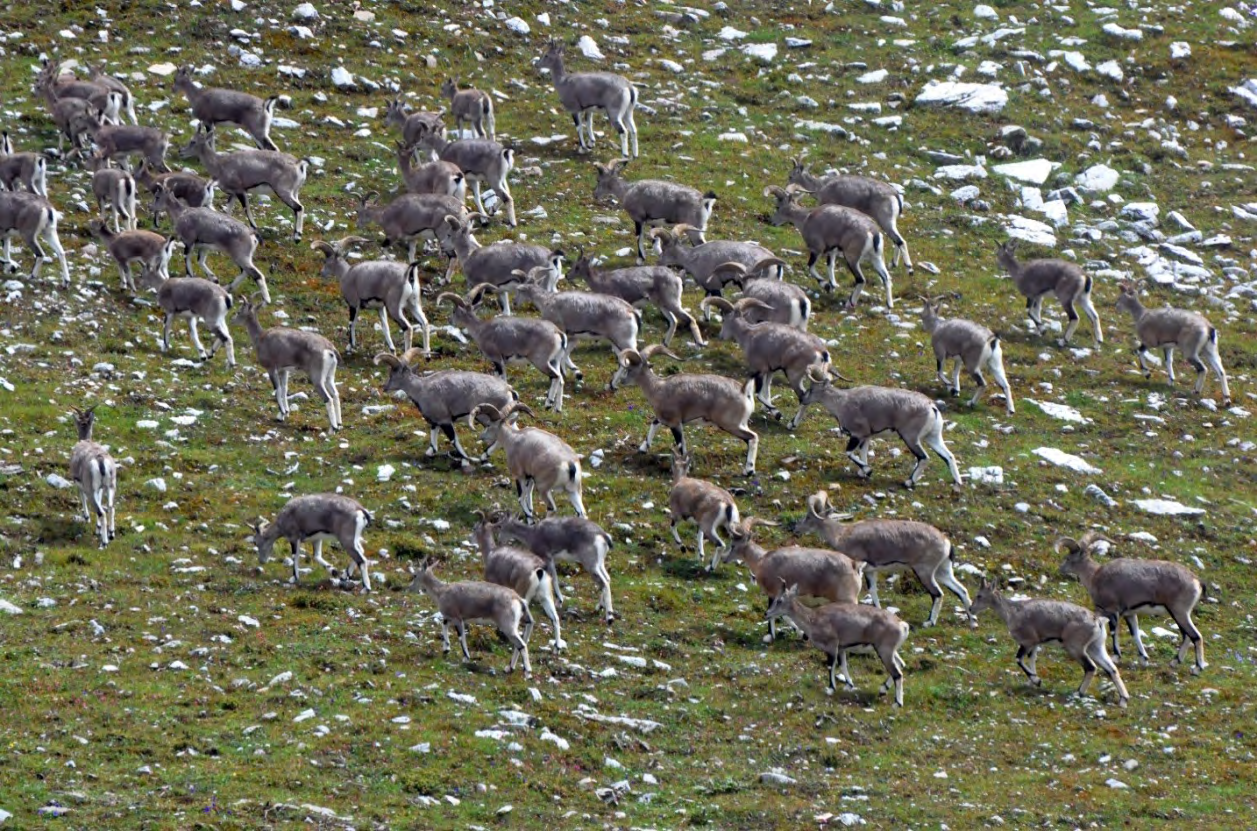
Key prey species for Snow Leopards in JKSNR is Blue Sheep unlike the species in Mongolia where Ibex, Markhor, Blue Sheep and Argali are equally important. With the good population of Blue Sheep in various places (Figure 18) inside the survey area viz. a herd each in Tshabjola (n=58), Tsang (n=20), Tshonapatra (n=30), Chuzomtse (n=30), Kampula (n=30), Tamzhing (n=30), Jazagortab (n=15), and Tshonathangkha (n=20) which is outside the Grid, the future of Snow Leopards in JKSNR is not insecure.
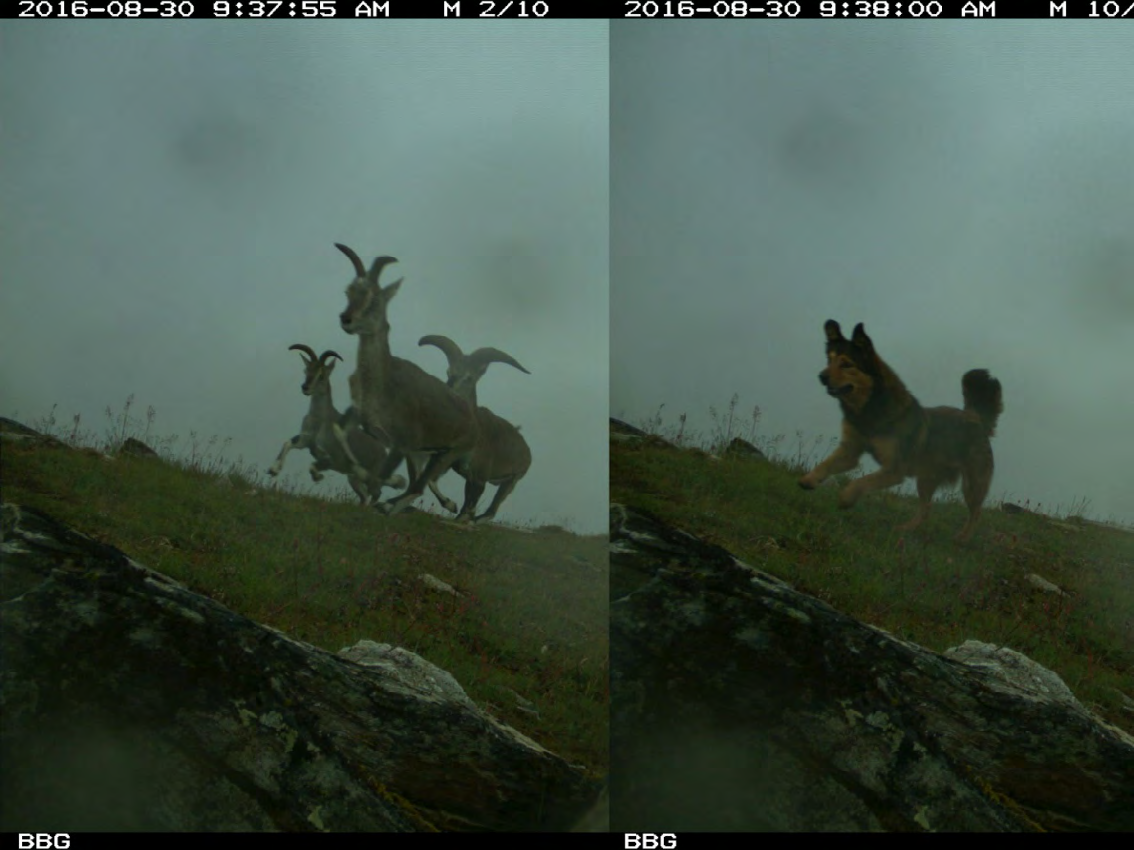
However, the diversity of prey species is lower than those in Mongolia which has at least four sympatric species on which the Snow Leopard can prey on. Though our study is ongoing, JKSNR can safely infer that the threat to Snow Leopard is not competition for food between the wild and the domestic prey species unlike the case in Mongolia. There are no threats of cattle population increasing since the numbers have dwindled with reducing number of herders over the last few years. However, a small threat of feral domestic dogs hunting Blue Sheep calves (Figure 19) are evident which JKSNR as a conservation entity may need to take care if the problem become worst in the near future.
Repeated capture of Individual Snow Leopard
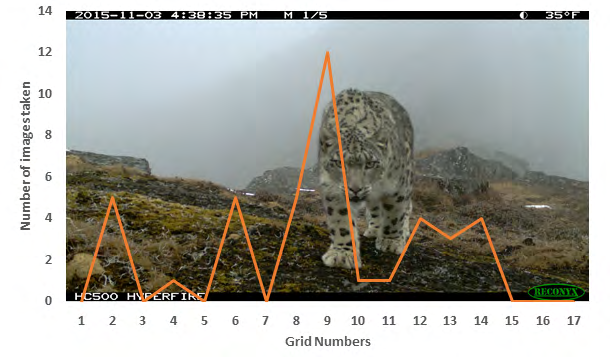
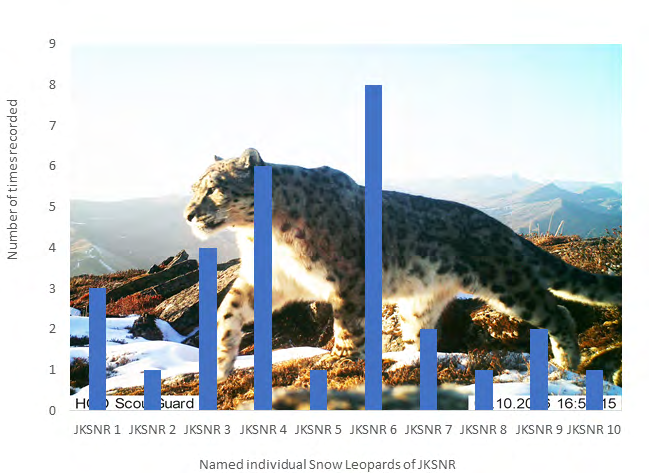
The most frequently captured Snow Leopard is individual JKSNR 6 which appeared at least 7 times in Grid number 2, 6, 8 and 12 followed by JKSNR 4 who appeared 5 times in grid number 9 and 13 (Table 4). JKSNR 2, 5 and 8 appeared only once each while JKSNR 1, 7 and 9 appeared two times each in various cameras traps. Similar analysis shows that the maximum number of Snow Leopard images (n=12) was captured in grid 9 Kampula while no images were captured at Grids 1, 3, 5, 7, 15, 16 and 17 (Figure 20). The highest captured and recaptured individual was JKSNR 6 which was recorded 7 times in Grid Numbers 2, 6, 8 and 12 (Figure 21). Individuals were captured more than once in at least 10 grids as explained in Table 4. During the extended period (January 2016), a new individual was captured in Grid 10. JKSNR, 1, 4 and 6 also appeared once each in the grid during the extended period (Table 5).
| JKSNR_SL_Member | Grid No# | Capture Date | Frequency | Compared with ID | Location Name | |||
|---|---|---|---|---|---|---|---|---|
| 1 | JKSNR 1 | 2 | 11-11-2015 | 2 | JKSNR 2, JKSNR 3, JKSNR 4 | Tshona-top | ||
| 1 | JKSNR 1 | 6 | 11-03-2015 | 2 | JKSNR 2, JKSNR 3, JKSNR 4 | Jo-shokopede | ||
| 2 | JKSNR 2 | 11 | 11-03-2015 | 1 | JKSNR 4, JKSNR 5, JKSNR 6, JKSNR 8 | Chhuzomtse | ||
| 3 | JKSNR 3 | 9 | 11-12-2015 | 4 | JKSNR 2, JKSNR 4, JKSNR 5 | Kampulaa | ||
| 3 | JKSNR 3 | 9 | 11/27/2015 | 4 | JKSNR 2, JKSNR 4, JKSNR 5 | Kampulaa | ||
| 3 | JKSNR 3 | 9 | 12-11-2015 | 4 | JKSNR 2, JKSNR 4, JKSNR 5 | Kampulaa | ||
| 3 | JKSNR 3 | 9 | 12/24/2015 | 4 | JKSNR 2, JKSNR 4, JKSNR 5 | Kampulaa | ||
| 4 | JKSNR 4 | 9 | 10-02-2015 | 5 | JKSNR 2, JKSNR 3, JKSNR 5, JKSNR 6 | Kampulaa | ||
| 4 | JKSNR 4 | 9 | 11/28/2015 | 5 | JKSNR 2, JKSNR 3, JKSNR 5, JKSNR 6 | Kampulaa | ||
| 4 | JKSNR 4 | 9 | 12-06-2015 | 5 | JKSNR 2, JKSNR 3, JKSNR 5, JKSNR 6 | Kampulaa | ||
| 4 | JKSNR 4 | 13 | 11/19/2015 | 5 | JKSNR 2, JKSNR 3, JKSNR 5, JKSNR 6 | 12-08-2015 | Jaaza gorthap | |
| 4 | JKSNR 4 | 13 | 12-08-2015 | 5 | JKSNR 2, JKSNR 3, JKSNR 5, JKSNR 6 | 12-08-2015 | Jaaza gorthap | |
| 5 | JKSNR 5 | 14 | 12/22/2015 | 1 | JKSNR 3, JKSNR 4, JKSNR 6, JKSNR 8 | Tshosheylaa | ||
| 6 | JKSNR 6 | 2 | 10-01-2015 | 7 | JKSNR 2, JKSNR 4, JKSNR 7 | Tshona-top | ||
| 6 | JKSNR 6 | 2 | 10-10-2015 | 7 | JKSNR 2, JKSNR 4, JKSNR 7 | Tshona-top | ||
| 6 | JKSNR 6 | 2 | 10/30/2015 | 7 | JKSNR 2, JKSNR 4, JKSNR 7 | Tshona-top | ||
| 6 | JKSNR 6 | 6 | 10-09-2015 | 7 | JKSNR 2, JKSNR 4, JKSNR 7 | 7 | JKSNR 2, JKSNR 4, JKSNR 7 | Jo-shokopede |
| 6 | JKSNR 6 | 10/23/2015 | 7 | JKSNR 2, JKSNR 4, JKSNR 7 | 7 | JKSNR 2, JKSNR 4, JKSNR 7 | Jo-shokopede | |
| 6 | JKSNR 6 | 8 | 10-03-2015 | 7 | JKSNR 2, JKSNR 4, JKSNR 7 | 7 | JKSNR 2, JKSNR 4, JKSNR 7 | Tshabjotop/Pamling |
| 6 | JKSNR 6 | 12 | 10-03-2015 | 7 | JKSNR 2, JKSNR 4, JKSNR 7 | 7 | JKSNR 2, JKSNR 4, JKSNR 7 | Tshosheykha top |
| 7 | JKSNR 7 | 8 | 10-09-2015 | 2 | JKSNR 1, JKSNR 4, JKSNR 6 | Tshabjotop/Pamling | ||
| 7 | JKSNR 7 | 8 | 10-10-2015 | JKSNR 1, JKSNR 4, JKSNR 6 | ||||
| 8 | JKSNR 8 | 9 | 10-02-2015 | 1 | JKSNR 5, JKSNR 6 | Kampulaa | ||
| 9 | JKSNR 9 | 9 | 12/16/2015 | 2 | JKSNR 3, JKSNR 6 | Kampulaa | ||
| 9 | JKSNR 9 | 14 | 12-01-2015 | 2 | JKSNR 3, JKSNR 6 | Tshosheylaa |
Table 4: Capture Frequency.
| JKSNR_SL_Member | Grid No# | Capture Date | Frequency | Compared with ID | Location Name | Remarks | |
|---|---|---|---|---|---|---|---|
| 10 | JKSNR 10 | 10 | 01-01-2016 | 1 | JKSNR 2 | Jaadotoen | |
| 11 | JKSNR 4 | 9 | 12/29/2015 | 1 | JKSNR 4 | Kampulaa | |
| 12 | JKSNR 6 | 12 | 02-12-2016 | 1 | JKSNR 6 | Tshosheykha top | |
| 13 | JKSNR 1 | 2 | 01-12-2016 | 1 | JKSNR 1 | Tshona top | |
| Sl. No | JKSNR_SL_Member | Grid # | Capture Date | Frequency | Compared with ID | Location Name | Remarks |
| 1 | JKSNR 6 | 12 | 5/26/2016 | 2 | JKSNR 6 | Tshosheykha | 1st Monitoring |
| 2 | JKSNR 6 | 12 | 6/13/2017 | JKSNR 6 | Tshosheykha | 1st Monitoring | |
| 3 | JKSNR 6 | 8 | 2/18/2017 | 1 | JKSNR 6 | Pamling | 2nd Monitoring |
| 4 | Unknown | 8 | 3/20/2017 | 1 | Pamling | 2nd Monitoring | |
| 5 | JKSNR 6 | 8 | 3/29/2017 | 7 | JKSNR 6 | Pamling | 3rd Monitoring |
| 6 | JKSNR 6 | 8 | 4/18/2017 | 7 | JKSNR 6 | Pamling | 3rd Monitoring |
| 7 | JKSNR 6 | 8 | 05-03-2017 | 7 | JKSNR 6 | Pamling | 3rd Monitoring |
| 8 | JKSNR 6 | 8 | 5/27/2017 | 7 | JKSNR 6 | Pamling | 3rd Monitoring |
| 9 | JKSNR 6 | 8 | 07-12-2017 | 7 | JKSNR 6 | Pamling | 3rd Monitoring |
| 10 | JKSNR 6 | 8 | 7/17/2007 | 7 | JKSNR 6 | Pamling | 3rd Monitoring |
| 11 | JKSNR 6 | 8 | 7/28/2017 | 7 | JKSNR 6 | Pamling | 3rd Monitoring |
| 12 | New Member? | 8 | 7/13/2017 | 1 | JKSNR 5, JKSNR 6, JKSNR 7, JKSNR 8, JKSNR 9 | Pamling | 3rd Monitoring |
| 13 | Unknown | 8 | 4/23/2017 | 5 | No good image to compare ID | Pamling | 3rd Monitoring |
| 14 | Unknown | 8 | 7/17/2017 | 5 | No good image to compare ID | Pamling | 3rd Monitoring |
| 15 | Unknown | 8 | 7/28/2017 | 5 | No good image to compare ID | Pamling | 3rd Monitoring |
| 16 | Unknown | 8 | 08-08-2017 | 5 | No good image to compare ID | Pamling | 3rd Monitoring |
| 17 | Unknown | 8 | 8/26/2027 | 5 | No good image to compare ID | Pamling | 3rd Monitoring |
Table 5: New individual captured (JKSNR 10) during the extended period.
Identification of Snow Leopard Using the Captured Images
Cameras traps were set to photograph Snow Leopard
directly approaching or departing trap sites to primarily document facial features, forelimbs, flanks and dorsal surface of tail. Distinctive shapes of rosette groups were mostly used for distinguishing individuals because most of the images showed these body parts (Figure 22).
Only nine individuals from ten grids could be identified from 215 images of Snow Leopard. Many images could not be used for identification as some were blurred while others contained body parts that could not be analyzed. About 26 percent of Snow Leopard images were captured facing the camera traps directly while 5 percent of images taken were photographed from behind. At least 29 percent of the photographs were taken sideways resulting into 59 percent of all images captured showing only three-quarters of the animal’s torso while 41 percent of images showed up full torso. Limb visibility was restricted to 32 percent with one limb images making up 9 percent, two limbs 20 percent, and three limbs making up 25 percent while all four limbs visibility made up 14 percent. About 29 percent of images captured showed no tails while dorsal surface visibility made up 20 percent, and lateral surface visibility made up 21 percent. At least, 50 percent of the images captured showed
30 percent of tails. All these images made the laboratory work easier to identify individuals which are all named after the Reserve.
Activity Pattern and Habitat Use
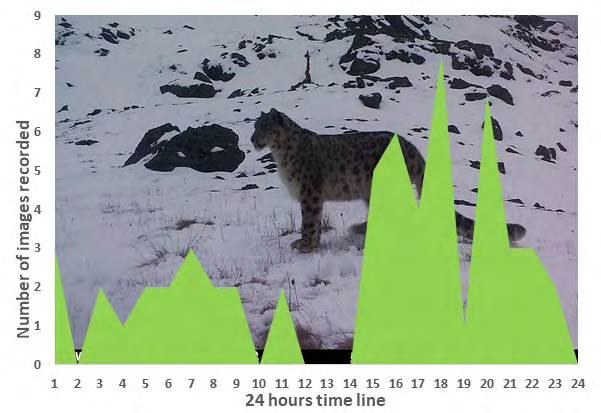
The distribution of the Snow Leopard activity patterns on a 24 hours scale, based on the number of images of individuals photographed by different camera traps showed bimodal (two peaked) distribution, one in early morning and one in the late evening (Figure 23). Such a pattern suggests crepuscular habit of Snow Leopards in conformity to various other studies conducted on the species. Very few images were also taken from 8 am to noon. Similarly, a study on Snow Leopard conducted by Thinley [18] in Jigme Dorji National Park, Bhutan have also reported similar observation.
Habitat use inferred from camera-trap images indicate that Snow Leopards spent most of their time in the rugged rocky outcrops, a pattern which was generally observed in other range countries too [17]. A similar observation was made on estimating the species abundance and distribution in Jigme Dorji National Park using camera traps [18].
Distribution Pattern
Analysis of the capture history data showed that the three individuals JKSNR 1, 6 and 7 were captured in camera trap-station G2 (Tshonatop), G6 (Tshabjola/Peak Base) and G8 (Tshabjola), while individuals JKSNR 3, 4, 8 and 9 were captured only in camera trap-station G9 (Kampula), indicating high concentration and overlap of habitat among the individuals. Thus, the species could be mostly found in Kampula and Tshebjola ridges backed by the number of individuals photographed by camera-traps around these areas (Figure 24). The highest concentration of the species is in Grid Number 9 (Kampula) where as many as 4 individuals JKSNR 3, 4, 8 and 9 were captured followed by Grid Number 2 where at least two individuals JKSNR 1 and 6 roam around (Table 4). Therefore, JKSNR can safely conclude that most of its mountains above 3500masl has Panthera uncia as a primary predator. The Reserve, therefore, may focus more of their patrolling and monitoring activities in these high- density areas.
Conclusion and Way Forward
The Snow Leopard is a carnivore of the high mountains of JKSNR and is as many experts believe is noted for its rarity and its ability to indicate the ecological health of high altitude ecosystems. Being at the top of the food chain, the species is known to need large home ranges and cover vast areas. In pristine conditions like that of the Reserve it is known to do well in breeding, hunting and managing the alpine ecosystem.
Prior to the current study, its presence inside JKSNR was a hearsay, with few reports of people encountering the animals and talks of seeing signs like Pug marks on the snow up on the ridge of Nub-Tshonapata and very few other evidences from the yak herders passed on to one another orally.
With this study, the presence of the species is genuinely confirmed as majority of the cameras traps captured stunning photographs of Snow Leopard in almost 10 grids; (G2, G3, G4, G6, G8, G9, G11, G12, G13 and G14) giving the Reserve 10 individuals. JKSNR perhaps can use this cat as Flagship species to conserve the biodiversity of the whole reserve including the transboundary Kanchenjunga landscape which has been identified as home of the Snow Leopards. Thus, it is proven beyond doubt that Jigme Khesar Strict Nature Reserve, Haa serves as an important habitat for Snow Leopards.
Other wildlife species of significance include Guar (Bos gaurus), Yellow Throated Marten (Martes flavigula), Red Fox (Vulpes vulpes), Blue Sheep (Pseudois nayaur), Wild Dog (Cuon alpines), and avifauna like Monal Pheasant (Lophophorus impejanus), Blood pheasant (Ithaginis cruentus), Snow Partridge (Lerwa lerwa) and Tibetan Snow Cock (Tetraogallus tibetanus).
Further, this study confirms the promising nature of the Reserve for global conservation of Snow Leopards with vast expanse of habitats for Snow Leopard and its prey, blue sheep. The study also suggests camera traps to be a valuable tool for studying the distribution and the habitat use patterns of this species which serve as an important information to conservationists to maintain and manage the population of the species throughout its range. The findings of the studies can be used for developing scientifically robust management plans for conservation of the alpine rangelands ecosystems including the Snow Leopard at the landscape level.
The Reserve strive to monitor and manage the species annually as per the permanent schedule (Table 6) and promise to keep the Snow Leopard population well managed till perpetuity.
- Ethics Approval and Consent to Participate: Government project and all authors are government officials
- Consent for Publication: We agree to the publication policy and bylaws
- Availability of Data and Materials: All the data were put on the paper
- Competing Interests: No competing interest
Funding
Royal Government of Bhutan
Authors’ Contributions
Most of the writing work done by the first and second author while data were collected equally by all authors
Acknowledgments
First and foremost, it is the support of the Royal Government of Bhutan and the rules that are in place to conserve all the species. JKSNR as management is indebted to the Government. As primary author I would like to put in record that this paper could never have been written if there were no national level survey and the trained staff for collecting data. To all those who are concern with conservation of species, I have a boundless acknowledgement. Team JKSNR is proud of our work.
References
-
JKSNR (2011) Toorsa Strict Nature Reserve Management Plan 2012-2017. Department of Forest and Park Services, Bhutan, pp: 60.
-
Worboys GL, Francis WL, Lockwood M (2010) Connectivity Conservation Management a Global Guide (with particular reference to mountain connectivity conservation). Connectivity conservation management. Earthscan, London, Washington DC, USA, pp: 373.
-
Mittermeier RA, Gils PR, Hoffman M, Pilgrim J, Brooks T, et al. (2004) Hotspots Revisited. Earth’s Biologically Richest and Most Endangered Terrestrial Ecoregions. USA: CEMEX.
-
Olson DM, Dinerstein E (2002) The Global 200: Priority ecoregions for global conservation. In: Annals of Missouri Botanical Garden 89: 199-224.
-
Hussain S (2003) The status of the snow leopard in Pakistan and its conflict with local farmers. Oryx 37(1): 26-33.
-
Jackson R, Hunter OD (1996) Snow Leopard Survey and Conservation Handbook. International Snow Leopard Trust and US Geological Survey, Seattle, USA.
-
Bhutan Times (2017) Presence of Snow Leopard in JSWNP is confirmed.
-
McCarthy J, McCarthy KP, Fuller TK, McCarthy TM (2010) Assessing Variation in Wildlife Biodiversity in the Tien Shan Mountains of Kyrgyzstan Using Ancillary Camera- trap Photos. Mountain Research and Development 30(3): 295-301.
-
Efford MG (2004) Density estimation in live-trapping studies. Oikos 106(3): 598-610.
-
Howe EJ, Obbard ME, Kyle CJ (2013) Combining data from 43 standardized surveys to estimate densities of female American black bears by spatially explicit capture-recapture. Population Ecology 55(4): 595-607.
-
Royle JA, Chandler RB, Sollmann R, Gardner B (2013) Spatial Capture -Recapture. Academic Press/Elsevier pp: 612.
-
Sollmann R, Gardner B, Chandler RB, Shindle DB, Onorato DP, et al. (2013) Using multiple data sources provides density estimates for endangered Florida panther. Journal of Applied Ecology 50(4): 961-968.
-
WCD (2015) Field Manual for Surveying and Monitoring of Snow Leopards in Bhutan. In: Wildlife Conservation Division 1st (Edn.), DoFPS, MoAF, Bhutan.
-
Jackson RM, Roe JD, Wangchuk R, Hunter DO (2006) Estimating Snow Leopard Population Abundance Using Photography and Capture-Recapture Techniques. Wildlife Society Bulletin 34(3): 772-781.
-
Gee EP (1967) Occurrence of the snow leopard, _Panthera_ _uncia_ (Schreber) in Bhutan. Journal of Bombay Natural History Socirety 64: 552-553.
-
JKSNR (2014) Field report on Jigme Khesar Strict Nature Reserve snow leopard sign and scat survey. pp: 13.
-
Jackson RM, Munkhtsog B, Mallon DP, Naranbaatar G, Gerelmaa K (2009) Camera-trapping snow leopards in the TostUul region of Mongolia. Cat News 51: 18-21.
-
Thinley P (2012) Estimating snow leopard (_Panthera_ _uncia_) abundance and distribution in Jigme Dorji National Park using camera traps: A technical report, Bhutan.
- California Red-Legged Frog and Non-Listed Amphibians Response to Non-Native Fish Removal
- Industrial Standardization of the Bio-OS: Algorithmic Codification of Resilience Engineering Guidelines and Version V8 Architecture
- Climate Variability and the Sustainability of Snail Farming in Nigeria: Past Trends, Present Challenges and Potential Outlook
- The Evaluation of the Surveillance System of Anthrax in Gilgit-Baltistan, Pakistan, 2018
- Natural Decline to Extinction of A New Zealand Rabbit Population
- Mitochondrial Bio-Logistics: Steering Co-Enzyme Q10 and Lycopene Synergies within the Science 4.0 Bio-OS Framework