
Review and Comparative Assessment of Biacetabulum macrocephalum McCrae, 1962 (Cestoda: Caryophyllidae) from Catostomus commersoni (Lacépède) in Wisconsin, USA
Specimens of Biacetabulum macrocephalum McCrae, 1962 (Cestoda: Caryophyllidae) were first described from the white sucker, Catostomus commersoni (Lacépède) in Colorado. The white sucker appears to be its major host species in a few other states often in the Mississippi River basin. We have collected and examined this uncommon cestode, also from C. commersoni in Tichigan Lake, a tributary of the Mississippi River and from the Root River in SE Wisconsin. We update our first and only 1986 account of our Wisconsin population, with new observations and measurements, and compare with those in the original and other descriptions. The morphology of B. macrocephalum is revisited using light microscopy revealing new features. Emphasis is placed on the morphological variability of its scolex and reproductive structures especially its ovarian arms and pre- and post-ovarian vitellaria. Measurements of 10 specimens from the Root River provided an opportunity to review the taxonomy and description of the species, distinguish locality differences, and correct and update other statements and concepts by other observers. The disconnected distribution of worms from the same host species in separate waters of various states is described.
Introduction
Mackiewicz [1, 2, 3], Ash, et al. [4, 5], Scholz and collaborators [6, 7] independently provided insights into the morphology, anatomy, development, zoogeography, evolution, and systematics of the Caryophyllidea van Beneden (Cestoidea) from the Nearctic, Neotropical, Palearctic, Ethiopian, Oriental, Indo-Malayan, and Australian regions. Of these, 14 genera and 90 species belonging to 3 families were described from the Indo-Malayan region in Bagridae, Heteropneustidae, Schilbeidae and Siluridae, cypriniformes, and cobitid fishes [3]. Chubb [8] reviewed the seasonal ecology of the Caryophyllidea in the various climate zones of the world. Amin [9, 10, 11, 12, 13] recognized 15 species in 8 families of caryophyllid cestodes mostly from suckers (Catostomidae) in lake and river systems in Arizona and Wisconsin. These included Biacetabulum macrocephalum McCrae, 1962.
In Wisconsin, Amin [11] gave a brief systematic account of Biacetabulum macrocephalum McCrae, 1962 from the white sucker Catostomus commersoni (Lacépède) in the Root River, SE Wisconsin [11, 12] followed in 1986 with another brief record from the same host in Tichigan Lake, on the Fox River, a tributary of the Mississippi River in SE Wisconsin [13].
Biacetabulum macrocephalum was described from C. commersoni in two connected localities in Colorado: The Horsetooth Reservoir and the Cache la Poudre River in Larimer County [14]. The Horsetooth Reservoir was constructed in 1949 by creating 4 earth dams on the Lower South Platte River. The Cache la Poudre River flows into the South Platte River. Since its original description, B. macrocephalum has been scarcely reported from unrelated locations in disconnected states with occasional common relation to the Mississippi River, and listed below in chronological order.
Buchwald, et al. [15] examined the effect of temperature on the development of procercoids in tubificids in an unnamed location which could have been in Iowa where M. J. Ulmer worked between 1950 and 1983 at Iowa State University, Ames. In the same year, 1964, Calentine [16] studied the biology and taxonomy of Biacetabulum with a special reference to the developmental stages of B. macrocephalum from 11% of 339 C. commersoni examined in the Iowa River, a tributary of the Mississippi River. Calentine RL [16] provided 10 detailed line drawings including 2 of adults. In 1965, Calentine and Fredrickson [17] studied the seasonal periodicity of B. macrocephalum in C. commersoni also in the Iowa River and recovered gravid adults only in June, July and August. Calentine RL [17] obtained successful development of embryonated eggs to procercoids in Tubifex tubifex (Müller) and Tubifex tempeltoni Southern. One infected of 98 examined white suckers, C. commersoni, from the Susquehanna River in Pennsylvania harbored only 1 mature specimen of B. macrocephalum [18]. Forstie, et al. [19] reported specimens of B. macrocephalum in 5 infected of 66 examined white suckers, C. commersoni, in 1 of 10 largemouth buffalofish, Ictiobus cyprinellus (Valenciennes) and in 1 of 61 examined walley, Stizostedion vitreum (Mitchill) in various localities on the James and Sheyenne rivers in North Dakota. The James River is another tributary of the Missouri River in the Mississippi River Basin and the Sheyenne River is a tributary of the Red River [20, 21, 22].
The objectives of this work were to revise and update on the morphology of B. macrocephalum especially with new perspectives using light microscopy, and to review and account for its distribution in the US from C. commersoni.
Materials, Collections, and Methods
Collections
Seasonal collections of specimens of B. macrocephalum were made from C. commersoni in 2 Wisconsin sites, the Root River and Tichigan Lake in SE Wisconsin. The Root River in Milwaukee and Racine counties (42° 44’ 1” N-87° 46’ 42” W) flows eastwards into Lake Michigan. The poorer parasitic fauna in the Root River compared to the nearby Pike River is attributed to its higher flow rate and its higher non-fecal organic pollutant content than in the Pike River [12]. Both rivers are independent streams not connected to either Tichigan or the land-locked Silver Lake. Tichigan Lake is a relatively large eutrophic impoundment on the Fox River which is a tributary of the Mississippi River in Racine County (42°48′20″N,88°13′00″W).
Methods
After capture and transfer to the laboratory in coolers on ice, the fish were dissected within a few hours after capture. Upon recovery, worms were placed at once in warm 70% ethanol then processed and stained with Semichon’s carmine. Worms were then transferred in ascending concentrations of ethanol for dehydration reaching 100%. Worms were ultimately cleared in oil of winter green before whole mounting in Canada balsam. Measurements are in mm or micrometers as noted in Table 1; the range is followed by the mean values between parentheses. Width measurements represent maximum width. Microscope images were created using 10X and 40X objective lenses of a BH2 light Olympus microscope (Olympus Optical Co., Osachi- shibamiya, Okaya, Nagano, Japan) attached to an AmScope 1000 video camera (United Scope LLC, DBA AmScope, Irvine, California), linked to an ASUS lab top equipped with HDMI high-definition multimedia interface system (Taiwan- USA, Fremont, California). Images from the microscope were transferred from the lab top to a USB and stored for subsequent processing on a computer. We found microscope images to be considerably more informative than schematic line drawings as they depict the natural appearance of anatomical structures.
Results
Our Wisconsin Findings
Amin [11, 13] briefly described 124 and 3 specimens of B. macrocephalum from C. commersoni in the Root River and Tichigan Lake, respectively, SE Wisconsin. In the Root River, 124 specimens of B. macrocephalum were recovered from 20% of 186 white suckers examined in the autumn of
1971 and 1972 with up to 55 worms per fish. Of these 124 worms, only 6 were mature adults that provided some basic measurements; the rest were small juveniles [11]. These worms were later reported by Amin [12] from the same location. In Tichigan Lake, only one 16-cm long white sucker of 105 examined suckers harbored 3 cestodes; one gravid worm and 2 juveniles in June, 1978 [13]. Amin [11, 13] noted some similarities and differences from specimens described by McCrae [14]. “All young and mature adults were loosely attached or suspended in the stomach, with one exception. Fifteen young adults were found in the anterior portion of the small intestine in close proximity to the stomach in one (Root River) host with a relatively heavy parasitic load (55 young adults)” [11, page 84]. Considerably smaller immature specimens and younger unreproductive adults with undefined scolexes were more common especially in younger fish. Worms were more prevalent, more mature, and larger in larger hosts [11]. Vitelline glands are found in large number anterior to anterior testes in gravid worms.
Taxonomic Review
We provide below a revised account of our qualitative morphological findings with emphasis on reported variations in the scolex and reproductive structures and a comparative morphometrical data for mature adults (Table 1) emphasizing variations and additions to our earlier account [11, 13] and those of McCrae [14]. No other descriptive accounts are known for this cestode. We measured 10 gravid adults (Table 1) of this uncommon cestode from C. commersoni mostly in the Root River but also in Tichigan lake, Wisconsin (Table 1). We also included microscope images of various structures including scolexes and reproductive structures in immatures and gravid adults (Figs. 1-20).
| Locality | Root River & Tichigan Lake, Wisconsin | Horsetooth Reservoir & Cache la Poudre River, Colorado |
|---|---|---|
| Specimens measured | 10 | 20 |
| Authority | Amin (1974, 1986) and this paper | McCrae (1962) |
| Characters | ||
| Body length (mm) | 7.36-11.50 (9.00) | 4.0-6.5 |
| Body width at gonopore (mm) | 0.56-0.95 (0.78) | 0.55-0.88 |
| Scolex | Biacetabulate, bothrioloculodiscate, widest posteriorly, wider than long | II-shaped with 1 pair of well-developed acetabular suckers & 2 pairs of shallow loculi (Figs. 1, 8) |
| Scolex length (mm) | 0.42-0.54 | 0.40-0.45 |
| Scolex width (mm) | 0.72-0.88 (0.78) | 0.63-0.83 |
| Neck | With prominent constriction | Marked |
| Neck length (mm) | 0.32-0.52 (0.44) | 0.22-0.53 |
| % Neck length to worm length | 4.80% | --- |
| Neck width (mm) | 0.35-0.52 (0.42) | 0.32-0.47 |
| Vitellaria | Oblong & variable, lateral rows and medullary, starting considerably anterior to first testis and extending posterior to last testis | Irregular, as large as testes, throughout testicular field (Figs. 2, 10, 12) |
| Vitellaria length (µm) | 104-208 (143) | --- |
| Vitellaria diameter (µm) | 62-114 (98) | --- |
| First vitellarium to anterior tip (mm) | 0.82-0.88 | --- |
| % of worm length | 9.40% | --- |
| Testes | Ovoid-elongate, irregularly shaped | Irregularly oval |
| Testes number | 68-110 (82) | 75-95 |
| Testis length (µm) | 135-208 (164) | --- |
| Testis diameter (µm) | 90-138 (115) | 156-224 (probably referring to testis length) |
| First testis to ant. tip (mm) | 1.25-1.75 (1.46) | --- |
| % of worm length | 16.20% | --- |
| Post-gonopore distance (mm) | 0.91-1.09 (0.99) | --- |
| % of worm length | 11.00% | --- |
| Ext. seminal vesicle length (µm) | Reaching 125 | 85-110 |
| Ext. seminal vesicle width (µm) | 68 | 70 |
| Cirrus sac | Round-pyriform | Pyriform |
| Cirrus sac diameter (µm) | 135-168 (145) | 120-170 |
| Post-ovarian vitellaria | Clumped or in open U-shape, 8-13 (10) | 1-3 (10-12 clustered in Figs. 2 & 10) |
| Uterus | Extensive ant. to ovary & post-ovarian | Pre- and post-ovarian, with glands (Fig. 2) |
| Ovary shape | H-shaped, heavily lobate with robust wings | H-shaped, lobate with oblong wings (Fig. 2) |
| Ovarian arms’ length (µm) | 552-575 (563) | 265-521 |
| Ovarian arms’ width (µm) | 260-275 (269) | 154-182 |
| Shape of posterior end | Bluntly pointed | Bluntly pointed, with excretory bladder (Fig. 2) |
| Egg shape | Ovoid, operculate | Oval, operculate, thin-shelled, with 3-5 yolk cells (Fig. 9) |
| Egg length (µm) | 38-57 (52) | 50-550 (550 misspelled for 55) |
| Egg diameter (µm) | 26-35 (33) | 30-85 (85 probably misspelled for 35) |
Table 1: Comparative morphometrics of adult Biacetabulum macrocephalum from Catostomus commersoni in the Root River and Tichigan
•Bolded figures indicate numbers markedly different among relevant populations. Table 1: Comparative morphometrics of adult Biacetabulum macrocephalum from Catostomus commersoni in the Root River and Tichigan Lake, Wisconsin, and in Horsetooth Reservoir and Cache la Poudre River, Colorado.
Morphological Description of B. macrocephalum Adults from Wisconsin (Figs. 1-20)
Body of medium size with short neck (Fig. 7) widest at gonopore. Body usually dorso-ventrally flattened, covered with thin cuticle enclosing prominent cortical parenchyma with thick medullary region (Fig. 20) and at least 3 pairs of well-developed inner and outer longitudinal muscles evident along whole body in juveniles and adults (Figures 1-4,7,20). Measurements and counts in Table 1.
In adults, Scolex bulboloculate, bothrioloculodiscate, and biacetabulate, relatively large, about as wide as body at gonopore, with one pair of deep central acetabula and two pairs of less pronounced lateral loculi (Figs. 5,6). Scolex in younger specimens distinctly broader than body and slightly anteriorly cone-shaped with indistinguishable acetabula or loculi as well as with primordia of reproductive structures in various stages of development. (Figures 1-4). Testes occupying less space than vitellaria anteriorly and posteriorly. Ovoid but irregularly shaped 68-110 testes randomly dispersed in medial field extending anteriorly from well behind anterior vitellaria to just anterior to uterus well anterior to posterior extension of pre-ovarian vitellaria (Figures 11-14). Paired osmoregulatory canals in testicular field. External seminal vesicle oblong. Cirrus sac round-pyriform, near ventral surface (Figures 18, arrow). Ovary H-shaped, robust, heavily lobate with thick arms connected by chunky commissure (Figures 15-19). Uterine coils extending considerably anterior to cirrus sac and posteriorly reaching to posterior tip of posterior ovarian arms (Figures 15,16). Male and female reproductive systems open into common genital aperture with post gonopore distance of 11% of worm length. Pre-ovarian vitellaria slightly smaller than testes, ovoid-irregular, essentially in two lateral rows (Figures 11-14) especially evident most anteriorly where not obscured by medial testes (Figures 8,9) but randomly scattered less commonly throughout testicular field (Figures 10-14). Post ovarian vitellaria always present, not continuous with pre-ovarian vitellaria, clumped or in open U-shaped pattern numbering 8-13 (Figures 17-20). Posterior end bluntly conical (Figs. 19,24,28,29) with slight terminal middle invagination where excretory vesicle and pore open tremino-ventrally (Figures 20). Eggs ovoid, operculate, thin-shelled, with yolk cells.
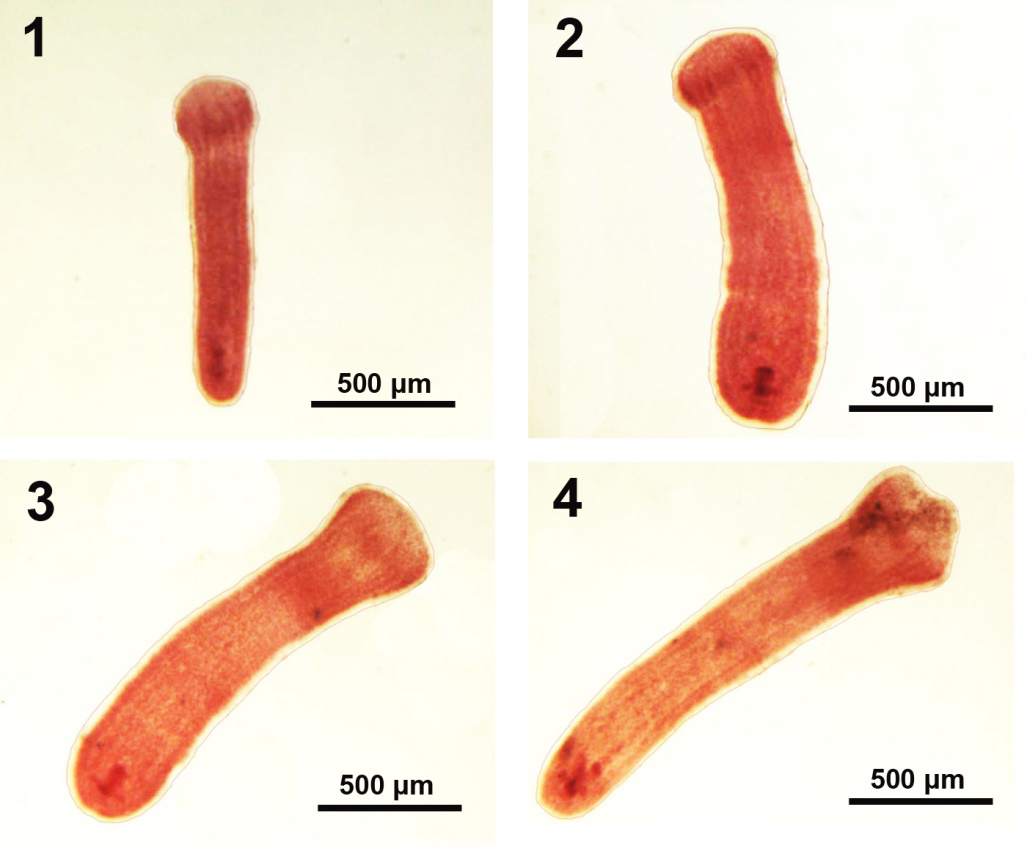
Figures 1-4: Microscope images of immatures of Biacetabulum macrocephalum from Catostomus commersoni in the Root River, Wisconsin. Stages of development of immatures. Note the developing shape of the scolex and the reproductive system and the early development of the longitudinal muscles even in the youngest form (Figure 1).
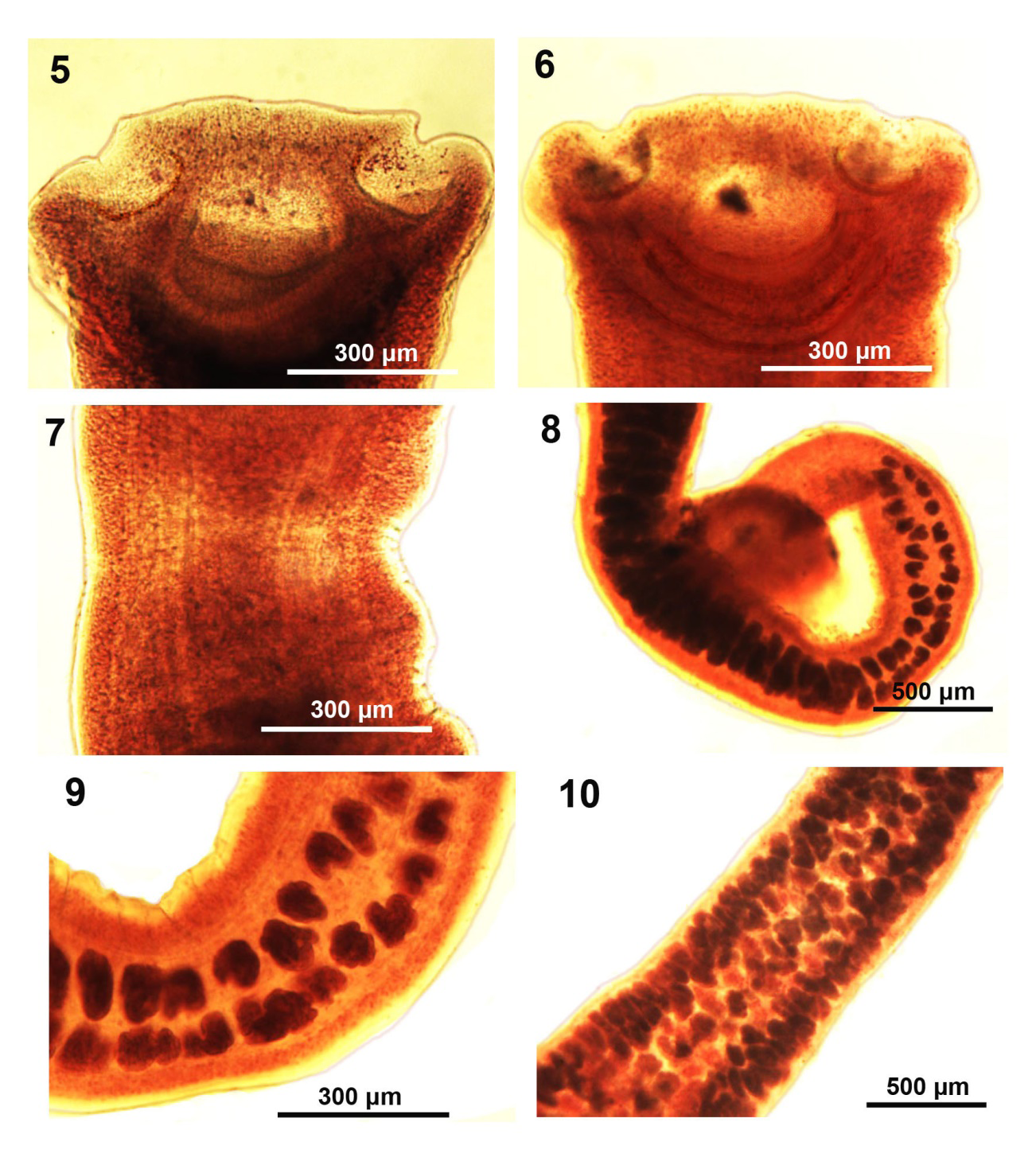
Figures 5-10: Microscope images of adult Biacetabulum macrocephalum from Catostomus commersoni in the Root River, Wisconsin. 5, 6. Scolexes of 2 worms showing the girth of the acetabulum (center) and substantial loculi. 7. The neck of one adult showing the marked longitudinal muscles. Note the anterior-most vitellaria at the bottom. 8. The pattern and distribution of anterior vitellaria in a twisted specimen preceding their more posterior position packed with testes (left side). 9. Detail of the anterior testes-free area in one specimen (in Figure 8) showing the essential lateral distribution of vitelline glands and their characteristic indented shape. 10. A more posterior portion of the same worm in Figures 8 & 9 showing the primary lateral organization of the pre-ovarian vitellaria and their occasional random intrusion into the medullary area.
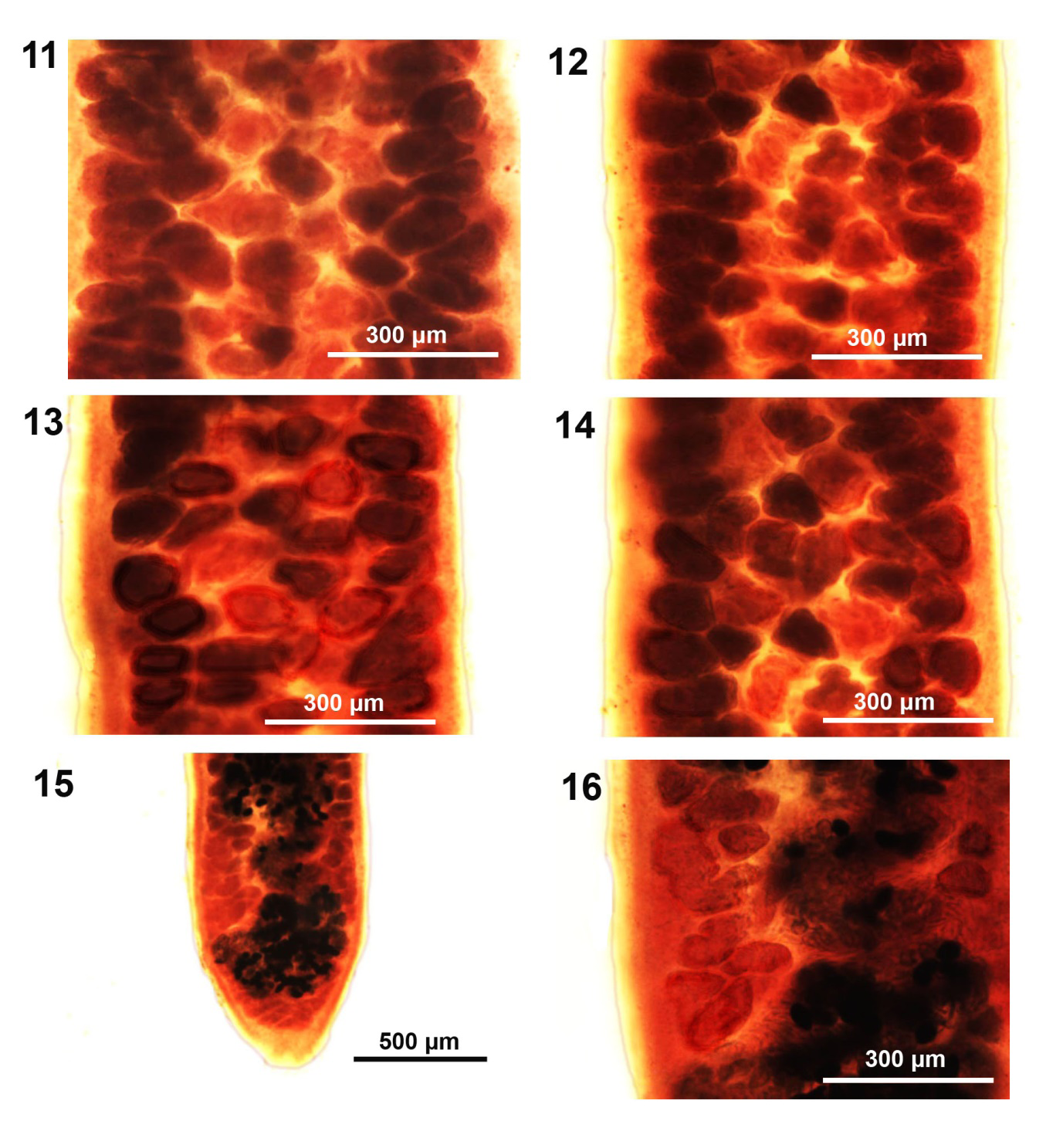
Figures 11-16: Microscope images of adult Biacetabulum macrocephalum from Catostomus commersoni in the Root River, Wisconsin. 11-14. Variations in the lateral arrangement of the pre-ovarian vitellaria and their random distribution in the medullary region overlapping the testes. Note the extremely variable irregular shape of testes staining red. 15. The posterior portion of a specimen showing one clear lobular ovarian arm and the anterior extension of the uterine coils (marked by the blackened eggs) beyond the ovary. Note also the large number of post-ovarian vitellaria. 16. A greater magnification of the clear ovarian arm and some uterine coils with eggs shown in Figure 15.
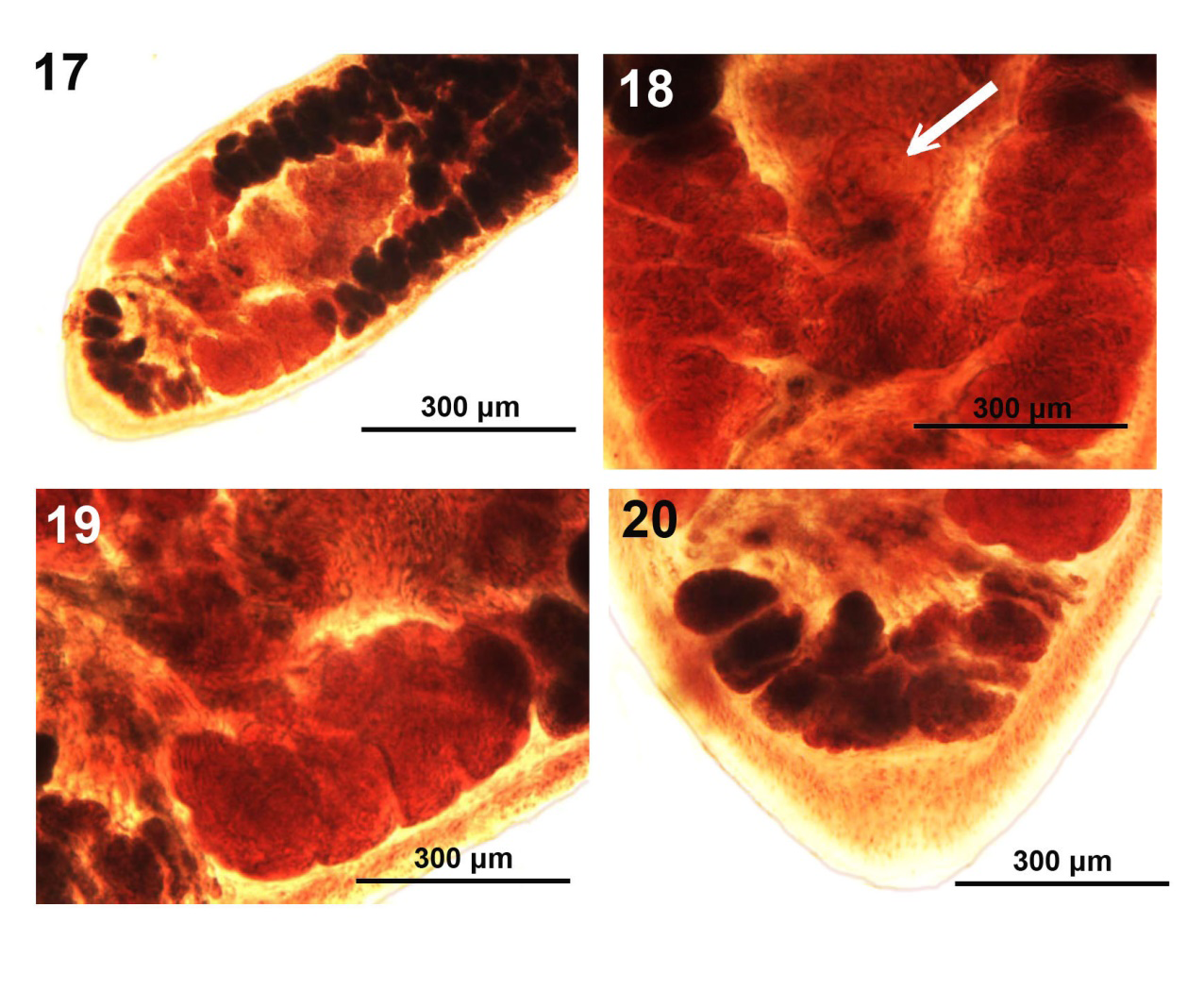
Figures 17-20: Microscope images of the reproductive system of one adult Biacetabulum macrocephalum from Catostomus commersoni in the Root River, Wisconsin. 17. A general view of the ovarian arms and commissure, uterus, posterior extension of the pre-ovarian vitellaria, and post-ovarian vitellaria. Note the thickness of ovarian arms, the terminal branching of the commissure, the posterior extension of the pre-ovarian vitelllaria to the ovarian arms and the many post-ovarian vitellaria. 18. A greater magnification of the lobulated ovary. Note the cirrus sac (arrow). 19. A greater magnification of one arm of the ovary being touched by pre- and post-ovarian vitellaria. 20. The posterior end of the same specimen detailing the post-ovarian vitellaria and the cuticular and cortex layers.
Taxonomic Summary
Type and current host: White sucker, Catostomus commersoni (Lacépède)
Other hosts: Largemouth buffalofish, Ictiobus cyprinellus (Valenciennes) and walley, Stizostedion vitreum (Mitchill) [19].
Type locality: The Horsetooth Reservoir and the Cache la Poudre River connected via the South Platte River (41°6′50″N,100°40′33″W) in Larimer County, Colorado [14].
Other localities: Root River and Tichigan Lake (Racine & Kenosha counties), SE Wisconsin [11, 12, 13]; The Iowa River (Franklin and Hardin counties), Iowa [16, 17]; Susquehanna River (Wyoming and Luzerne County), Pennsylvania [18]; the James and Sheyenne rivers & Lake Ashtabula, North Dakota [19].
Deposited specimens from our Wisconsin material: US
National Museum Helminthological collections no. 78659
Remarks
The original description of B. macrocephalum from C. commersoni in Colorado [14] and the subsequent account of adults from the same host in Iowa especially figures 9 & 10 [16] were representative and well documented but, however, variable from ours from Wisconsin. Table 1 provides a morphometric comparison between the Wisconsin and Colorado populations with major differences being bolded. These are the only two populations of B. macrocephalum with sufficient data available for comparisons. The Iowa River specimens [16, 17]; Susquehanna River, Pennsylvania specimens [18, 19]; the North Dakota specimens were not measured except for Calentine’s [16] reference to 7.0 (5.5- 9.0) mm long gravid specimens.
Our Wisconsin specimens were longer than those described from Colorado [14] and Iowa [16] and the description of the scolexes was at variance (Table 1), they were not really II-shaped as noted in the original description. McCrae [14] described the vitellaria as being as large as testes and present throughout the testicular field (page 807). In our Wisconsin specimens, the vitellaria were actually slightly smaller than testes and they were essentially in 2 lateral rows with occasional random presence in the testicular field beyond which they extended farther anteriorly (Figures 8,9) and posteriorly (Figure 17). The external seminal vesicle in one of our Wisconsin specimens reached 125 µ compared to 85-110 µ in the Colorado material. McCrae [14] reported 1-3 post-ovarian vitellaria but his line drawings (Figures 2 & 10, page 808) showed 10-12 clustered vitellaria and Fig. 10 (page 244) of Calentine [16] showed 22 compact vitellaria. The ovarian arms were markedly larger and more robust in the Wisconsin specimens compared to those from Colorado (Table 1).
Discussion
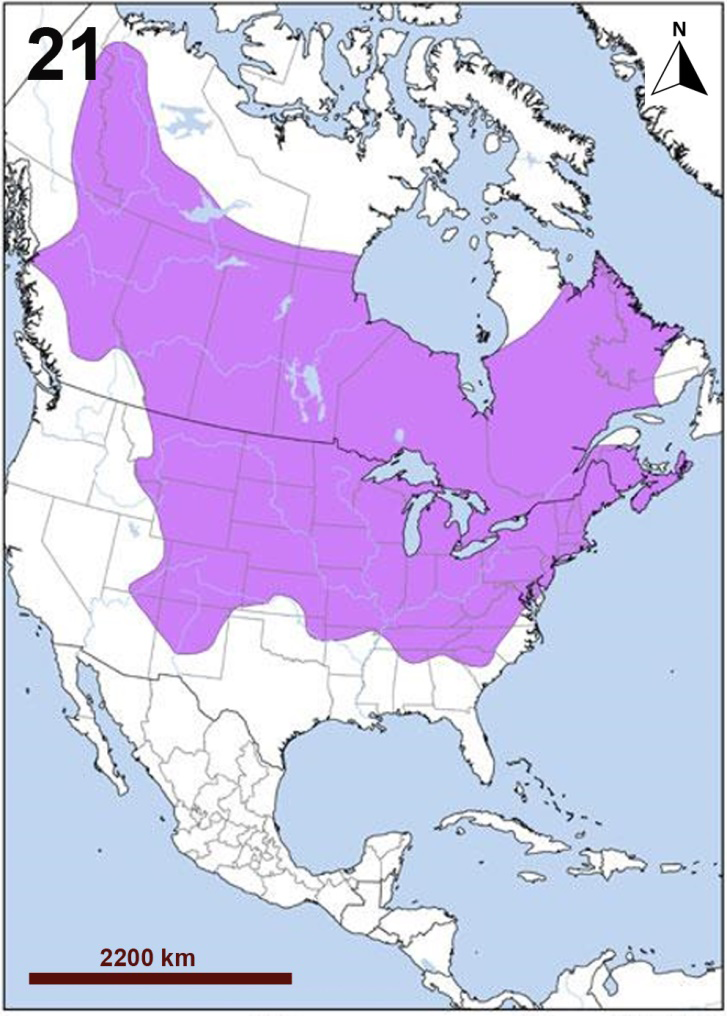
Variations in the morphometric characteristics presented in Table 1 appear to fall within the natural range of intraspecific variability, allowing for some occasional mis- interpretations such as the distribution of the pre-ovarian vitellaria and the number of post-ovarian vitellaria. A better understanding of the host and geographical distribution is needed. Our results (Table 1) were compared with those presented in the original description in Colorado. The primary host of B. macrocephalum appears to be C. commersoni. The only exceptions are the largemouth buffalofish, I. cyprinellus and walley, S. vitreum from North Dakota [19]. These two host species must be considered accidental hosts; only one of each of 10 and 61 fishes, respectively, were infected. Some of the collecting sites from C. commersoni were in waters associated with the Mississippi River Basin such as Tichigan Lake, Wisconsin, the James River, North Dakota, and the Iowa River, Iowa which may provide a common source of infection. However, other sites in Wisconsin (Root River) [11, 12, 13], Colorado (Horsetooth Reservoir and Cache la Poudre), Pennsylvania (Susquehanna River) [18], and North Dakota (Sheyenne River & Lake Ashtabula) [19] are not connected with the Mississippi River and are hard to explain the presence of B. macrocephalum in them. The primary host, C. commersoni, is a ubiquitous temperate Nearctic fish that occupies a wide range of habitats including streams, rivers, and lakes from east of the Makenzie River (Northwest Territories) to Labrador in Canada, and into 40 states in the Eastern and Midwestern United States extending south to Georgia and west to New Mexico (Figures21). It has also been introduced into the Colorado River drainage basin [23, 24].
Conclusions
Morphology
We conclude our treatment of B. macrocephalus from Wisconsin fishes with our acknowledgement of the morphological variability in 6 other Arizona and Wisconsin caryophyllid cestodes originally collected and reported by Amin. Other species in this series include Isoglaridacris hexacotyle (Linton, 1897) Mackiewicz, 1968 from Arizona, and Biacetabulum biloculoides Mackiewicz & McCrae, 1965, Glaridacris catostomi Cooper, 1920, Pseudoglaridacris confusus (Hunter, 1929) Oros, Uhrovič, Scholz, 2018, Pseudoglaridacris laruei (Lamont, 1921) Oros, Uhrovič, Scholz, 2018, and Isiglaridacris agminis Williams and Rogers, 1972 from Wisconsin. In all cases, we have reported the expanded range of qualitative variations in the morphology of the scolex and reproductive structures that varied with host species and/or developmental stages. Scolexes in developing juveniles assume immature and often anteriorly tapering morphology usually lacking defined terminal disc or loculi. The degree of variations in the size, shape or number of testes by host species or geographical locations varied in many species. In addition, we included among the pivotal features of taxonomic importance the distance between the male and female gonopores, the development of the testes compared to vitellaria, the lateral vs. the medullary fields of distribution of vitellaria, size of cirrus sac and eggs and whether the latter are operculated, the degree of development of inner vs. outer longitudinal muscles, the number of post- ovarian vitellaria, the distance between anterior-most vitellaria and scolex tip, the shape and makeup of the ovary (whether lobate or granular), and the anterior and posterior extensions of uterine coils. Some of these characters are of taxonomic importance at the generic level such as the shape and makeup of ovarian tissue, the organization of the posterior ovarian arms, the distance between the male and female gonopores and whether they are in a common genital atrium. Measurements of some of these structures were not reported in many original descriptions and other descriptive accounts but are all included and tabulated for our reported Arizona and Wisconsin specimens.
Distribution
The geographic distribution of this uncommon cestode, B. macrocephalum, appears to be within localities in states where its primary host, C. commersoni, is abound. A number of such localities such Tichigan Lake in Wisconsin, the Iowa River in Iowa, and the James River in North Dakota are associated with the Mississippi River drainage system. However, other sites in Colorado, Wisconsin (the Root River), Pennsylvania (Susquehanna River) and North Dakota
(Sheyenne River & Lake Ashtabula) are not connected to the Mississippi River and lack that potential common source of infection. It is easier to understand the presence of B. macrocephalam in Colorado where the species was described with the knowledge that C. commersoni was introduced into Colorado by bait bucket release of unspecified source and trout stock contamination in the last 2 centuries. Woodling [25] reported the first introduction in the Colorado River took place in 1860s and 1870s. Holden and Stalnaker [26] reported later introductions in 1926 and 1938. They [26] also assumed that a population in the Yampa River was from a separate introduction. Fuller [27] listed 17, mostly western, states with nonindigenous occurrences of C. commersoni. In Colorado, nonindigenous introductions were observed in the following water bodies: Alamosa Trinchera; Animas; Blue; Colorado Headwaters; Colorado Headwaters Plateau; Conejos; Gunnison; Little Snake; Lower Green- Diamond; Lower Gunnison; Lower Yampa; McElmo; North Fork Gunnison; Piedra; Rio Chama; Rio Grande Headwaters; Roaring Fork; Saguache; San Luis; San Miguel; Tomichi; Uncompahgre; Upper Colorado; Upper Colorado-Dolores; Upper Dolores; Upper Green-Flaming Gorge Reservoir; Upper Gunnison; Upper San Juan; Upper Yampa [27]. We have no accounting about corresponding nonindigenous introductions of C. commersoni in Wisconsin, Pennsylvania, or North Dakota. The year-round range of C. commersoni is represented in the map (Figure 21) adapted from Lee, at al. [28] and Scott and crossman [29].
Acknowledgments
This project was supported by an Institutional Grant from the Parasitology Center, Inc. (PCI), Scottsdale, Arizona.
Declarations
- Compliance with Ethical Standards
- Conflict of Interest: The authors declare no conflicts of interest or competing interests.
- Ethical Approval: The authors declare that they have observed all applicable ethical standards.
- Availability of Data: All presented and related data are available by contacting the senior author.
References
-
Mackiewicz JS (1972) Caryophyllidea (Cestoidea): a review. Exper Parasitol 31(3): 417-512.
-
Mackiewicz JS (1982) Caryophyllidea (Cestoidea): Perspect Parasitol 84(2): 397-417.
-
Mackiewicz JS (1994) Order Caryophyllidea van Beneden in Carus, 1863. In: Khalil LF, Jones A, et al. (Eds.), Keys to the cestode parasites of vertebrates. CAB Intern Wallingford UK pp: 21-43.
-
Ash A, Scholz T, Oros M, Kar PK (2011a) Tapeworms (Cestoda: Caryophyllidea), parasites of _Clarias batrachus_ (Pisces: Siluriformes) in the Indomalayan region. J Parasitol 97(3): 435-459.
-
Ash A, Scholz T, Oros M, Levron C, Kar PK (2011b) Cestodes (Caryophyllidea) of the stinging catfish _Heteropneustes fossilis_ (Siluriformes: Heteropneustidae) from Asia. J Parasitol 97(5): 899-907.
-
Scholz T, Kuchta R, Oros M (2021) Tapeworms as pathogens of fish: A review. J Fish Dis 44(12): 1-18
-
Scholz T, Kuchta R (2017) A digest of fish tapeworms. Vie et milieu - Life and environment 67(2): 43-58.
-
Chubb JC (1982) Seasonal occurrence of helminths in freshwater fishes Part IV. Adult Cestoda, Nematoda and Acanthocephala. Adv parasitol 20: 1-292.
-
Amin OM (1968) Helminth fauna of Suckers (Catostomidae) of the Gila River System, Arizona. PhD Thes Ariz St Univ 202 pp (No 68-1644) Univ Microfilms. Ann Arbor, Michigan; Dissert Abstr 28: 3521.
-
Amin OM (1969) Helminth fauna of suckers (Catostomidae) of the Gila River System, Arizona. II. Five parasites from _Catostomus_ spp. Am Midland Nat 82: 429- 443.
-
Amin OM (1974) Intestinal helminths of the white sucker, _Catostomus commersoni_ (Lacépède), in SE Wisconsin. Proc Helminthol Soc Wash 41(1): 81-88.
-
Amin OM (1977) Distribution of fish parasites from two southeast Wisconsin streams. Trans Wis Acad Sci, Arts, Lett 65: 225-230.
-
Amin OM (1986) Caryophyllaiedae (Cestoda) from lake fishes in Wisconsin with a description of _Isoglaridacris multivitellaria_ sp. n. from _Erimyzon sucetta_ (Catostomidae). Pro Helminthol Soc Wash 53(1): 48-58.
-
McCrae RC (1962) _Biacetabulum macrocephalum_ sp. n. (Cestoda: Caryophyllaeidae) from the white sucker _Catostomus_ _commersoni_ (Lacépède) in northern Colorado. J Parasitol 48: 807-811.
-
Buckwald BZ, Ulmer MJ (1964) Effects of temperature stress on the development of procercoids of _Biacetabulum macrocephalum_ McCrae, 1962 (Cestoda Caryophyllaeidae). J Parasitol 50(2): 45.
-
Calentine RL (1964) The biology and taxonomy of _Biacetabulum_ (Cestoda: Caryophyllaeidae). J Parasitol 51(2): 243-248.
-
Calentine RL, Fredrickson LH (1965) Periodicity of Caryophllyaeid cestodes in the white sucker, _Catostomus_ _commersoni_ (Lacépède). Iowa State J Sci 39: 243-250.
-
Deutsch WG (1977) Fish parasites from the Susquehanna River in Pennsylvania, with new host records. Proc Penn Acad Sci 51(2): 122-124.
-
Forstie MD, Hollowy HL (1984) Parasites of fish from the James and Sheyenne rivers, Jamestown Reservoir Complex, and Lake Ashtabula in North Dakota. Prairie Nat 16: 11-20.
-
Pinter N, Heine RA (2011) Hydrologic History of the Lower Missouri River. Geology Department. Carbondale, IL: South. Illinois University.
-
Stone C (2013) Missouri River. The Natural Source. Northern State Univ.
-
Knofczynski J (2010) Missouri River Mainstem System 2010–2011 Draft Annual Operating Plan (PDF) (Report). U.S. Army Corps of Engin.
-
Page L, Burr B (2011) Peterson field guide to freshwater fishes of North America north of Mexico. Boston: Houghton Mifflin Harcourt, pp: 663.
-
Zimmerman (2012) Stream fishes of Ohio: Ohio Dept Nat Res pp: 80.
-
Woodling J (1985) Colorado’s little fish: a guide to the minnows and other lesser known fishes in the state of Colorado. Colorado Div Wildlife, Denver, CO. pp: 77.
-
Holden PB, Stalnaker CB (1975) Distribution and abundance of mainstream fishes of the middle and upper Colorado River basins, 1967-1973. Trans Amer Fisher Soc 104(2): 217-231.
-
Fuller P (2023) _Catostomus commersonii_ (Lacépède, 1803): U.S. Geological Survey, Nonindigenous Aquatic Species Database, Gainesville, FL.
-
Lee DS, Gilbert CR, Hocutt CH, Jenkins RE, McAllister DE, et al. (1980) Atlas of North American freshwater fishes. North Carolina St Mus Nat Hist, pp: 867.
-
Scott WB, Crossman EJ (1973) Rainbow trout, Kamloops trout, Steelhead trout _Salmo gairdneri_ Richardson. pp. 184-191. In: Freshwater fishes of Canada. Ottawa, Canada: Fisher Res Board Canada, Bulletin 184, pp: 966.
- California Red-Legged Frog and Non-Listed Amphibians Response to Non-Native Fish Removal
- Industrial Standardization of the Bio-OS: Algorithmic Codification of Resilience Engineering Guidelines and Version V8 Architecture
- Climate Variability and the Sustainability of Snail Farming in Nigeria: Past Trends, Present Challenges and Potential Outlook
- The Evaluation of the Surveillance System of Anthrax in Gilgit-Baltistan, Pakistan, 2018
- Natural Decline to Extinction of A New Zealand Rabbit Population
- Mitochondrial Bio-Logistics: Steering Co-Enzyme Q10 and Lycopene Synergies within the Science 4.0 Bio-OS Framework