
Screening the Health Status of Postpartum Anoestrus Cows of Biratnagar of Nepal
High yielding dairy cattle are often prone to postpartum anestrus that retards both production and reproductive performances. To investigate the postpartum anestrus, 21 nondescript dairy cows raised in and around Biratnagar have been included in this study. The basic information regarding the breeding history, nutritional status, milk yield, suckling and frequency of milking were obtained on request from the owners. Fecal samples were collected directly from the rectum of all cows to diagnose the parasitic infestations. Rectal palpation was performed to explore the status of the ovary and other reproductive tracts. Blood samples were collected through jugular vein puncture in vials with and without anticoagulant for hematological and serobiochemical analysis. Rectal palpation revealed inactive ovaries in most of the dairy cows. The fecal and blood samples had been forwarded to Regional Veterinary Diagnostic Laboratory, Biratnagar for further analysis. Fecal examination resulted in severe parasitic infestations in 90.47% of dairy cows. The predominantly observed parasites were Paramphistomum (38%) followed by Paramphistomum + Nematodes (19%), Nematodes (9%), Liver fluke + Nematodes (9%), Liver fluke (5%), Liver fluke + Paramphistomum (5%) and Nematodes + Moniezia expansa (5%). Among all, 47.61%, 42.85%, 28.57%, 23.80% and 4.76% of cows revealed lower values for total protein (TP), hemoglobin (Hb), calcium (Ca), packed cell volume (PCV), glucose (Glc) and inorganic phosphorus (P), respectively. However, 23.80% and 9.52% of cows showed higher values of inorganic P and Glc. It was concluded that lower values of TP, Hb, Ca, PCV, Glc and inorganic P rightly held responsible for the condition of postpartum anoestrus in cows. An improved managemental practices and nutritional status of cows is suggested for the management of postpartum anoestrus in cows.
Introduction
Increasing demand of livestock production can be achieved only if the animals have a long useful life with maximum production span and minimum offspring losses. More offspring per animal would allow judicious selection for replacement stock without which it might be difficult to improve the genetic merit of the herd from generation to generation. Consequently, good fertility management of farm animals provides valuable protein viz. milk, meat and other by-products become inevitable. Cows should calve yearly to attribute optimum production and economy in the life period and this ideology can only be achieved if the cows remain empty for not more than 90 days of post calving. Postpartum anoestrus refers to a condition where dairy cows have not been observed and returned in estrus for several weeks after calving [1]. Every effort therefore should be implemented to resume the cows into estrus after 60 days and must conceive within 90 days after calving. Returns to normal cyclical ovarian activity, involution of uterus, rejuvenation of endometrium, elimination of bacterial contaminants are important changes that occur during this period. Postpartum anoestrum, a multifactorial syndrome, evinced after dystocia, metritis, retention of placenta, postpartum prolapse, mastitis as well as predisposed due to parity, breed, environment, nutritional status, managemental practices and hormonal interaction. All these factors determine the possibility of dairy cows to become pregnant during the breeding season. The reproduction is the main factor that positively correlates with the postpartum anoestrus and thereby influences the breeding efficiency of dairy cattle [2]. There is increased incidence of anestrus in high-yielding dairy herds [3, 4, 5, 6, 7]. Malnutrition also influences the reproductive performances thereby prolonging the post-partum anoestrus periods in cows. The changes in hormonal and biochemical milieu are also responsible for anoestrus. The biochemical profile depicts the nutritional status of the animal and furthermore helps in diagnosis and management of the postpartum anoestrus in cows. Therefore, the present study was performed to assess the status of parasitic infestations, relevant hematological and serobiochemical parameters in postpartum dairy cows.
Materials and Methods
Dairy Cows
A total of 21-nondescript postpartum anoestrus dairy cows of apparently healthy conditions from Biratnagar and its vicinity were included purposively in this study A well-structured questionnaire containing breeding history, nutritional status, milk production, suckling and frequency of milking were filled after direct consultations with owners. Rectal palpations were performed in all selected cows to know the status of their reproductive organs before sample collections.
Sample Collection
Feces were collected directly from the rectum of the cows and placed in the zip plastic bag. Thereafter, it was coded and brought soon to Regional Veterinary Diagnostic Laboratory (RVDL), Biratnagar for investigation of parasitic infestations. After proper restraining of the cows, blood samples were collected aseptically through jugular vein puncture in vials with EDTA (5 ml) for hematological (Hb and PCV) and without anticoagulant (5 ml) for serobiochemical evaluation (Ca, P, TP, ALB, Mg and Glc).
Processing of the Sample
All fecal samples had been examined by both sedimentation and floatation methods to estimate the parasitic infestations and their load. The blood in vials with EDTA was analyzed quickly for Hb and PCV. The whole blood without anticoagulant was kept overnight at room temperature for serum separation. The serum, extracted after clot retraction using pasteur pipette, was transferred into the sterile serum vials. However, serum had been separated after centrifugation at 3000 rpm for 15 minutes from the blood samples that had haemolysed. The serum vials were labeled properly and stored in the deep freeze until estimation of Ca, inorganic P, TP, ALB, Glc and Mg following the method described in their respective kits using spectrophotometer.
Statistical Analysis
Data are presented as Mean ± S. D. and percentage as appropriately. Descriptive analyses were performed utilizing the IBM-SPSS versus 23 (Armonk, NY: IBM Corp).
Results and Discussion
Postpartum anestrus is one of the most dynamic periods in the reproductive life of the dairy cow. It is of natural occurrence, and is characterized by the absence of estrus [1]. The postpartum period plays a pivotal role in cattle reproduction. The duration of postpartum anestrus has an important influence on reproductive performance [2]. The prevalence of postpartum anoestrus in dairy cattle is herd- specific and varies widely from one herd to another. The exact prevalence rates of postpartum anoestrus at the end of the elective waiting period i.e., 60-80 days after calving is in the range of 10-30% [8, 9, 10, 11] whereas it is reported as higher as 59% in individual herd [8, 10, 12]. In the present study, all experimental cows were in a state of anoestrus for more than 90 days after calving. Upon rectal examination, most of them revealed inactive ovaries with normal genitalia. The rectal examination revealed the inactive ovaries with normal genitalia in most of the cows which would be considered as the cause of anoestrus. Kumar and Sharma [13] investigated 47 heifers and 86 cows and reported 36.16% heifers and 43% cows had inactive ovaries. The incidence of anoestrus can occur from moderate to high to correlate infertility of the dairy animals and thereby the economic loss to the farmer [14]. The interval from calving to first estrus was longer in high milk producing cows or being milked four times a day, in poor or low level of nutritive intake as well as in the older pluriparous cow. Furthermore, a longer postpartum interval to first estrus occurred in nursing cows, anemic cows and those fed with thyroprotein [15]. There is failure of displaying the overt signs of estrus by the animals after attaining puberty or 60–90 days postpartum [16]. The multifactorial causes of postpartum anoestrus could be broadly categorized into physiological, nutritional, managerial, environmental and pathological conditions in dairy cattle [17, 18, 19, 20, 21, 22, 23, 24, 25, 26]. All three classes of parasites i. e., Trematodes (Paramphistomum and Liver fluke), Nematodes and Cestodes (Moniezia expansa) or their mixed infestatons were observed in microscopic examination of faecal samples. As shown in Figure 1, 90.47% of dairy cows were infested severely with different internal parasites.
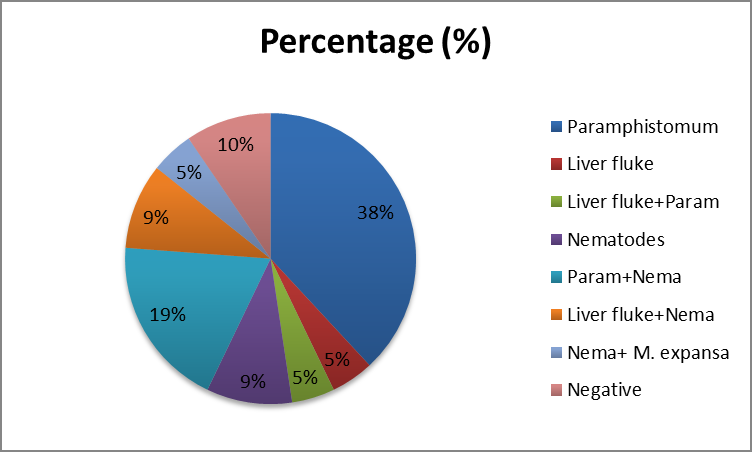
Of them, Paramphistomum infestations were the predominant followed by mixed infestations of Paramphistomum plus nematode, Liver fluke plus nematode, Nematode, Negative, Liver fluke and Nematode plus Moniezia expansa.
The values of hematological and serobiochemical parameters have been presented in Table 1. Blood analysis revealed the lower values for TP, Hb, Ca, PCV, Glc and inorganic P in 47.61%, 42.85%, 28.57%, 23.80 % and 4.76% of dairy cows, respectively. However, 23.80% and 9.52% of cows showed higher values of inorganic P and Glc. These values remained in normal range in few postpartum anoestrus cows.
| S.N. | Parameters | Unit | Mean ±S.D. | Normal Range |
|---|---|---|---|---|
| 1 | Hemoglobin (Hb) | gm% | 8.45±1.61 | Aug-15 |
| 2 | Packed Cell Volume (PCV) | % | 28.71±6.94 | 24-46 |
| 3 | Calcium (Ca) | mg/dl | 8.96±1.69 | 8-10.5 |
| 4 | Phosphorus (P) | mg/dl | 6.25±1.51 | 04-Jul |
| 5 | Total Protein (TP) | gm% | 5.95±0.95 | 5.7-8.1 |
| 6 | Albumin (ALB) | gm% | 2.72±0.43 | 2.1-3.6 |
| 7 | Magnesium (Mg) | mg/dl | 3.06±0.22 | 1.2-3.5 |
| 8 | Glucose (Glc) | mg/dl | 45.18±12.25 | 35-55 |
Table 1: Haematological and serobiochemical parameters in postpartum anoestrus cows.
During postpartum, cows present a period of negative energy balance that can last up to 140 days [27]. The lag phase between the higher milk production and the gradual increase in the energy consumption capacity trigger the postpartum anoestrus in dairy cows [28]. The low level of Ca could affect fertility and ovarian pituitary axis. The lower P level results in reproductive failures and ovarian dysfunction [29]. The increased partitioning of energy to milk production can result in anestrus by delaying resumption of follicular activity. However, factors such as limited energy intake, lower body reserves, and postpartum diseases can also delay the return to cyclicity. A trouble-free calving favors prompt resumption of postpartum ovarian activity [7]. The lower blood Glc level in non-fertile animals indicates the sub normal energy status and cessation of estrus in cows and heifers exposed to negative energy balance and pituitary function.
It is interesting to note that half of the dairy cows exhibited the lower TP level. A very earlier study of Kesler, et al. [30] described the TP level as an indicator for better fertility in postpartum anoestrus cows. The results of the present study revealed deficiencies in various biochemical constituents which are associated with postpartum anoestrus conditions of dairy cows. Nutritional supplementation and hormonal therapy to shorten or to break postpartum anestrus are directed towards reestablishing the hormonal and metabolic balance of the cow [28].
Conclusions
Most postpartum anoestrus cows revealed inactive ovaries with normal genitalia and parasitic infestations followed by lower values of several hematological and serobiochemical parameters. Thereby cows should be dewormed routinely and must be supplemented with mineral mixtures to shorten their postpartum anoestrus period. The dairy cows should be flushed during the last trimester and fed with higher nutrients to the parturated cows in order to have a few animals suffering from this condition [29, 30].
Conflict of Interest
The author declares no any Conflict of Interest
Author Contributions
MKS solely involved with conception, design, draft and revision of the manuscript. The author read and approved the final manuscript.
Funding
No external funds.
Acknowledgments
The author wishes to thank Dr. Ashok Singh for his skillful technical assistance.
References
-
Ambrose DJ (2021) Postpartum Anestrus and Its Management in Dairy Cattle. In: Hopper RM (Ed.), Bovine Reproduction pp: 408-430.
-
Lucy MC (2007) Fertility in high-producing dairy cows: reasons for decline and corrective strategies for sustainable improvement. Soc Reprod Fertil Suppl 64: 237-254.
-
Berger PJ, Shanks RD, Freeman AE, Laben RC (1981) Genetic Aspects of Milk Yield and Reproductive Performance. J Dairy Sci 64(1): 114-122.
-
Etherington WG, Christie KA, Walton JS, Leslie KE, Wickstrom S, et al. (1991) Progesterone profiles in postpartum Holstein dairy cows as an aid in the study of retained fetal membranes, pyometra and anestrus. Theriogenology 35(4): 731-746.
-
Opsomer G, Coryn M, Deluyker H, De Kruif A (1998) An Analysis of Ovarian Dysfunction in High Yielding Dairy Cows after Calving Based on Progesterone Profiles. Reprod Domest Anim 33(3-4): 193-204.
-
Opsomer G, de Kruif A (1999) Postpartum anestrus in dairy cattle- a review. Tierarztl Prax Ausg G Grosstiere Nutztiere 27(1): 30-35.
-
Opsomer G, Grohn YT, Hertl J, Coryn M, Deluyker H, et al. (2000) Risk factors for postpartum ovarian dysfunction in high producing dairy cows in Belgium: A field study. Theriogenology 53(4): 841-857.
-
Rajala Schultz PJ, Gröhn YT (1999) Culling of dairy cows. Part II. Effects of diseases and reproductive performance on culling in Finnish Ayrshire cows. Prev Vet Med 41(4): 279-294.
-
Francos G, Mayer E (1988) Analysis of fertility indices of cows with extended postpartum anestrus and other reproductive disorders compared to normal cows. Theriogenology 29(2): 399-412.
-
Darwash AO, Lamming GE, Woolliams JA (1997) The phenotypic association between the interval to post- partum ovulation and traditional measures of fertility in dairy cattle. Anim Sci 65(1): 9-16.
-
Stevenson JS, Pursley JR, Garverick HA, Fricke PM, Kesler DJ, et al. (2006) Treatment of cycling and noncycling lactating dairy cows with progesterone during Ovsynch. J Dairy Sci 89(7): 2567-2578.
-
Kerslake JI, Amer PR, O Neill PL, Wong SL, Roche JR, et al. (2018) Economic costs of recorded reasons for cow mortality and culling in a pasture-based dairy industry. J Dairy Sci 101(2): 1795-1803.
-
Kumar S, Sharma MG (1991) Level of hemoglobin and certain serum biochemical constituents in rural cows during fertile and non-fertile estrus. Indian Vet J 68(4): 361-354.
-
King GJ, Macleod GK (1984) Reproductive function in beef cows calving in the spring or fall. Anim Reprod Sci 6(4): 255-266.
-
Wagner WC, Oxenreider SL (1971) Endocrine physiology following parturition. J Anim Sci 32(S1): 525-532.
-
Kumar PR, Singh SK, Kharche SD, Govindaraju CS, Behera BK, et al. (2014) Anestrus in Cattle and Buffalo: Indian Perspective. Adv Anim Vet Sci 2(3): 124-138.
-
Short RE, Bellows RA, Staigmiller RB, Berardinelli JG, Custer EE (1990) Physiological mechanisms controlling anestrus and infertility in postpartum beef cattle. J Anim Sci 68(3): 799-816.
-
Mwaanga ES, Janowski T (2000) Anoestrus in dairy cows: Causes, prevalence and clinical forms. Reproduction in Domestic Animals 35(5): 193-200.
-
Crowe MA, Diskin MG, Williams EJ (2014) Parturition to resumption of ovarian cyclicity: Comparative aspects of beef and dairy cows Animal 8(S1): 40-53.
-
Peter AT, Vos PLAM, Ambrose DJ (2009) Postpartum anestrus in dairy cattle. Theriogenology 71(9): 1333- 1342.
-
Ginther OJ, Kot K, Kulick LJ, Martin S, Wiltbank MC (1996) Relationships between FSH and ovarian follicular waves during the last six months of pregnancy in cattle. J Reprod Fertil 108(2): 271-279.
-
Savio JD, Boland MP, Hynes N, Roche JF (1990) Resumption of follicular activity in the early post-partum period of dairy cows. J Reprod Fertil 88(2): 569-579.
-
Beam SW, Butler WR (1999) Effects of energy balance on follicular development and first ovulation in postpartum dairy cows. J Reprod Fertil 54: 411-424.
-
Wiltbank MC, Gumen A, Sartori R (2002) Physiological classification of anovulatory conditions in cattle. Theriogenology 57(1): 21-52.
-
Markusfeld O (1987) Inactive ovaries in high-yielding dairy cows before service: aetiology and effect on conception. Vet Rec 121(7): 149-153.
-
McDougall S, Burke CR, Macmillan KL, Williamson NB (1995) Patterns of follicular development during periods of anovulation in pasture-fed dairy cows after calving. Res Vet Sci 58(3): 212-216.
-
Beever D, Cammell SB, Sutton JD, Rowe N, Perrott GE (1998) Energy metabolism in high yielding cows. Proc Br Soc Anim Sci 86(9): 2904-2913.
-
Gonzalez Maldonado J, Perez Hernandez P, Salazar Ortiz J, Cortez Romero C, Gallegos Sánchez J, et al. (2021) Reproductive activity of dairy cattle in the postpartum anestrus period. Agroproductividad 3.
-
Morrow DA, Roberts SJ, McEntee K (1968) Latent Effects of Pregnancy on Postpartum Estrous Cycle Length in Dairy Cattle. J Anim Sci 27(5): 1404-1407.
-
Kesler DJ, Faulkner DB, Shirley RB, Dyson TS, Ireland FA, et al. (1996) Effect of Interval from Melengestrol Acetate to Prostaglandin F2α on Timed and Synchronized Pregnancy Rates of Beef Heifers and Cows. J Anim Sci 74(12): 2885-2890.
- California Red-Legged Frog and Non-Listed Amphibians Response to Non-Native Fish Removal
- Industrial Standardization of the Bio-OS: Algorithmic Codification of Resilience Engineering Guidelines and Version V8 Architecture
- Climate Variability and the Sustainability of Snail Farming in Nigeria: Past Trends, Present Challenges and Potential Outlook
- The Evaluation of the Surveillance System of Anthrax in Gilgit-Baltistan, Pakistan, 2018
- Natural Decline to Extinction of A New Zealand Rabbit Population
- Mitochondrial Bio-Logistics: Steering Co-Enzyme Q10 and Lycopene Synergies within the Science 4.0 Bio-OS Framework