
A Social Bird Species Ending Solitary: Flocking and Breeding Aspects of Greater Rheas (Rhea americana) in the Brazilian Dry Forest Region
Populations of numerous bird species have been declining around the world due to factors such as habitat loss and hunting. This involves the reduction of flock size of social species in non-protected landscapes. The Greater Rhea (Rhea americana) historically occurred in flocks of up to 30 individuals in the Caatinga, the Brazilian dry forest region. The objective of this study was to examine the composition of flocks of the Greater Rhea in the Caatinga through citizen science data. Breeding aspects also were studied. Searches for photographic records were done in the WikiAves platform in April 2023. As some birds could be out of frame, the authors of photographs were consulted to confirm flock size. A total of 112 records of Greater Rheas, including eight with breeding evidence, were found and included in this study. Most of them have been obtained by citizens in central and eastern Caatinga. Among the 104 records with only adults, most (n = 77; 74%) showed a single adult, while 23 (22%) had a pair, and only three (3%) showed three adults; these percentages referred to 38%, 20% and 15% when considering only those records (n = 45) with flock size confirmed by authors of photographs. Only three records had 20-25 adults confirmed by authors. Breeding records comprised a nest with six eggs, a nest with an incubating adult, and six families with 1-2 adults and 1-8 young. Our results indicate that Greater Rheas currently found in non-protected landscapes in the Caatinga tend to occur solitary or in small groups. If this situation persists or get worse, Greater Rheas might become extinct in numerous Caatinga regions. We suggest that conservation programs reintroduce the subspecies R. americana americana in protected and non-protected landscapes throughout Caatinga regions where it originally occurred. Educational programs also are welcome to reduce or avoid their hunting in current and future areas of occurrence in this dry forest region.
Introduction
Populations of numerous bird species have been declining due to factors such as habitat loss and modification, hunting and capture [1, 2, 3, 4]. This involves the reduction of flock size of social species in contemporary landscapes of all continents [5, 6]. Among the South American social birds is the Greater Rhea Rhea americana (Linnaeus, 1758), a species considered Near Threatened, mainly due to hunting and expansion of agriculture [7]. This is a large and omnivorous species that relies on grasslands, savannas, and other open habitats [8, 9, 10].
Greater Rheas occur widely in South America, and are found mainly in open landscapes from Bolivia and Argentina to northeastern Brazil [10]. In Argentina and northeastern Brazil, its geographic distribution and populations have been substantially reduced [11, 12, 13]. Studies with radio-tracked birds showed that they use a range of native and modified habitats within agricultural landscapes in Argentina [14, 15, 16, 17]. In the Pantanal wetland, the density of Greater Rheas was higher in open fields than in open savanna, indicating that they can be favored by deforestation and the implementation of exotic pastures [18]. In the Brazilian Cerrado, Greater Rheas use a range of modified habitats in non-protected landscapes, and their occurrence is strongly associated with municipalities with low human abundance [19]. They breed between August and April, depending on the region [9, 10, 19]. Nests are round shallow depressions in the ground and usually have 20-30 eggs, eventually reaching up to 80, as polygyny is a remarkable characteristic of this species; incubation and chick-care are done exclusively by male [9, 10, 20].
In Brazil, Greater Rheas are commonly found in the Pantanal, the Cerrado and the Pampa ecoregions [18, 19, 20, 21, 22]. They were widespread and common in the Caatinga - the dry forest region of northeastern Brazil - by the mid twentieth century, when groups of 20-30 individuals were commonly found in its northern portions [8]. However, populations of the Caatinga have declined substantially since the 1960s, mainly due to hunting [23, 24, 25]. As result of this current scarcity in the Caatinga, Greater Rheas have been recorded only eventually and by a few recent avian inventories [26, 27, 28]. As a result, studies on aspects of its biology are lacking in this ecoregion.
We considered that the knowledge on the biology of Greater Rheas could be increased through the use of citizen science data, as recently occurred for its geographic distribution in Brazil and its breeding in the Cerrado [13, 19]. The objective of this study was to examine flocking and breeding aspects of Greater Rheas in the Caatinga through the use of data gathered by citizen scientists and deposited in the WikiAves platform. Results were discussed in relation to their flock size, reproduction and conservation in this dry forest and other South American ecoregions.
Material and Methods
Study Area
The Caatinga is the tropical dry forest region that lies in northeastern South America, where it covers near 800,000 km2 exclusively in Brazil [29, 30]. It covers about 11% of national territory, and occurs in nine geopolitical states, mostly in northeastern Brazil [31, 32]. The climate is tropical semiarid, with high temperatures and irregular rainfall; mean daily temperatures vary between 26°C and 28°C, and might reach 42°C; the mean annual rainfall is about 750 mm [33]. Landscapes are usually covered by xeric vegetation, including forests and shorter shrubby vegetation [33]. The aspect of its major matrix types - vegetation become whitish as trees and shrubs lose their leaves to avoid excessive water loss due transpiration -gave origin to the name “caatinga” (white forest) [33]. The fauna and flora are highly diverse, with remarkable numbers of endemic species [32]. Deforestation, fire and roads have led to modification of about 65% Caatinga’s landscapes [34]. The collection of vegetal material and the hunting of animals lead to transformations in habitat conditions; animals are often hunted for meat, and include armadillos, anteaters, and birds of the families Columbidae, Tinamidae, Cracidae and Anatidae, and the Greater Rhea [35].
Record Obtention
This study was based on photographic records of the Greater Rhea obtained by citizen scientists in the Caatinga, and deposited in WikiAves (https://www.wikiaves.com.br/). This citizen science project coordinates the largest platform of photographic and sound records regarding Brazilian birds. Currently, it counts with the contribution of approximately 45,300 observers and harbors about 4,590,000 records of more than 1,950 species. Searches for photographic records were done in mid-April 2023 through the “Mapa de registros” (Map of records) option; the name “Rhea americana” was typed in the “Espécie” (Species) field. Then, geopolitical states where Caatinga´s landscapes occur were individually selected. Each resulting municipality had its number of photographic records selected. The resulting records of the Greater Rhea were carefully examined to know the number of photographed adults and young, and to search for breeding evidence (nests, eggs, incubating adults, and young). When two or more photographs were gathered in the same municipality in a given day, only one of them was selected, randomly. This procedure was adopted to avoid repetition of a given situation (e.g., a pair of adults) in a certain municipality. As some birds of a photographed Greater Rhea flock could be out of frame, we contacted the authors of the photographs in mid-April to ask about the number of adults and young present in each flock. This was done through messages by using the “Comentários” (Comments) option, after making the login. When the informed number of birds was uncertain (e.g., “5 or 6”; or “20-25”), we considered the lowest value to avoid overestimation of flock sizes. Information on the location or not of a given municipality within the Caatinga ecoregion was obtained in IBGE (https://cidades.ibge.gov.
br/brasil/panorama). When a record occurred in an ecotonal municipality (e.g., Caatinga-Cerrado), it also was included in this study. Photographs included in this paper were gathered in the WikiAves platform, and published here (Figure 2) with permission by their authors.
Data Analysis
Records with evidence of breeding activities (here called “breeding records”) were classified into two periods, based on their data of obtention: (1) dry period and (2) rainy period. It was based on information available in INPE - the National Institute for Space Research (http://clima1.cptec.inpe.br/ monitoramentobrasil/pt). This information was obtained through the “Dados Diários” (Daily Data) option. For each breeding record, the “Precipitação” (Precipitation) option was selected, and the date, month and year of its obtention was added. After this, the precipitation that occurred in and around its municipality in the last 4-5 weeks was examined. With this, it was possible to classify each record as part of a rainy or dry period.
Photographic records were divided according to the flock size of Greater Rheas. This was made for two situations: (1) were considered the birds shown in the photographic records obtained by citizens; (2) we considered only records whose numbers of birds were informed by citizens through messages. This distinction was done to avoid underestimating the flock size, as some birds could be out of frame. Families with small young were not included in these comparisons, as young care is usually provided by a single adult [8].
Results
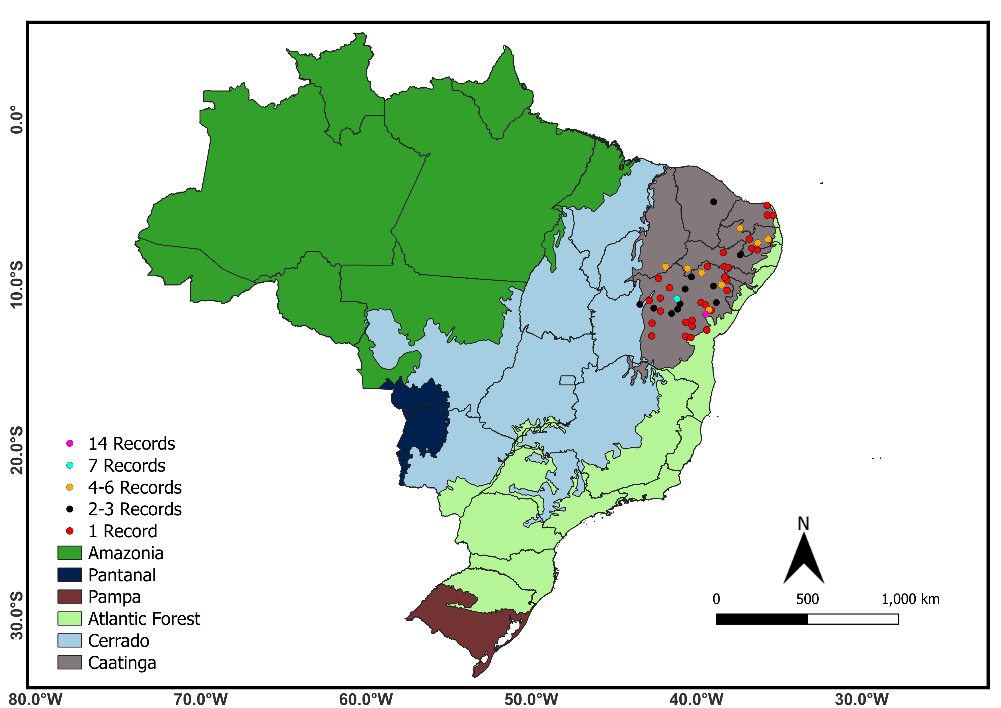
A total of 112 photographic records of the Greater Rhea have been produced by citizen scientists in the Caatinga, and deposited in the WikiAves platform (Appendix, Table 1). Most of them have occurred in central and eastern Caatinga, and were obtained in 52 municipalities of six states between 2007 and 2023 (Figure 1). Municipalities had 1-14 records, and those with more records were Riachão do Jacuípe and Ourolândia, with 14 and seven records, respectively. On the other hand, most municipalities (n = 33; 63%) had only one record (Appendix, Table 1).
| Date | Municipality | State | Evidence | Period | Code |
|---|---|---|---|---|---|
| 25-Dec-11 | Cafarnaum | BA | An incubating adult. | Rainy | WA531063 |
| 23-Dec-13 | Riachão do Jacuípe | BA | Seven young crossing a stream, behind an adult. | Rainy | WA1210380 |
| 12-Jan-14 | Petrolina | PE | A nest with six yellowish or whitish eggs. | Rainy | WA1213098* |
| 31-Jan-15 | Cabaceiras | PB | A young with an adult. | Dry | WA1599122 |
| 11-Feb-18 | Riachão do Jacuípe | BA | Eight young with two adults. | Rainy | WA2923702 |
| 21-Apr-19 | Riachão do Jacuípe | BA | Four young with an adult. | Rainy | WA3336180* |
| 03-Jul-19 | Sertânia | PE | Six juveniles and two adults. | Rainy | WA3793728 |
| 08-Apr-21 | Dom Inocêncio | PI | A young and an adult. | Rainy | WA4267287 |
The number of adult Greater Rheas shown in the photographic records ranged between 1 and 5 (Figure 2), excluding those records showing evidence of breeding activities (Figure 3). When considering the information brought by photographs, most records (n = 77; 74%) had a single adult, 23 records (22%) had a pair of adults, while a minor portion (4%) showed three or five adults. Of the
104 records involving only adults, 45 (43%) had the flock size confirmed by authors of the photographs (Appendix). Among them, 17 records (38%) had a single adult, while 9 records (20%) had a pair of adults. Seven (15%) records had only three adults, while records with more adults were even less common. Three (6.7%) records had 20-25 adults (Figure 3, Appendix).
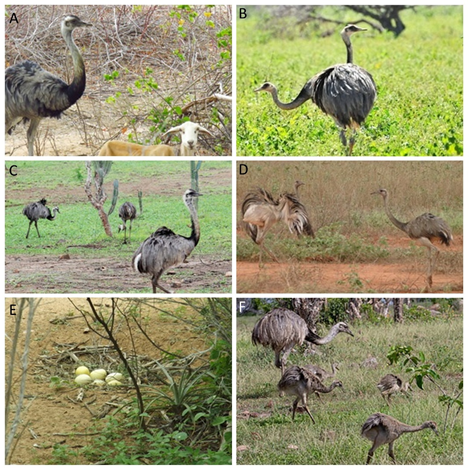
Figure 2: Photographic records of the Greater Rhea (Rhea americana) obtained by citizen scientists in the Caatinga, Brazil: (A) a solitary adult walking on a dirty road at Cabaceiras-PB; (B) a pair of adults in a patch of second growth caatinga at Canudos- BA; (C) three adults on a cultivated field at Riachão do Jacuípe-BA; (D) two adults on a dirty road at Ibipeba-BA; (E) a nest with six eggs adjacent to shrubs at Petrolina-PE; (F) four young and an adult at Riachão do Jacuípe-BA. Photo authors: Nailson Junior (A), Ruana Souza (B), Jaelson Gomes (C), Tiago Moreira (D), Adelmo Queiroz (E), Jaelson Gomes (F). Records were gathered in the WikiAves platform, and included here with permission by their authors.
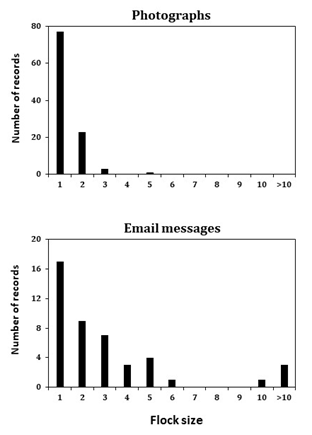
Figure 3: Number of adults found per record (flock size) of the Greater Rhea (Rhea americana) obtained by citizen scientists in the Caatinga, Brazil. Results were shown for to situations: (1) flock size shown on photographs (n = 104); (2) flock size informed by authors of the photographs through email messages (n = 45). Records of families made up of adult(s) and small young were not included here. Records were gathered in the WikiAves platform in April 2023.
Eight (7%) of the total number of Greater Rheas records showed evidence of breeding activities (Table 1). They involved a nest with an incubating adult, a nest with exposed eggs, and six records of families with 1-8 small young and 1-2 adults (Figure 2). These breeding records usually occurred between December and April, with the exception of a record obtained in July. Most of them were gathered during rainy periods (Table 1).
Discussion
Apparently, this study is the first to examine in detail aspects of the natural history of Greater Rheas in the Caatinga. This is because previous studies examined only its geographic distribution [13]. Other information results from inventories of bird communities that reported its presence or absence in particular localities; of 51 avian inventories conducted in the Caatinga during the last three decades (1990-2019) [28], only eight recorded Greater Rheas [23, 26, 27, 36, 37, 38, 39, 40]. Thus, citizen scientists have been more effective than researchers in recording Greater Rheas, as they found it in more than 50 municipalities (this study).
Olmos [23] reported the occurrence of Greater Rheas in the northern portion of Parque Nacional da Serra da Capivara in the early 1990s, but a more recent inventory in this same region reported its absence in the early 2010s [25]. Thus, it is probable that Greater Rheas do not persist in the localities reported by researchers and citizen scientists some years ago. For example, the local extinction of Greater Rheas has been mentioned for some protected areas found in the Caatinga, including the Floresta Nacional de Negreiros [24], and the Estação Ecológica do Seridó [41]. Further, a recent evaluation of its regional distribution in the Caatinga indicated its absence at several localities of previous occurrence, with a resulting range collapse [13]. These and other studies Olmos F [8, 42] mention hunting as the major cause of its population decline in the Caatinga since the 1960s. Despite not dealing with causal factors, our study suggests that populations of Greater Rheas in this dry forest region have been facing reduction of flock size.
Recent studies of Greater Rheas in the Caatinga just mention their occurrence, and do not mention aspects of their flocking behavior [13, 23, 26, 27, 36, 37, 38, 39, 40]. Thus, our study is the first to examine this aspect of its biology in this ecoregion. Information gathered by citizen scientists since the late 2000s indicates that Great Rheas tend to occur solitary or in flocks of 2-3 birds in the Caatinga. This pattern substantially contrasts with the reported commonness and the often encounters of flocks with 20-30 birds in its northern portion until the 1950s [8, 43, 44].
Flock size shown in the photographic records was substantially smaller than that informed by their authors. Major differences included (1) a higher frequency of solitary rheas, and flocks with 2-3 birds, in photographic records than in the set of messages provided by authors, and (2) the absence of flocks with six or more rheas in photographs. Probably, these differences happen because some citizen scientists might focus 1-2 particular rheas, to show them in detail, while other members of the flock become out of frame. Thus, the information obtained through messages sent by citizen scientists should be that considered when examining Greater Rheas flocks in the Caatinga and elsewhere.
The set of breeding records obtained by WikiAves citizen scientists indicate that, apparently, the breeding season of Greater Rheas occurs, at least, between December and July in the Caatinga. Records with small young occurred until April, while a record with more developed juveniles occurred in July. Thus, the breeding season in the Caatinga is delayed in relation to other Brazilian ecosystems. This is because its breeding season occurs between August and June in the Pampa [21], between June and March-April in the Cerrado [19], while young are found between September and December in the Pantanal [22]. Most breeding records obtained in the Caatinga occurred during rainy periods, while a single one was obtained in a dry period. Due to our small set of breeding records, further studies based on citizen science data and observations by researchers are necessary for a better understanding of the breeding phenology of the Greater Rhea in the Caatinga.
It is not known if the photographed Greater Rheas of our study refer to naturally free-living birds or individuals released from captivity. Reintroductions by IBAMA have occurred in some localities, such as Estação Ecológica do Seridó in the early 1990s [41], but information on how they happened throughout the Caatinga is apparently not available. Reintroduction has been proposed for protected areas such as Parque Nacional da Serra da Capivara [42]. We suggest that reintroductions occur in protected as well as unprotected areas throughout the Caatinga regions where it originally was found. Greater Rhea has five subspecies, and R. americana americana is the one that occurs in the Caatinga [10]. Thus, we suggest that reintroductions involve individuals of this subspecies. These actions should be accompanied by educational programs to mitigate hunting pressure in localities with current and future reintroduced flocks.
Authors Contributions
Dárius P. Tubelis [Idealization, conceptualization, data analysis, interpretation and writing].
Filipe M. O. Costa [Idealization, conceptualization, data collection and analysis, interpretation and writing].
Conflicts of Interest
The authors declare that there are no conflicts of interest involving this publication.
Acknowledgements
We thank Universidade Federal Rural do Semi-Árido [UFERSA] for logistic support. We are grateful to all citizen scientists that deposited their photographs of the Greater Rhea in the WikiAves database. We especially thank Adelmo Queiroz, Jaelson Gomes, Nailson Junior, Ruana Souza and Tiago Moreira for giving permission to include photographs of their authorship in this paper. Two anonymous reviewers and the Editorial Committee improved this manuscript with numerous suggestions.
References
-
Rendón MA, Green AJ, Aguilera E, Almaraz P (2008) Status, distribution and long-term changes in the waterbird community wintering in Doñana, south-west Spain. Biological Conservation 141(5): 1371-1378.
-
Patten MA, de Silva HG, Smith-Patten BD (2010) Long- term changes in the bird community of Palenque, Chiapas, in response to rainforest loss. Biodiversity and Conservation 19: 21-36.
-
Wright TF, Lewis TC, Lezama-López M, Smith-Vidaurre G, Dahlin CR (2019) Yellow-naped Amazon Amazona auropalliata populations are markedly low and rapidly declining in Costa Rica and Nicaragua. Bird Conservation International 29: 291-307.
-
Hille DC, Wiedenfeld DA, Lezama-López M, Brightsmith DJ, Patten MA (2023) Parrot population trends in Nicaragua revealed by long-term monitoring. Bird Conservation International 33: e36.
-
Smith FA, Doughty CE, Malhi Y, Svenning J, Terborgh J (2016) Megafauna in the Earth system. Ecography 39: 99-108.
-
Moleón M (2020) Rethinking megafauna. Proceedings of the Royal Society B 287: 20192643.
-
BirdLife International (2023) Species factsheet: Rhea americana.
-
Sick H (1997) Ornitologia brasileira. Nova Fronteira, Rio de Janeiro, Brazil.
-
Folch A (1992) Order Struthioniformes. In: Del Hoyo J, et al. (Eds.), Handbook of the birds of the world. Ostrich to Ducks, Lynx Editions, Barcelona, Spain, pp: 76-111.
-
Kirwan GM, Korthals A, Hodes CE (2021) Greater Rhea (Rhea americana).
-
Roldán A, Rossi VA, Fraire H, Navarro JL, Gardenal CN, et al. (2009) Genetic structure of Greater Rhea (Rhea americana) populations in two regions with different land-uses in central Argentina. Emu 109: 214-221.
-
Bazzano G, Giordano PF, Navarro JL, Martella MB (2014) Linking landscape data with population viability analysis for evaluating translocation as a conservation strategy for Greater Rhea (Rhea americana) in central Argentina. Ornitologia Neotropical 25: 25-35.
-
Miranda EBP (2021) Rhea americana distribution: range expansion and introductions of America´s largest bird. In: Mikkola H (Ed.), Birds - challenges and opportunities for business, conservation and research. Intech Open, Rijeka, Croacia, pp: 1-12.
-
Bazzano G, Martella MB, Navarro J, Bruera N, Corbella C (2002) Uso de hábitat por el Nandú (Rhea americana) en un refugio de vida Silvestre: implicancias para la conservación y manejo de la especie. Ornitologia Neotropical 13: 9-15.
-
Bellis LM, Martella MB, Navarro JL (2004) Habitat use by wild and captive-reared Greater Rheas Rhea americana in agricultural landscapes in Argentina. Oryx 38: 304- 310.
-
Giordano PF, Bellis LM, Navarro JNL, Martella MB (2008) Abundance and spatial distribution of Greater Rhea Rhea americana in two sites on the Pampas grasslands with different land use. Bird Conservation International 18: 63-70.
-
Erize FG, Villafañe IEG (2016) Habitats selected by the endangered Greater Rhea (Rhea americana) – implications for conservation. Emu 116: 379-386.
-
Gräbin DM, Tomas MA, Tomas WM (2012) Densidade de Rhea americana em três paisagens diferentes do pantanal da Nhecolândia, MS. Oecologia Australis 16: 905-913.
-
Tubelis DP (2023) Remnant avian megafauna in South America: an evaluation of the occurrence of breeding Greater Rheas (Rhea americana) in non-protected landscapes in the Brazilian Cerrado. International Journal of Zoology and Animal Biology 6(1): 000446.
-
Dani S (1993) A ema (Rhea americana). Biologia, manejo e conservação. Fundação Acangaú, Belo Horizonte, Brazil.
-
Codenotti TL (1997) Fenologia reprodutiva y biometria de nidos, huevos y pollos del Nandú, Rhea americana, en Rio Grande do Sul, Brasil. Hornero 14(4): 211-223.
-
Hasenclever L, Reiman C, Mourão GM, Campos ZMD (2004) Densidades, tamanho de grupo e reprodução de emas no Pantanal Sul. Boletim de Pesquisa e Desenvolvimento 55. EMBRAPA Pantanal, Corumbá, Brazil.
-
Olmos F (1993) Birds of Serra da Capivara National Park, in the “caatinga” of north-eastern Brazil. Bird Conservation International 3: 21-36.
-
Farias GB, Pereira GA, Burgos KQ (2010) Aves da Floresta Nacional de Negreiros (Serrita, Pernambuco). Atualidades Ornitológicas 157: 41-46.
-
Olmos F, Albano C (2012) As aves da região do Parque Nacional da Serra da Capivara (Piauí, Brasil). Revista Brasileira de Ornitologia 20: 173-187.
-
Silva M, França BRA, Irusta JB, Souto GHBO, Oliveira Junior TM, et al. (2012) Aves de treze áreas de caatinga no Rio Grande do Norte, Brasil. Revista Brasileira de Ornitologia 20: 312-328.
-
Bezerra DMM, Araújo HFP, Alves RNN (2013) Avifauna de uma área de Caatinga na região Seridó, Rio Grande do Norte, Brasil. Ornithologia 6: 53-69.
-
Tubelis DP (2020) Methods used in recent avian inventories conducted in the Caatinga: a review. Ornithology Research 28: 195-208.
-
Ab’saber AN (1977) Os domínios morfoclimáticos na América do Sul. Primeira aproximação. Geomorfologia 52: 1-21.
-
Rizzini CT (1997) Tratado de fitogeografia do Brasil. Editora Âmbito Cultural Ltda, Rio de Janeiro, Brazil.
-
Leal IR, Tabarelli M, Silva JMC (2003) Ecologia e conservação da Caatinga. Universidade Federal de Pernambuco, Recife, Brazil.
-
Silva JMC, Leal IR, Tabarelli M (2017) Caatinga: the largest tropical dry forest region in South America. Springer International Publishing, New York, USA.
-
Prado DE (2003) As caatingas da América do Sul. In: Leal IR, Tabarelli M, et al. (Eds.), Ecologia e conservação da Caatinga. Universidade Federal de Pernambuco, Recife, Brazil, pp: 3-73.
-
Silva JMC, Barbosa LCF (2017) Impact of human activities on the Caatinga. In: Silva JMC, Leal IR, et al. (Eds). Caatinga: the largest tropical dry forest region in South America. Springer International Publishing, New York, USA, pp: 359-368.
-
Albuquerque UP, Araújo EL, de Castro CC, Alves RRN (2017) People and natural resources in the Caatinga. In: Silva JMC, Leal IR, Tabarelli M (Editors). Caatinga: the largest tropical dry forest region in South America. Springer International Publishing, New York, USA, pp: 303-333.
-
Parrini R, Raposo MA, Pacheco JF, Carvalhães AMP, Melo TA, et al. (1999) Birds of the Chapada Diamantina, Bahia, Brazil. Cotinga 11: 86-95.
-
Schunck F, Piacentini VQ, Souza EA, et al. (2012) Birds of the lower middle São Francisco river. Revista Brasileira de Ornitologia 20: 350-364.
-
Freitas MA, França DPF, Filadelfo TM, Huligh V (2013) Avifauna do município de Xique-Xique, região norte da Caatinga baiana. Atualidades Ornitológicas 171: 17-23.
-
Barnett JM, Silva CLG, Araújo HFP (2014) The avifauna of Curaçá (Bahia): the last stronghold of Spix´s macaw. Revista Brasileira de Ornitolologia 22: 121-137.
-
Mariano PN (2016) Riqueza, estrutura trófica, status de ocorrência e grau de ameaça da avifauna no município de Morro do Chapéu, estado da Bahia, nordeste Brasileiro. Atualidades Ornitológicas 193: 4-9.
-
Pichorim M, Damasceno JPT, Toledo-Lima G, de Araújo RD, Ferreira PVS (2016) Guia de aves da Estação Ecológica do Seridó. Caule de Papiro, Natal, Brazil.
-
Olmos F (1992) Serra da Capivara National Park and the conservation of northeastern Brazil´s caatinga. Oryx 26: 142-146.
-
Faria OL (1961) A caça nos sertões do Seridó. Serviço de Informação Agrícola, Rio de Janeiro, Brazil.
-
Sagot-Martin F, Lima RD, Pacheco JF, Irusta JB, Pichorim M, et al. (2020) An updated checklist of the birds of Rio Grande do Norte, Brazil, with comments on new, rare, and unconfirmed species. Bulletin of the British Ornithologists Club 140: 218-298.
- Mitochondrial Bio-Logistics: Steering Co-Enzyme Q10 and Lycopene Synergies within the Science 4.0 Bio-OS Framework
- Hymenoptera Specimens from the Caño Negro Wetland, of the National Museum Collection, Costa Rica
- Science 4.0: Comprehensive Architecture of the Biological Operating System (Bio-OS) A Framework for Systemic Resilience and Industrialized Bio-Governance
- Rabbit on, or Hare Back? Understanding Climate Change
- Clinical Validation of Science 4.0: Flow Steering and Epigenetic Drift Inversion on a 76-Year-Old Hybrid System
- Seeds Planted by another Mind