
A New Species of Ptilothyris Walsingham (Lepidoptera: Lecithoceridae: Torodorinae) from Nigeria
Since Ptylothyris purpurea Walsingham, 1897 of the family Lecithoceridae was described from Nigeria, no additional species of the family has been known. As the second species of the genus Ptilothyris Walsingham reported from Nigeria, P. medleri Park, sp. nov. is described, based on a single male. The new species can be distinguished from P. purpurea by the antenna light orange throughout and the hind wing lacking orange-white patch.
Introduction
Nigeria is located in the western coast of Africa, bordered to the north by Niger, to the east by Chad and Cameroon, to the south by the Gulf of Guinea of the Atlantic Ocean, and to the west by Bennin. Nigeria consists of plains in the north and south interrupted by plateaus and hills in the center of the country, with a tropical climate ranging from arid to humid equatorial. The country is one of the most poorly explored area for the faunal study of the family Lecithoceridae, with only single known species, Ptylothyris purpurea Walsingham, 1897, which was described based on three syntypes (two from Lagos, Nigeria and one from Gabon) [1, 2].
The genus Ptilothyris Walsingham is an Afrotropical genus, comprising 19 known species [2, 3, 4]. The genus is closely related to Thubdora Park [3] but it can be distinguished by the forewing being more elongated and the antenna strongly bipectinate; the male genitalia are specialized by the broadened uncus and the juxta usually forming double plates; and the abdomen usually with a pair of long hair-pencils between segment VII and VIII. The new species is the second species of the genus, also of the family known from Nigeria.
Material and Methods
Specimen studied in this paper is based on loan material provided by De Prins, Willy and De Prins J. from the collection in the collection of the Royal Museum for Central Africa (RMCA), Turvuren, Belgium, which was collected from Nigeria in 1971 by J. T. Medler. The color standard of adults mainly follows Kornerup, et al. [5]. The type specimen is deposited in RMCA.
Description
Genus Ptilothyris Walsingham, 1897 Type species: Ptilothyris purpurea Walsingham, 1897: 38. Type locality: Nigeria, Lagos. Ptilothyris medleri Park, sp. nov.
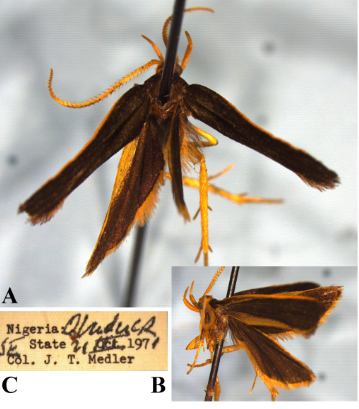
Type specimen: Holotype: Male, Nigeria, Oludu CR, SE State, 21 III (probably March) 1971, leg. J. T. Medler, gen. slide no. CIS-7099, deposited in RMCA.
Diagnosis: The new species can be distinguished from P. purpurea Walsingham by the antenna light orange throughout (dark brown in basal 3/5 and orange white beyond in P. pupurea), and the hind wing has no orange-white patch. The male genitalia can be distinguished by the uncus bifurcated and the juxta lacking heavily sclerotized caudal processes, whereas in P. pupurea the uncus is broadened, concave on caudal margin medially and the juxta has heavily scleritized, forceps-like caudal process.
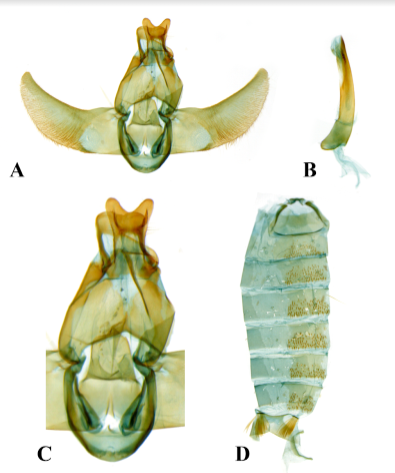
Description: Male (Figures 1A & 1C). Forewing length 10.0 mm. Head: head and thorax bronzy dark brown dorsally. Antenna much shorter than forewing; scape slightly dilated toward apex, light orange all around; flagellum strongly bipectinate, light orange throughout, with fine whitish cilia. Second segment of labial palpus thickened, light orange all around; 3rd segment shorter than 2nd segment, strongly upturned. Forewing ground color bronzy dark brown, with orange narrow streak along costa. Hind wing ground color as same as the forewing. Hind tibia light orange all around. Abdomen (Figure 2D): spinous zones on tergites broad, dense; with a pair of short hair-pencils along anterior margin of segment VII.
Male genitalia (Figures 2A-2C): uncus bifurcated, with broad latero-caudal lobes which are rounded apically, deeply emarginated in U-shape on caudal margin medially, exceeding gnathos basal plate. Gnathos basal plate broad, broader than the width of uncus, slightly emarginated medially. Valva elongated, with nearly parallel in basal 1/3; slightly expanded basally; cucullus triangularly narrowed toward apex, with arched ventral margin, upturned, with long hairs near lower corner of cucullus. Juxta large; basal half broad; dorsal plate slightly longer than basal plate; ventral plate deeply emarginated into U-shape. Vinculum narrowly banded. Aedeagus slender, narrowed toward apex from basal 3/5, slightly sclerotized, sharply acuted apically; consistus absent.
Female unknown Distribution: Nigeria (South-east: Oludu).
Etymology: The species name is in honor of Prof. J. T. Medler who collected the type specimens in Nigeria.
Discussion
Of the 19 known species of Ptilothyris in the Afrotropical Region, 12 species are known in the western part (including Nigeria, Cameroon, and Ghana) and seven species in the east of Africa (including Uganda and Zambia). The new species is the second species of the genus and also of the family known from Nigeria. Most of Ptilothyris species are superficially similar and hardly distinguishable in appearance, but they can be distinguished from each other by the male genital characters. The commonly used diagnostic characters of the male genitalia include the shape of the uncus and the cucullus, the processes of the juxta, and the aedeagus. The uncus is mostly broadened, fan-shaped, but only that of P. galbiplatella Park, 2021 which was described from Uganda is bifurcated as similar as that of the new species. However, it can be easily distinguished by the shape of the cucullus narrowed apically and the aedeagus lacking cornutus. The type locality in the label was unclearly written, but we could read it by the same label reported in a Torticid-paper by Razowski from Nigeria [6].
Conflicts of Interest
The authors declare that there are no conflicts of interest.
Acknowledgements
I am indebted to Joel Minet, Muséum National d’Histoire Naturelle, Paris, France for the loan of material deposited in the museum. This research was supported by Basic Science Research Program through the National Research Foundation of Korea (NRF) funded by the Ministry of Education (2018R1D1A1B07042503).
References
-
Walsingham TG (1897) Western Equatorial African Micro-lepidoptera. Tran Ent Soc London, UK, pp: 33-67.
-
Park KT, Mey W, Koo JM, De Prins J, Cho SW (2019) Revision of the genus Ptilothyris Walsingham, 1897 (Lepidoptera: Gelechioidea: Lecithoceridae), with descriptions of eight new species from Africa. Zootaxa 4567 (2): 201-235.
-
Park KT (2018) A new genus Thubdora Park, sp. nov. and seven new species of the subfamily Torodorinae (Lepidoptera, Lecithoceridae) from Africa. J Asia-Pacific Entomol 21(3): 1085-1093.
-
Park KT, Cho SW, Koo JM (2022) The subfamily Torodorinae of the world (Lepidoptera: Lecithoceridae). National Institute of Biological Resources, Incheon, Korea, pp: 584.
-
Kornerup A, Wanscher JH (1978) Methuen Handbook of Color. In: 3rd (Edn.), Eyre Methuen, London, UK, pp: 252. 6. Razowski J (2014) Tortricidae from the Tervuren Museum, 5: Archipini (Lepidoptera: Tortricidae). SHILAP Revta lipid 42 (167): 449-479.
- Mitochondrial Bio-Logistics: Steering Co-Enzyme Q10 and Lycopene Synergies within the Science 4.0 Bio-OS Framework
- Hymenoptera Specimens from the Caño Negro Wetland, of the National Museum Collection, Costa Rica
- Science 4.0: Comprehensive Architecture of the Biological Operating System (Bio-OS) A Framework for Systemic Resilience and Industrialized Bio-Governance
- Rabbit on, or Hare Back? Understanding Climate Change
- Clinical Validation of Science 4.0: Flow Steering and Epigenetic Drift Inversion on a 76-Year-Old Hybrid System
- Seeds Planted by another Mind