
Therapeutic Considerations of Antimicrobial and Antifungal Uses for Oral Infections in Birds of Prey: A Short Review
Raptors are carnivorous predatory birds, represented by various species of hawks, falcons, eagles, owls, and vultures, with adaptations for active hunting and the types of food that comprise their diet. The health of the oral cavity is of utmost importance. Infectious diseases affecting the oral cavity and digestive tract can occur, leading to emaciation, lethargy, weakness, and death, with the most prevalent being those caused by Candida spp. and Trichomonas gallinae. Treatment with antimicrobial drugs such as nystatin and metronidazole is necessary, avoiding underdosing, and preventing cases of microbial resistance is highly important.
Introduction
Raptors are represented by the orders Accipitriformes, Falconiformes, Strigiformes, and Cathartiformes, comprising various species of hawks, falcons, eagles, owls, vultures, condors, and buzzards. They exhibit adaptations for active hunting, such as curved beaks, sharp talons, and high visual acuity [1]. They are predatory birds, with a major part of their diet being carnivorous, and their preference for a specific type of prey depends on the species and food availability [2], including birds, rodents, reptiles, and fish when in the wild. Birds in captivity have a more restricted diet, commonly offered laboratory mice and rats, as well as birds like quails and chicks, but they should not be fed with birds from the wild whose cause of death has not been determined, as it may lead to the spread of diseases [3, 4].
Within the avian species, the gastrointestinal tract is composed of various anatomical components, encompassing the beak, oropharynx (comprising the tongue, palate, and pharynx), esophagus, crop, proventriculus, ventriculus (gizzard), intestine, cecum, rectum, cloaca, and anus [5]. Raptors, being birds of prey, display beaks that have undergone morphological adaptations specific to their unique feeding habits, with the rhinotheca housing the nostrils and the gnathotheca playing a crucial role. Additionally, raptors possess a hyperkeratinized tongue, which plays a vital role in facilitating efficient food handling [2]. Strigiformes are an exception, as they possess a specialized sphincter that facilitates the smooth passage of ingested material. This distinctive anatomical feature replaces the crop, a dilation of the esophagus responsible for temporary food storage, which assumes particular importance during chick rearing [2].
In the context of their limited ability to digest keratinaceous substances present in feathers, beaks, and hair, the ventriculus (gizzard) plays a vital role in the formation of regurgitated pellets. Contraction of the ventriculus leads to the aggregation of indigestible materials into these pellets, which exhibit considerable variation in size, shape, appearance, and odor. The examination of pellet contents offers valuable dietary insights into the consumed prey by raptors. Furthermore, any alterations in pellet composition may serve as potential indicators of underlying gastrointestinal pathologies [6, 7, 8].
The well-being of raptors heavily relies on maintaining optimal oral health. Clinical manifestations of pathological conditions affecting the oropharynx include emaciation, regurgitation, anorexia, head shaking, dyspnea, and dysphagia. These symptoms can arise from a diverse range of underlying etiologies, encompassing nutritional, traumatic, neoplastic and infectious origins [2]. Notably, infectious causes may involve microorganisms such as Candida spp. and Trichomonas sp. [9, 10]. Treatment typically involves the administration of antimicrobial agents, and in severe cases, surgical intervention may be necessary to effectively address the condition [11].
Body of Paper
Trichomoniasis is an infectious disease caused by the protozoan Trichomonas gallinae. It can lead to the formation of caseous, diphtheritic, pinpoint, and painful lesions in the upper digestive and respiratory tracts, making it highly significant in raptors [12, 13]. The microorganism is highly adapted to Columbiformes, often not manifesting clinical signs in birds of this order [6], and transmission occurs through the ingestion of contaminated prey. The disease causes prostration and depression. Cases of stomatitis were reported in Saker falcons (Falco cherrug) caused by Pseudomonas aeruginosa, a bacterium commonly associated with pneumonia in captive birds, following oral infection by T. gallinae [14], and a study comparing different orders shown that the most severe lesions, such as large abscesses in the oropharynx and lesions in the palate, occurred in the Southern Boobook owl (Ninox boobook) against to diurnal Accipitriformes and Falconiformes raptors [15].
Candidiasis (or moniliasis) is caused by Candida spp., an opportunistic fungal microorganism that affects the upper gastrointestinal tract, producing plaque-like lesions on the mucosa of the tongue, pharynx, and crop, or deep lesions unrelated to oral lesions. Clinical signs include dysphagia, hyporexia, vomiting, regurgitation, and prostration. Infection generally occurs orally through the ingestion of food or via fomites [12, 16]. Candida albicans is considered an environmental contaminant and a normal part of the avian gastrointestinal microbiota. However, stress situations such as corticosteroid use, viral infections, and malnutrition can predispose birds to develop disease [17]. Prolonged use of antibiotics can lead to opportunistic Candida spp. infection [18]. Oral yeast infections have been associated with the ingestion of carcasses from domesticated animals in farm areas with antibiotic residues [9].
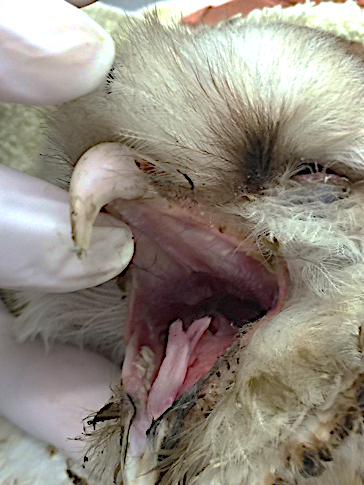
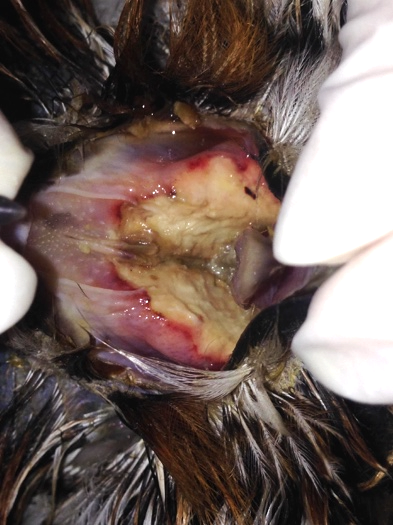
The diagnostic process for oral cavity diseases in raptors can be intricate, owing to the diverse range of potential etiologies involved. One of the essential steps in this process is the isolation of microorganisms, which can be accomplished through the collection of samples from the oral cavity. In instances where lesions are situated deep within the oral cavity, endoscopy serves as a valuable tool for visualization and sample retrieval [11, 19]. Illustrative examples of caseous and diphtheritic lesions can be observed in (Figures 1 & 2) respectively.
Arbitrary selection of antimicrobials or inadequate dosing can result in the development of resistance and, concurrently, a disruption in the normal microbiota of the digestive tract. Therefore, the efficacy of antimicrobial therapy is contingent upon a comprehensive clinical approach tailored to the specific needs of the individual and the surrounding environment. Tailoring treatment to target the particular microorganism responsible for the infection is of utmost importance [18].
The treatment of choice for Trichomonas gallinae infections is through nitroimidazoles [20]. Metronidazole, as well as carnidazole and ronidazole, are the most commonly used drugs [13, 21]. Metronidazole is a heterocyclic nitroimidazole compound, and its mechanism of action is thought to be similar to that of nitrofurans. The antimicrobial action of these compounds is not well understood, but it is believed that they are reduced by bacterial flavoproteins, forming reactive and damaging intermediates to the microorganism’s DNA [22]. Although metronidazole is the most commonly used and presents good results there may be some resistance in raptors undergoing treatment [23, 24].
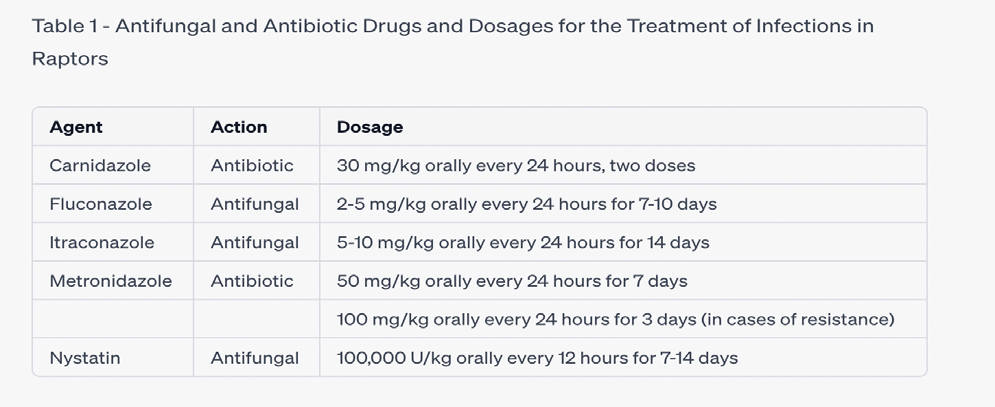
Nystatin is the drug of choice for yeast infections restricted to the digestive tract [16, 13]. Nystatin is a polyene antifungal obtained from Streptomyces noursei, which is not absorbed by mucous membranes and skin. It is used in the treatment of fungal infections of the gastrointestinal tract and has no effect on the normal microbiota [22]. More aggressive or invasive infections may require the use of itraconazole, fluconazole, or amphotericin B [17], especially in cases of infection caused by Candida albicans that presents nystatin’s resistance in some isolates [25]. The triazoles (itraconazole and fluconazole) cause plasma membrane alterations in the fungal microorganism, with itraconazole being more effective at lower doses compared to ketoconazole. Amphotericin B is indicated orally only for the treatment of digestive tract infections and, like nystatin, is a polyene antibiotic [26]. The recommended treatment doses [11, 12, 24, 27] are found in (Figure 3).
Conclusion
In the context of raptor health, Candida spp. and Trichomonas gallinae as microorganisms causing oral infections represent relatively frequent occurrences. Nonetheless, the availability of suitable antimicrobial and antifungal drugs specifically indicated for their treatment remains limited. Ensuring successful outcomes depends on prescribed adequate dosages and treatment durations, thereby mitigating the risks associated with underdosing and averting the potential emergence of microbial resistance against the administered drugs.
References
-
Menq W (2018) O Que Sao Aves De Rapina?.
-
Klaphake E, Clancy J (2005) Raptor Gastroenterology. Vet Clin N Am-Exot Anim Pract 8(3): 307-327.
-
Caudell JN, Riddleberger KA (2001) Best Management Practices for Captive Raptors in Georgia, A Technical Guide for the use of Raptors in Environmental Education Programs.
-
Rogers KH, Girard YA, Woods L, Johnson CK (2016) Avian Trichomonosis in Spotted Owls (Strix Occidentalis): Indication of Opportunistic Spillover from Prey. Int J Parasitol Int J parasitol: Parasites And Wildlife 5(3): 305- 311.
-
Denbow DM (2000) Gastrointestinal anatomy and physiology. In: Whittow GC (ED.), Sturkie’s avian physiology 5th (Edn). San Diego: Academic Press, pp: 299-321.
-
Ford S (2010) Raptor gastroenterology. J Exot Pet Med 19(2): 140-150.
-
Cooper JB (2003) Birds of Prey: Health & Disease. In: 3rd (Edn). Iowa State Press, pp: 827.
-
Merling de Chapa M, Auls S, Kenntner N (2021) To Get Sick or not to get Sick-Trichomonas Infections in two Accipiter Species from Germany. Parasitol Res 120: 3555-3567.
-
Pitarch A, Gil C, Blanco G (2017) Oral Mycoses in Avian Scavengers Exposed to Antibiotics from Livestock Farming. Sci Total Environ 605-606: 139-146.
-
Spriggs MC, Purple KE, Gerhold RW (2020) Detection of Trichomonas Gallinae in Wild Birds Admitted to a Rehabilitation Center, Florida, USA. J Wildl Dis 56(3): 733-735.
-
Samour J (2017) Management of Raptors. In: Harrison Greg (Org). Clinical Avian Medicine OnLine. Disponivel em.
-
jones MP, Susan EO, Sherry KC, Donita LF (2000) Pharmacokinetic Disposition of Itraconazole in Red- Tailed Hawks (Buteo jamaicensis). J Avian Med Surg 4(1): 15-22.
-
Scott DE (2016) Raptor Medicine, Surgery and Rehabilitation. In: 2nd (Edn), Cabi: Boston pp: 361.
-
Samour JH (2000) Pseudomonas aeruginosa Stomatitis as a Sequel to Trichomoniasis in Captive Saker Falcons (Falco cherrug). J Avian Med Surg 14(2): 113-117.
-
Park FJ (2011) Avian Trichomoniasis: A Study of Lesions and Relative Prevalence in a Variety of Captive and Free-Living Bird Species as Seen in an Australian Avian Practice. Aust Vet J 89(3): 82-87.
-
Chege SM (2016) Opportunistic Infections of Avians. In: Hurst CJ (Ed.), The Rasputin Effect: When Commensals and Symbionts Become Parasitic. Advances in Environmental Microbiology Series 3, Springernature: Cham pp: 221-260.
-
Velasco MC (2000) Candidiasis and Cryptoccocosis in Birds. Semin avian exot pet med 9(2): 75-81.
-
Huckabee JR (2000) Raptor therapeutics. Vet Clin N Am- Exot Anim Pract 3(1): 91-116.
-
Divers SJ (2010) Avian Diagnostic Endoscopy. Vet Clin N Am-Exot Anim Pract 13(2): 187-202.
-
Zimre GE, Najima A, Amin A, Michael H (2011) Genetically Different Clonal Isolates of Trichomonas Gallinae, Obtained from the Same Bird, can Vary in their Drug Susceptibility, an in Vitro Evidence. Parasitol Int 60: 213-215.
-
Speer B, Powers LV (2016) Anatomy and Disorders of the Beak and Oral Cavity of Birds. Vet Clin N Am-Exot Anim Pract 19(3): 707-736.
-
Gorniak SL (2008) Quimioterapicos In: Spinosa HS (Ed.), Farmacologia Aplicada A Medicina Veterinaria. 4th (Edn.), Guanabara-Koogan: Rio De Janeiro, pp: 348-356.
-
Gomez Munhoz MT, Gomez Molinero MA, Gonzalez F, Azami Conesa I, Bailen M, et al. (2022) Avian Oropharyngeal Trichomonosis: Treatment, Failures and Alternatives, a Systematic Review. Microorganisms 10(11): 2297.
-
Willette M, Julia P, Cruz Martinez L, Arent L, Bueno Padilla I, et al. (2009) Management of Selected Bacterial and Parasitic Conditions of Raptors. Vet Clin N Am-Exot Anim Pract 12(3): 491-517.
-
Talazadeh F, Ghorbanpoor M, Shahriyari A (2022) Candidiasis in Birds (Galliformes, Anseriformes, Psittaciformes, Passeriformes, and Columbiformes): A Focus on Antifungal Susceptibility Pattern of Candida Albicans and Non-Albicans Isolates in Avian Clinical Specimens. Top Companion Anim Med 46: 100598.
-
Costa E, Gorniak SL (2008) Agentes antifungicos e antivirais. In: Spinosa HS Farmacologia aplicada a Medicina Veterinaria. 4ed, Guanabara-Koogan: Rio de Janeiro pp: 372-386.
-
Hawkings MG (2013) Birds. In: Carpenter JW (Ed.), Exotics Animal Formulary. 4th (Edn.), Elsevier: Kansas, pp: 724.
- Mitochondrial Bio-Logistics: Steering Co-Enzyme Q10 and Lycopene Synergies within the Science 4.0 Bio-OS Framework
- Hymenoptera Specimens from the Caño Negro Wetland, of the National Museum Collection, Costa Rica
- Science 4.0: Comprehensive Architecture of the Biological Operating System (Bio-OS) A Framework for Systemic Resilience and Industrialized Bio-Governance
- Rabbit on, or Hare Back? Understanding Climate Change
- Clinical Validation of Science 4.0: Flow Steering and Epigenetic Drift Inversion on a 76-Year-Old Hybrid System
- Seeds Planted by another Mind