
Two New Ant-Eating Spider in the Genus Mallinella Strand, 1906 (Araneae: Zodariidae) from Tingloy Island, Batangas, Philippinesa
Two new species from the genus Mallinella Strand, 1906 (Zodariidae) were collected from Barangay Sto. Tomas of the island municipality of Tingloy, Batangas, Philippines from January to June 2018 through the use of pitfall traps. Male and female genitalia of Mallinella tingloy n. sp. and Mallinella marikaban n. sp. were observed and documented in details including their specific posterior ventral spines (PVS), a shared character among Mallinella spiders. This faunistic exploration and inventory of Zodariidae revealed that Mallinella tingloy n. sp. and Mallinella marikaban n. sp. are the sixth and seventh Mallinella species collected and recorded in the Philippines, respectively, and the first recorded species of Mallinella in the province of Batangas and in the island municipality of Tingloy. The new taxa are hereby described and photographs are provided to facilitate species identification. Diagnosis of each species is summarized herewith: Mallinella marikaban n. sp. is a member of the hilaris-group and it runs close to M. acanthoclada Dankittipakul, Jocqué & Singtripop, 2012 found in Thailand, but the new species from the Philippines can be distinguished from the latter by its distinct thick and sclerotized embolus with bifurcated tip and a “mouthlike” epigynum with a pair of spherical widely spaced spermatheca. Mallinella tingloy n. sp., on the other hand, belongs to the annulipes-group and runs close to M. calilungae (Barrion & Litsinger, 1992) found in the Philippines, and can be distinguished from the latter with the presence of long and broad embolus with deep longitudinal groove and a sclerotized, lip-like epigynum with widely-spaced longitudinal spermatheca with globular tip.
Introduction
Zodariidae is a family of ant-eating spiders first established by Thorell in 1881. They are small to large araneomorph spiders with an enormous variation of shapes, three tarsal claws with teeth on paired tarsal claws implanted on lateral side facing opposing claw. They have eight eyes, serrula absent, cheliceral fangs very short, shiny, smooth to sparsely-haired, red-to-dark-colored, with or without white spots on the abdominal dorsum. Eyes vary in arrangement from two rows of four to three rows of 2-2- 4 [1, 2]. Cephalothorax smooth and strongly convex, high anteriorly and sometimes sloping in the longitudinal fovea. Legs not spinous, apicoventral of metatarsi usually with a mat of black hairs, tarsi often three-clawed. These ant-eating spiders can be found on soil debris, leaf litter, underneath stones or logs or leaves around the entrance of the burrow [2, 3]. It is currently represented by 86 genera and more than 800 species worldwide [4]. Jocqué, et al. [1] considered Zodariidae as one of the problematic families as their placement is concerned.
In Systematics and Biogeography of Mallinella [2], genus Mallinella was redefined and characterized by a single synamorphy: the presence of posterior ventral spines (PVS) situated in front of the spinnerets arranged in a single row. Strand, et al. [5] established the genus in 1906 and his classification remained unchallenged, until Bosmans and van Hove in 1986 recognized strong posterior ventral spines (PVS) among Mallinella [6]. Presently there are 214 accepted species under genus Mallinella making it the largest genus of the Zodariidae [4]. Mallinella species can be found in Africa, China, Japan, Philippines, Sulawesi, Indonesia, Vietnam, Malaysia, and Thailand. In the Philippines, there are only five Mallinella species described as of May 2020 namely: Mallinella calicoanensis Dankittipakul, Mallinella calilungae, Mallinella panchoi; Mallinella pricei [3]; and Mallinella slaburuprica [7].
It is the first time to describe Mallinella spiders from the island municipality of Tingloy, Batangas, a very unique terrestrial ecosystem as part of the Verde Island Passage (VIP), known as the “center of the center of marine biodiversity” [8]. The terrestrial ecosystem of Tingloy is not yet well explored specifically for the spiders. The ecologically interconnected orchards, farmlands and secondary forest in the province and the fact that it is an island municipality make it an interesting area to explore. Apparently, there is no recorded biodiversity assessment for the spiders in the area for a baseline information. Hence, there is a strong need to explore the municipality of Tingloy for baseline information, occurrences and diversity of spiders. Herewith is the description of the two new species of Mallinella collected from the municipality of Tingloy, province of Batangas. These new species are both new records for the island of Tingloy, Batangas and the Philippines.
Materials and Methods
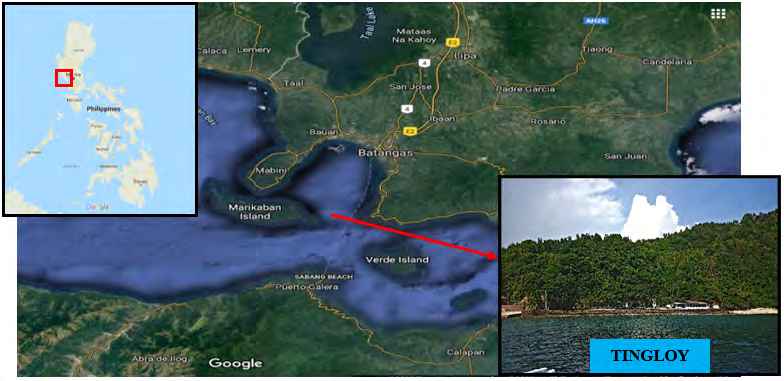
Taxonomic sampling and identification. The collection site is Barangay Sto. Tomas, Tingloy, Batangas, Philippines located specifically at 120 o 88’26” E; 13 o65’35” N (Figure 1). The island municipality of Tingloy is part of the Verde Island Passage (VIP) located within and bounded by the Maricaban Strait in the North and the Verde Island Passage in the South. The area is a known tourism and diving destination but it is also an important source of terrestrial biodiversity due to its isolation from the main island, Batangas province. Apparently, its general vegetation is dominated mainly by wooden trees, coconut, bamboos, mango trees, wild taro, banana, shrubs and some weeds. However, very limited number of studies on its terrestrial ecosystem and biodiversity have been conducted due to logistics and accessibility. Collection period is from January-June 2018 with a total of 200 pitfall traps placed in a one-kilometer transect. Each pitfall contains a mixture of 50:50 water and ethylene glycol (Tables 1-6).
All sample specimens were kept in Eppendorf tubes and stored in 80% ethyl alcohol. Each tube is provided with collection labels namely: province/municipality/collection site/habitat/collector/date of collection and the collection number. Preservation techniques was patterned largely after Barrion, et al. [3]
Observations, measurements and digital images were made using Nikon SMZ800 stereomicroscope attached with a ToupCam HD camera. Digital images of the habitus, cephalothorax and abdomen, eye pattern and genitalia were produced. All measurements were expressed in millimeters (mm). Leg measurements are as follows: total length (length of femur, length of patella + tibia, length of metatarsus, length of tarsus). Abbreviations follow Barrion, et al. [3] used in this paper include: AER =anterior eye row; PER = posterior eye row; AME = anterior median eyes; ALE = anterior lateral eyes; PME = posterior median eyes; PLE = posterior lateral eyes; CL = carapace length; CW = carapace width; AbL = abdominal length; AbW = abdominal width; RTA = retro lateral tibial apophysis; mm = millimeters.
All voucher specimens were deposited in the Arthropod Collections at De La Salle University-Science Technology Complex Spider Laboratory (DLSU-STC) in Binan, Laguna.
Species Accounts
Taxonomy Family Zodariidae Thorell, 1881 Subfamily Zodariinae Simon, 1890 Genus Mallinella Strand, 1906 Diagnosis: The genus Mallinela is phylogenetically defined by a single, unambiguous synapomorphy: the presence of a single row of posterior ventral spines situated in front of spinnerets. Males share the following combination of characters: the palpal tibial carries up to three apophyses but always with a retrolateral one; the heavily sclerotized conductor consists of a sharply pointed apex, a strongly pronounced prolateral base, and a dorsal process; the sclerotized TA is of variable shapes and sizes, always with marginal modification; the embolic base is superficially connected to a tegulum via a thin membrane. Females can be recognized by the following characters: the epigyne is represented by a simple, heavily sclerotized plate, occasionally with a deep anterior median incision; the insemination ducts are generally short and diverging; the spermatheca are widely separated and situated parallel to each other but perpendicular to the epigynal plate. An anterior dorsal scutum is present on the opisthosoma of males. The venter of opisthosoma is pale, marked by a broad median band and flanked by two oblique, lateral bands of dark sepia color [2].
Remarks. Differences and similarities of the described new species were compared to the described and published species by Dankittipakul, et al. [2] and later confirmed and validated by Dr. Alberto T. Barrion, the spider expert of the Philippines and the Adjunct Curator of Spiders, Parasitic Hymenoptera and Rice Arthropods, Museum of Natural History, University of the Philippines, Los Baños, Laguna.
Distribution and species composition. Diversity of Mallinela sp. from the Philippines are composed of five known species namely: Mallinella calicoanensis Dankittipakul, Jocqué & Singritripop, 2012; Mallinella calilungae; Mallinella panchoi; Mallinella pricei; and Mallinella slaburuprica, which can be found mostly in Luzon Island, Philippines. Specifically, M. calilungae was collected in upland ricefield in College Experiment Station (CES) in Los Baños, Laguna, Philippines.
Descriptions of Species
Mallinella marikaban Lualhati-Caurez & Barrion, n. sp. (Figures 2a-h (♂); 3a-h (♀))
Holotype: adult male (Accession no. T6352). Total length 5.21. CL 2.24, CL 1.87; AbL 2.97, AbW 1.78 . Carapace. Reddish-brown to black, smooth and shiny, convex, longer than wide, no visible fovea (Figure 2a). Sternum reddish brown, wider than long (Figure 2c). Labium subtriangular, light yellowish. Maxillae brownish yellow. Chelicerae vertical and longer.
Eyes: Eight eyes in two rows, all circular and clear (Figure 2d). AE is slightly recurved and PE strongly procurved. Eye separation: PME-PLE=0.27 > AME-ALE= 0.17 > PME- PME= 0.10 > AME-AME=0.08. AME is larger. Eye diameter: AME=0.20 > PME=0.15 > ALE= PLE=0.13. Legs: Yellowish brown except dark brown femora I-IV. Coxae almost white. Leg formula 4123.
| Femur | Patella | Tibia | Metatarsus | Tarsus | Total | |
|---|---|---|---|---|---|---|
| 1 | 1.56 | 0.55 | 1.56 | 1.56 | 1.12 | 6.35 |
| 2 | 1.47 | 0.49 | 1.26 | 1.58 | 1.15 | 5.95 |
| 3 | 1.29 | 0.58 | 1.2 | 1.54 | 0.91 | 5.51 |
| 4 | 1.51 | 0.55 | 1.63 | 2.25 | 1.15 | 7.09 |
| Pedipalp | 0.6 | 0.29 | 0.24 | - | 0.7 | 1.83 |
Table 1: Mallinella marikaban n. sp. pedipalp and leg measurements (mm).
Abdomen: Dorsum of opisthosoma dark sepia, clothed with fine hairs, with a pair of large, anterior pale irregularly shaped spots followed by a series of irregular pale white stripes (Figures 2a-c). The whole abdomen is globular, Venter
yellowish gray with chalk-white spots, without distinctive pattern. Side abdomen contain four irregularly shaped white markings. Twenty-one posterior ventral spines (PVS) in front of the spinnerets are neatly arranged measuring 0.03 mm each (Figure 2e). Spinnerets light brown, long and posterior spinnerets of equal sizes. Pedipalp: Prolateral tegular apophysis (PTA) small but sclerotized, rounded apically, and directed laterally towards tegulum; tegular apophysis (TA) in retrolateral view J-shaped, embolus thick and sclerotized, black, bifurcate at tip; tegular membrane with an erect tubercle behind tegular base; cymbium oblique (Figures 2f-h). Paratype 1: adult female (Accession no. T6351): Total length 5.40. CL 2.48, CW 1.73. AbL 2.95, AbW1.72. Carapace: Reddish-brown to black, smooth and shiny, convex, longer than wide, no visible fovea (Figure 3a). Sternum reddish brown, wider than long (Figure 3c). Labium subtriangular, light yellowish. Maxillae brownish yellow. Chelicerae vertical and longer. Eyes: Eight eyes in two rows, all circular and clear (Figure 3e). AE is slightly recurved and PE strongly procurved. Eye separation: PME-PLE=0.24 > AME-ALE= 0.14 > PME- PME= 0.12 > AME-AME=0.09. AME is larger. Eye diameter: AME=0.17 > PME=0.14 > PLE=0.13 > ALE= 0.12. Legs: Yellowish brown except dark brown femora I-IV. Coxae almost white. Leg formula 4132.
| Leg | Femur | Patella | Tibia | Metatarsus | Tarsus | Total |
|---|---|---|---|---|---|---|
| 1 | 1.41 | 0.58 | 1.49 | 1.49 | 1.26 | 7.15 |
| 2 | 1.27 | 0.62 | 1.23 | 1.3 | 1.09 | 5.3 |
| 3 | 1.08 | 0.67 | 1.28 | 1.46 | 0.92 | 6.21 |
| 4 | 1.5 | 0.72 | 1.73 | 2.2 | 1.35 | 7.9 |
Table 2: _Mallinella marikaban_ n. sp. leg measurements (mm).
Abdomen: Dorsum of opisthosoma dark sepia, clothed with fine hairs, with a pair of large, anterior pale irregularly shaped spots followed by a series of irregular pale stripes (Figures 3a-c). The whole abdomen is globular, Venter yellowish gray with chalk-white spots, without distinctive pattern. Side abdomen contain four irregularly shaped white markings. Twenty-one posterior ventral spines (PVS) in front of the spinnerets are neatly arranged measuring 0.03 mm each (Figure 3d). Spinnerets light brown, long and posterior spinnerets of equal sizes. Epigyne: Epigynum “mouth-like’ with transverse v-shaped sclerotized lateral margins, with a pair of spherical, widely spaced spermatheca, base with two lateral bands, first band broad and blunt tip, second band thin, longer than the first one and slightly curved upward (Figures 3f-h). Material examined: Holotype adult ♂ (Accession no. T6352): PHILIPPINES, Luzon Is.: Batangas Province, Tingloy, Barangay Sto. Tomas, C.L. Caurez, collected through pitfall traps, January-June 2018, Paratype: adult ♀ (Accession no. T6351), same data as holotype. Other material: 32♂♂ and 8♀♀ adults. PHILIPPINES, Luzon Is., Batangas, Tingloy, Barangay Sto. Tomas, same data as holotype. Etymology: Named after the type locality. Remarks: Mallinella marikaban n. sp_. can be distinguished easily from _Mallinela acanthoclada Dankittipakul, Jocqué, et al. [1] from Thailand based on the following characters:
| Mallinella marikaban_ Lualhati-Caurez & Barrion, n. sp. | Mallinela acanthoclada_ Dankittipakul, Jocqué & Singtripop, 2012 | |
|---|---|---|
| Body length/size | smaller body size (±5.21mm) | bigger body size (±8.24 mm) |
| Dorsal pattern | irregularly shaped spots followed by a series of irregular pale stripes | First pair represented by large pale spots fusing medially; second to fifth pairs by transverse chevrons |
| Tegular apophysis | In retrolateral view- J-shaped | With bifid apico-prolateral process |
| Embolus | thick and sclerotized, bifurcate at tip | Unbranched, with thin subapical flange, apex dilated |
| Epigynum/ spermatheca | “mouth-like”, with a pair of spherical, widely spaced spermatheca, with two lateral bands, first band broad and blunt tip, second band thin, longer than the first one and slightly curved upward | Slightly excavated posteromedially, with constricted mesolaterally and apically rounded spermatheca |
Table 3: _Mallinella marikaban_ n. sp. leg measurements (mm).
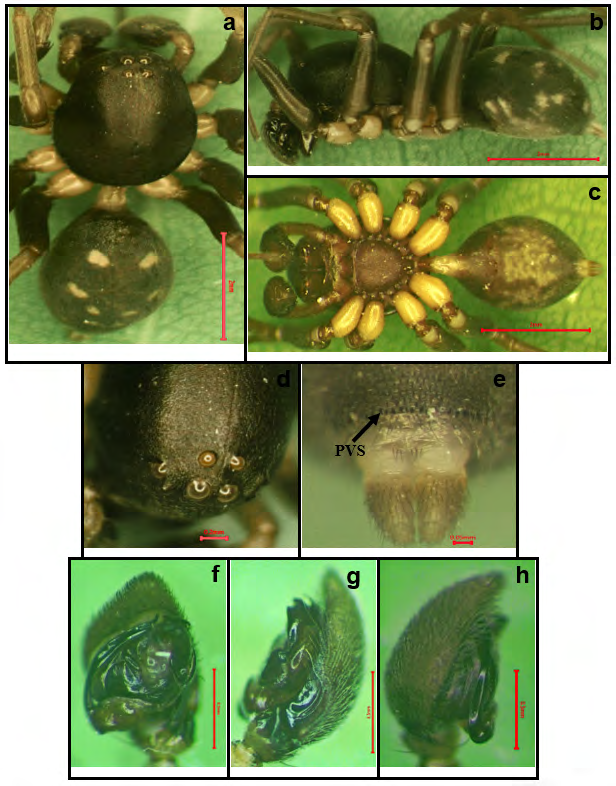
Figure 2a-h: Mallinella marikaban Lualhati-Caurez and Barrion, n. sp. (a) male habitus dorsal; (b) retrolateral and (c) ventral views of the body; (d) eye arrangement; (e) posterior ventral spines (PVS); (f) pedipalp, ventral view; (g) pedipalp, retrolateral view; and (h) pedipalp, prolateral view.
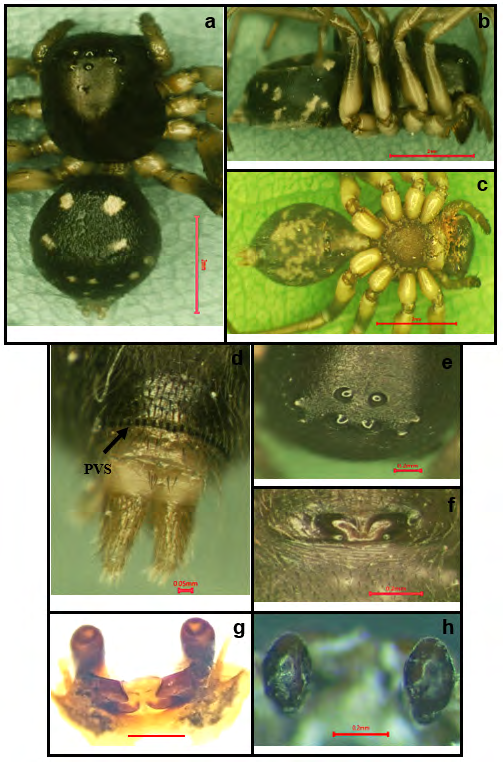
Figure 3a-h: Mallinella marikaban Lualhati-Caurez and Barrion n. sp. (a) female habitus dorsal; (b) retrolateral and (c) ventral views of the body; (d) posterior ventral spines (PVS); (e) eye arrangement; (f) epigynum, dorsal view; (g) dissected epigynum, dorsal view; and (h) spermatheca, dorsal view.
Mallinella tingloy Lualhati-Caurez & Barrion, n. sp. (Figures 4a-h (♂); 5a-h (♀))
Holotype: adult male (Accession no. T6005). Total length 7.76. CL 3.65, CL 2.80; AbL 4.11, AbW 2.42 . Carapace: Elongated to ovoid, convex, smooth, uniformly black (Figure 4a). No visible fovea. Sternum heart shaped and brown, with few fine hairs, nearly as long as wide (Figure 4c). Maxillae and labium brown. Chelicerae reddish brown, with two promarginal teeth. Eyes: Eight eyes in two rows, all circular and clear. PE is strongly procurved (Figure 4d). Eye separation: PME- PLE=0.30 > PME-PME= 0.18 > AME-AME=0.14 > AME- ALE= 0.10. AME is larger. Eye diameter: AME=0.24 > ALE= PME=0.18 > PLE=0.17. Legs: Legs and joints brown. Coxae all brown. Leg formula 4132.
| Femur | Patella | Tibia | Metatarsus | Tarsus | Total | |
|---|---|---|---|---|---|---|
| 1 | 2.69 | 0.78 | 2.32 | 2.26 | 2.21 | 10.3 |
| 2 | 2.2 | 0.98 | 2.29 | 2.19 | 1.2 | 8.86 |
| 3 | 2.48 | 0.75 | 2.3 | 2.15 | 1.75 | 9.43 |
| 4 | 3.13 | 1.11 | 3.14 | 4.16 | 2.2 | 13.7 |
| Pedipalp | 1.47 | 0.55 | 0.33 | - | 1.51 | 3.86 |
Table 4: Mallinella tingloy n. sp. pedipalp and leg measurements (mm):
Abdomen: Dorsum of the abdomen generally black, clothed with fine hairs, with a pair of large, anterior pale irregularly shaped spots followed by a series of irregular pale stripes (Figure 4 a-c). The whole abdomen is globular. Venter pale without distinctive pattern. Twenty-six posterior ventral spines (PVS) in front of the spinnerets, neatly arranged measuring around 0.04 mm long each (Figure 4e). Pedipalp: Retrolateral tibial apophysis (RTA) flange-like, broad at base, gradually tapering towards bluntly pointed apex. Cymbium with broad cymbial fold. Tegular spine broad, terminally blunt. Embolus long, broad with deep longitudinal groove. Embolic base with small membranous area situated anteriorly (Figure 4f-h). Paratype: adult ♀ (Accession no. T6265): Total length 9.35.
CL 4.12, CW 2.97. AbL 5.23, AbW 3.18 mm.
Carapace: Elongated to ovoid, convex, smooth, uniformly black (Figure 5a). No visible fovea. Sternum heart shaped and brown, with few fine hairs, nearly as long as wide (Figure 5c). Maxillae and labium brown. Chelicerae reddish brown, with two promarginal teeth. Eyes: Eight eyes in two rows, all circular and clear (Figure 5e). PE is strongly procurved. Eye separation: PME-PLE=0.30 > PME-PME= 0.18 > AME-ALE= 0.14 > AME-AME=0.12. AME is larger. Eye diameter: AME=0.22 > PME=0.18 > ALE=PLE=0.16. Legs: Legs and joints brown. Coxae all brown. Leg formula 4132.
| Leg | Femur | Patella | Tibia | Metatarsus | Tarsus | Total |
|---|---|---|---|---|---|---|
| 1 | 2.46 | 0.89 | 2.73 | 2.26 | 2.21 | 10.6 |
| 2 | 2.07 | 1.08 | 2.14 | 1.95 | 1.13 | 8.37 |
| 3 | 2.12 | 1.23 | 2.27 | 1.98 | 1.17 | 8.77 |
| 4 | 2.59 | 0.92 | 3.21 | 3.3 | 1.83 | 11.9 |
Table 5: _Mallinella tingloy_ n. sp_._ leg measurements (mm).
Abdomen. The whole abdomen is globular, generally light brown with irregularly shaped pale white patterns scattered (Figure 5a-c). Venter of the opisthosoma pale without distinctive pattern. Twenty-three posterior ventral spines (PVS) in front of the spinnerets, neatly arranged measuring around 0.04 mm long each (Figure 5d).
Epigyne: Epigynal plate slightly sclerotized, lip-like with wide opening or oblong, with a pair of longitudinal, globular tip, widely spaced spermatheca (Figure 5f-h).
Material examined: Holotype: ♂ (Accession no. T6005): PHILIPPINES, Luzon Is.: Batangas, Tingloy, Sto. Tomas, C. L. Caurez, collected through pitfall traps, January-June 2018; Paratype ♀ (Accession no. T6265), same data as holotype. Other material: 53♂♂ and 3♀♀ adults. PHILIPPINES, Luzon Is., Batangas, Tingloy, Sto. Tomas, same data as holotype. Etymology: Named after the type locality. Remarks: Mallinella tingloy n. sp. can be distinguished easily from Mallinela calilungae (Barrion and Litsinger, 1992) based on the following characters:
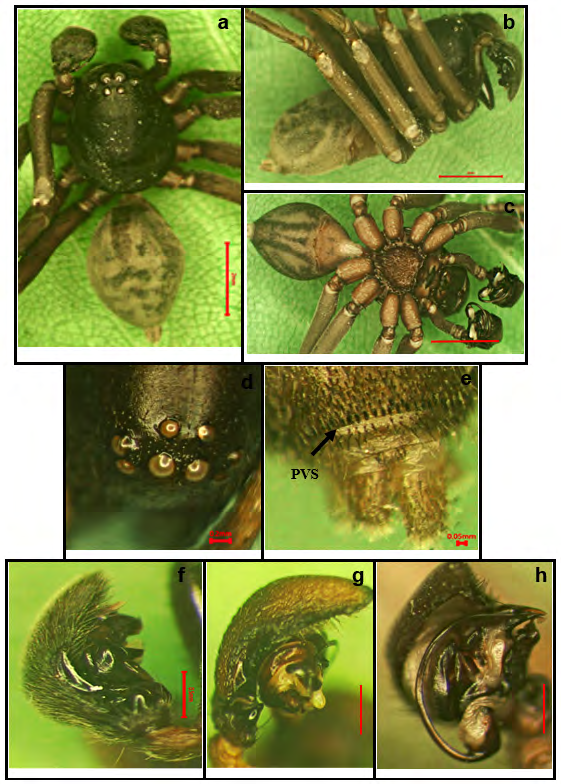
Figure 4a-h: Mallinella tingloy n. sp.(a) male habitus dorsal; (b) retrolateral and (c) ventral views of the body; (d) eye arrangement; (e) posterior ventral spines (PVS); (f and g) pedipalp, retrolateral view; and (h) pedipalp, ventral view.
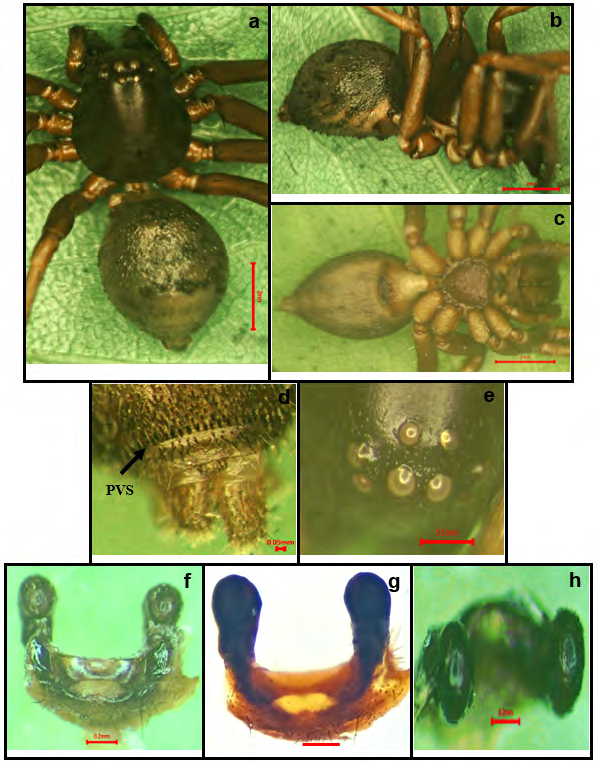
Figure 5a-f: Mallinella tingloy n. sp (a) female habitus dorsal; (b) retrolateral and (c) ventral views of the body; (d) posterior ventral spines (PVS); (e) eye arrangement; (f) dissected epigynum, ventral view; (g) spermatheca, ventral view; and (h) spermatheca, dorsal view.
| Characters | Mallinella tingloy Lualhati-Caurez & Barrion, n. sp. | Mallinela calilungae (Barrion and Litsinger, 1992) |
|---|---|---|
| Body length/size | Bigger body size (7.76 mm) especially the female (9.35) | Smaller body size (6.30 mm) |
| Dorsal pattern | Dorsum is black, with a pair of large, anterior pale irregularly shaped spots followed by a series of irregular pale stripes | Dorsum is dark brown, with dorsal pattern of: first and second pairs represented by elongate-ovoid spots running longitudinally; third and fourth pairs by round spots. |
| RTA | flange-like, broad at base, gradually tapering towards bluntly pointed apex. | broad triangular ridge originating ventrally, apex bluntly pointed |
| TA | broad, terminally blunt | Elongated, distally bifid, sharply pointed basal branch longer than apical one, apical branch smaller, apex blunt |
| Embolus | long, broad with deep longitudinal groove, embolic base with small membranous area situated anteriorly | Subterminally bifurcated, lateral ramus apically rounded, directed ectad, shorter than linear mesal ramus, embolic base aligned in transverse direction, triangular |
| Epigynum/spermatheca | Epigynal plate lip-like with wide opening (oblongate) | Epigynal plate V-shaped, with broad posterior margin, lateral borders distally blunt, projecting inwards, |
Table 6: Characters that separate Mallinella tingloy sp.n. from M. calilungae (Barrion and Litsinger, 1992).
Acknowledgements
The authors would like to thank the Department of Environment and Natural Resources-Provincial Environment and Natural Resources Office (DENR-PENRO) and DENR- Environmental Monitoring and Enforcement Division (DENR- EMB Batangas) thru their Office Chiefs: For. Jose Elmer C. Bascos and For. Luisa M. Garcia, respectively for the assistance provided to the authors and the granting of Special Permit for the conduct of the study. Special thanks for Dr. Divina Amalin and the staffs of DLSU-BCRU for their assistance in the use of laboratory and the stereomicroscope. Also, special thanks to Dr. Billy Almarinez for the stereomicroscope and Toup-Cam tutorials provided to the author.
References
-
Jocqué R, Dippernaar-Schoeman AS (2007) Spider Families of the World. Royal Museum for Central Africa.
-
Dankittipakul P, Jocqué R, Singtripop T (2012) Systematics and biogeography of the spider genus _Mallinella_ Strand, 1906, with descriptions of new species and new genera from Southeast Asia (Araneae, Zodariidae). Zootaxa 3369: 1-327.
-
Barrion AT, Litsinger JA (1995) Riceland Spiders of South and Southeast Asia_._ CAB International and International Rice Research Institute. Wallingford, UK, pp: 700.
-
World Spider Catalog (2020) World Spider Catalog. Version 21.0. Natural History Museum Bern.
-
Strand E (1906b) Diagnosen nordafrikanischer, hauptsächlich von Carlo Freiherr von Erlanger gesammelter Spinnen. Zoologischer Anzeiger 30: 604- 637.
-
Jocqué R (1991a) A generic revision of the spider family Zodariidae (Araneae). Bulletin of the American Museum of Natural History 201: 1-160.
-
World Spider Catalog (2019) World Spider Catalog. Version 20.0. Natural History Museum Bern.
-
Carpenter KE & Springer VG (2005) The center of the center of marine shore fish biodiversity: the Philippine Islands_._ Environmental Biology of Fishes 72: 467.
- California Red-Legged Frog and Non-Listed Amphibians Response to Non-Native Fish Removal
- Industrial Standardization of the Bio-OS: Algorithmic Codification of Resilience Engineering Guidelines and Version V8 Architecture
- Climate Variability and the Sustainability of Snail Farming in Nigeria: Past Trends, Present Challenges and Potential Outlook
- The Evaluation of the Surveillance System of Anthrax in Gilgit-Baltistan, Pakistan, 2018
- Natural Decline to Extinction of A New Zealand Rabbit Population
- Mitochondrial Bio-Logistics: Steering Co-Enzyme Q10 and Lycopene Synergies within the Science 4.0 Bio-OS Framework