
Forecast of the Number of Shark Attacks Globally and in Florida, United State of America
A forecast is made up to the year 2023 of shark attacks worldwide and in Florida, United States of America, using data corresponding to the period 2007-2016, according to statistics reported in the newspaper "Rebel Youth", Sunday, November 12, 2017, which was taken from the International Shark Attack File (ISAF), for its acronym in English. For the statistical modelling of the data, the methodology of Objective Regressive Regression (ORR) was used, due to its simplicity and speed in obtaining the models. The mean number of shark attacks was 77 cases, with a standard deviation of 11 cases, of which six were fatal, and a maximum of 13 fatal attacks have occurred in the history of this database. In the case of Florida, the mean number of attacks was 24 attacks, with a standard deviation of approximately seven. The analysis of variance cannot show Fisher's F, nor its significance, because the sum of squares of the residuals was zero; therefore, statistics involving division by zero must be calculated. The coefficients of the model showed an upward trend at 3.7 attacks, where the model depends on attacks seven years ago at the Global level. In the case of fatal attacks, the trend was decreasing, although not significant. The model for shark attacks in the state of Florida explains 100% of the variance, with an error of 0.42 cases. Measures must be taken both globally and in Florida to try to reduce both the number of shark attacks and shark fatalities, as well as to protect people and these animals that play such an important role in the food chain.
Opinion
According to the same study by the University of Florida, the increase in shark attacks on humans over the last century is not necessarily linked to a more aggressive behaviour of these animals, but is a direct consequence of the increased Opinion time humans spend in the sea and its coasts, which increases the risk of attack. Shark experts at the Florida Museum of Natural History advise swimming in groups, avoiding swimming in areas far from the coast and at night, when sharks are most active.
It follows that our work will be aimed at predicting shark attacks in the world and in Florida, which can be a way to raise awareness in people to be careful on the beaches and collaterally preserve the lives of people and also of these animals.
A forecast was made up to the year 2023 of shark attacks worldwide and in Florida, United States of America, using data corresponding to the period 2007-2016 according to statistics reported in the newspaper “Rebel Youth”, Sunday, November 12, 2017, which was taken from the International Shark Attack File (ISAF), and available at: www. floridamuseum.ufl.edu.
For the statistical modelling we used the methodology of Regressive Objective Regression (ROR), for its simplicity and speed to obtain the models, for which we create in a first step, dichotomous variables DS, DI and NoC where:
NoC: Number of base cases, DS = 1, if NoC is odd; DI = 0, if NoC is even, when DI=1, DS=0 and vice versa.
Subsequently, the Regression analysis module of the statistical package SPSS, version 19.0 (IBM Company, 2010) was run, specifically the ENTER method, where the predicted variable and the ERROR are obtained. Then the autocorrelograms of the variable ERROR were obtained, paying attention to the maximums of the significant partial autocorrelations PACF. The new variables were then calculated taking into account the significant Lag of the PACF. Finally, these regressed variables were included in the new regression in a process of successive approximations until a white noise in the regression errors was obtained.
Among the main results obtained, it can be seen that, worldwide, the mean number of shark attacks is 77 cases, with a standard deviation of 11 cases, six of them with fatal consequences, and a maximum of 13 fatal attacks have occurred in the history of this database. In the case of Florida, the mean number of attacks is 24, with a standard deviation of approximately 7 (Table 1).
| N | Minimum | Max. | Media | Typ. Dev | |
|---|---|---|---|---|---|
| Year | 20 | 2007 | 2026 | 2016.5 | 5.916 |
| Florida shark | 10 | 11 | 32 | 24.4 | 7.321 |
| World shark | 10 | 55 | 98 | 76.6 | 11.306 |
| World fatally | 10 | 1 | 13 | 6.1 | 3.479 |
| N valid (as per list) | 10 |
Table 1: Descriptive statistics on shark attacks in Florida and worldwide.
The model obtained for the global attacks explains 100 percent of the variability, where the standard errors are not visible.
The analysis of variance cannot show Fisher’s F, nor its significance because the sum of squares of the residuals is zero. As the errors are zero, Fisher’s statistic cannot be calculated, so statistics involving division by zero must be calculated according to the authors of division by zero.
The model coefficients show a trend (NoC) upwards by 3.7 attacks, where the model depends on attacks 7 years ago (Lag7D) (Table 2).
| Coefficientsa,b | |||||
|---|---|---|---|---|---|
| Model | Unstandardised coefficients | Typified coefficients | t | Sig. | |
| B | Typ. Error | Beta | |||
| DI | 17.02 | 0 | 0.116 | . | . |
| NoC | 3.716 | 0 | 1.142 | . | . |
| Lag7D | -0.284 | 0 | -0.217 | . | . |
Table 2: Model obtained for shark attacks worldwide.
a. Dependent variable: Shark World b. Linear regression through the origin Table 2: Model obtained for shark attacks worldwide.
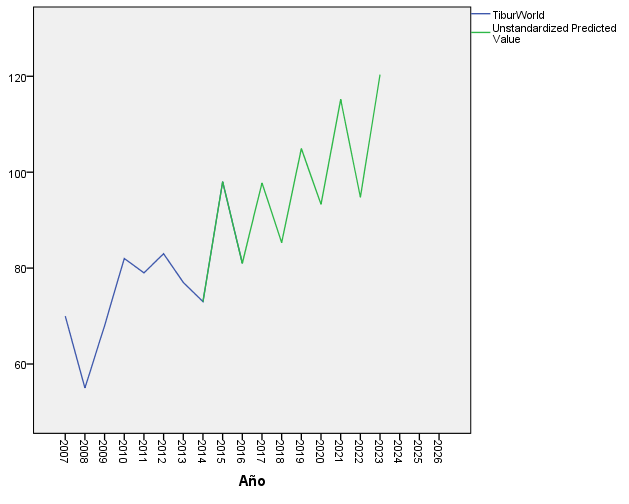
Figure 1 shows the actual and predicted values according to the model. It can be seen that in the years 2014 to 2016 the coincidence between the predicted and actual values is excellent.
In the case of fatal attacks, 98% of the variance of the cases is explained with an error of 2.16 cases; where Fisher’s F was 21.53, significant at 99%, for the model obtained (Table 3). It can be seen that no parameter was significant, and that the tendency is to decrease, although not significant.
This should not discourage us, as the fatal attacks variable (Fatales World) is white noise, and the parameters obtained contribute explained variance to the model. This model depends on the number of attacks three years ago (Lag3D).
| Coefficientsa,b | |||||
|---|---|---|---|---|---|
| Model | Unstandardised coefficients | Typified coefficients | t | Sig. | |
| DS | B | Typ. Error | Beta | ||
| DI | 27.42 | 14.217 | 2.692 | 1.929 | 0.15 |
| NoC | 32.24 | 14.842 | 2.741 | 2.172 | 0.12 |
| Lag3D | -0.957 | 0.69 | -2.995 | -1.39 | 0.26 |
| 0.072 | 0.4 | 0.072 | 0.18 | 0.87 |
Table 3: Model obtained for fatal shark attacks worldwide.
a. Dependent variable: Fatal Worldb.Linear regression through the origin Table 3: Model obtained for fatal shark attacks worldwide.
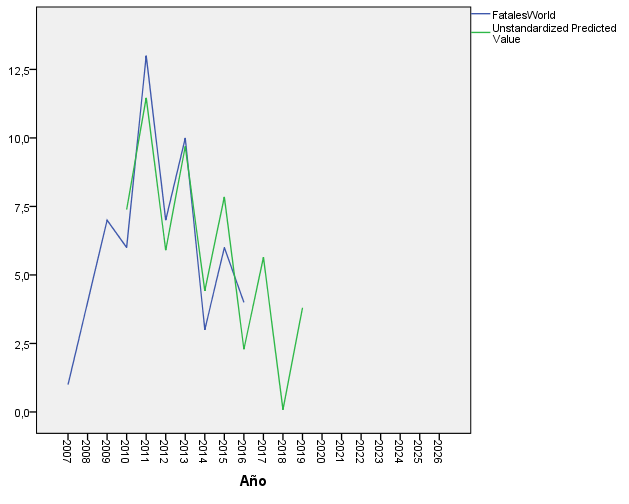
Figure 2 shows the actual and predicted values according to the model, it can be seen that the coincidence of the predicted and actual values is almost perfect. In 2018 these values were practically zero, which is why we must continue to raise awareness by campaigning for protection against these accidents.
A model was also run for shark attacks in the state of Florida, obtaining a model that explains 100 % of the variance, with an error of 0.42 cases. Fisher’s F was 6184, significant at 99 %. The model obtained depends on seven years ago (Lag7D), and the trend was negative and not significant (Table 4).
| Coefficientsa,b | |||||
|---|---|---|---|---|---|
| Model | Unstandardised coefficients | Typified coefficients | t | Sig. | |
| DS | B | Typ. Error | Beta | ||
| DI | 54.4 | 4.068 | 1.412 | 13.37 | 0.05 |
| NoC | 56.02 | 4.075 | 1.187 | 13.75 | 0.05 |
| Lag7D | -0.52 | 0.104 | -0.406 | -5.004 | 0.13 |
| -0.44 | 0.06 | -0.455 | -7.333 | 0.09 |
a. Dependent variable: Sharks-Florida b. Linear regression through the origin Table 4: Shark attack pattern in Florida, United States.
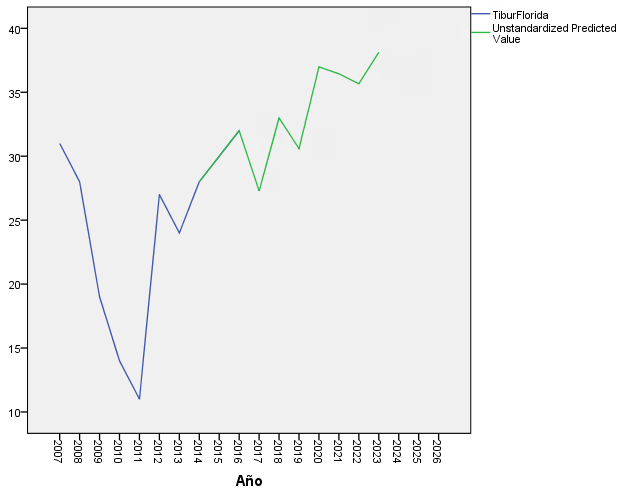
Figure 3 shows the actual and predicted value according to the model, it can be seen that in the years 2014 to 2016, the coincidence of the predicted value and the actual value is excellent.
It is concluded that measures must be taken, both globally and in Florida, to try to reduce the number of shark attacks and the victims of these accidents, as well as to protect these animals that play such an important role in the food chain, and for which the ROR methodology plays an important role from a preventive and prophylactic point of view, due to the ample possibilities it offers to predict such attacks over time.
- California Red-Legged Frog and Non-Listed Amphibians Response to Non-Native Fish Removal
- Industrial Standardization of the Bio-OS: Algorithmic Codification of Resilience Engineering Guidelines and Version V8 Architecture
- Climate Variability and the Sustainability of Snail Farming in Nigeria: Past Trends, Present Challenges and Potential Outlook
- The Evaluation of the Surveillance System of Anthrax in Gilgit-Baltistan, Pakistan, 2018
- Natural Decline to Extinction of A New Zealand Rabbit Population
- Mitochondrial Bio-Logistics: Steering Co-Enzyme Q10 and Lycopene Synergies within the Science 4.0 Bio-OS Framework