
First Record of the White-Eyed Gull Ichthyaetus leucophthalmus in Lebanon 2020
The White-eyed Gull Ichthyaetus leucophthalmus is a medium-sized gull, similar in appearance, on some counts, to the Sooty Gull I. hemprichii, with which it is known to associate near fishing harbours). The known range of this bird is restricted to the Red Sea, and the Gulf of Aden. On the 31st of December 2020, Michel Sawan saw an individual in Al Mina, Tripoli District, north Lebanon, flying over the Abed Al Wahad Island. After the confirmation of the identity of the species by Bassel Abi Jumaa and Dr Ghassan Ramadan Jaradi, it was confirmed to be a first record to Lebanon.
Mini Review
The White-eyed Gull Ichthyaetus leucophthalmus is a medium-sized gull, similar in appearance, on some counts, to the Sooty Gull I. hemprichii, with which it is known to associate near fishing harbours ). The known range of this bird is restricted to the Red Sea, and the Gulf of Aden [1]. The White-eyed Gull Larus leucophthalmus breeds colonially on inshore islands and islets in the Gulf of Aden and the Red Sea, in Egypt (mainly on islands at the mouth of the Gulf of Suez), Sudan, Eritrea (Dahlak Archipelago), Djibouti, Saudi Arabia, Yemen and Somalia. Wintering birds disperse throughout the breeding range.
This species has an extremely large range, and hence does not approach the thresholds for Vulnerable under the range size criterion (Extent of Occurrence <20,000 km2 combined with a declining or fluctuating range size, habitat extent/quality, or population size and a small number of locations or severe fragmentation). The population trend appears to be stable, and hence the species does not approach the thresholds for Vulnerable under the population trend criterion (>30% decline over ten years or three generations). The population size is very large, and hence does not approach the thresholds for Vulnerable under the population size criterion (<10,000 mature individuals with a continuing decline estimated to be >10% in ten years or three generations, or with a specified population structure). For these reasons the species is evaluated as Least Concern. The population is believed to be stable [2].
The species is mostly sedentary [3, 4] although it disperses from its breeding sites to occur throughout the Red Sea during the non-breeding season. There may also be some southward and eastward movements during this time, when it is reported to become scarce in the northern part of its [3]. Breeding takes place during the months of June - August, extending to September in Egypt. It breeds in loose colonies, usually consisting of fewer than 25 pairs, though occasionally larger colonies of hundreds of individuals can be observed. During the non-breeding season, it is usually found in small groups, but sometimes forms flocks of hundreds or even thousands to forage.
The species is mainly coastal. It usually feeds at sea (PERSGA/GEF 2003), but some Egyptian populations have adopted a scavenging role at rubbish tips, harbours and touristic area along the Egyptian Red Sea Cost. Breeding It breeds on inshore islands, where it occupies bare rock and sand flats. Non-breeding Outside the breeding season, it often occurs further out to the sea. It roosts on rocks, coral reefs, piers and fishing vessels.
The diet consists largely of fish, but also includes crustaceans, molluscs, annelids and. Fish species taken in Egypt include Scarpus spp. about 110 mm in length. It also feeds on fruits and plants such as Nitraria retusa and is known to predate the eggs and nestlings of the Lesser Crested Tern Sterna bengalensis. It scavenges in the northern part of its range, feeding on all types of food (i.e. meat, rice, bread, water melon and flying insect [5]), but to a lesser extent than does L. hemprichii with which it often associates [6].
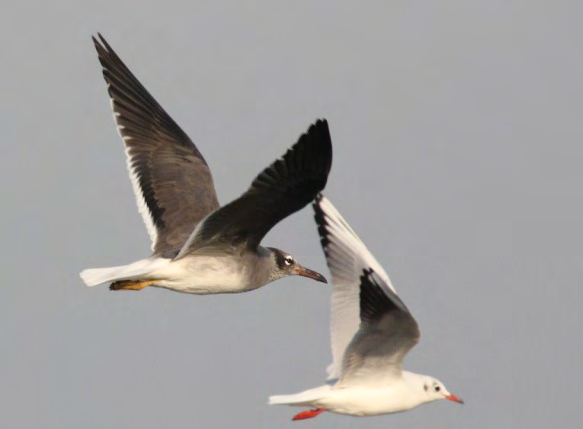
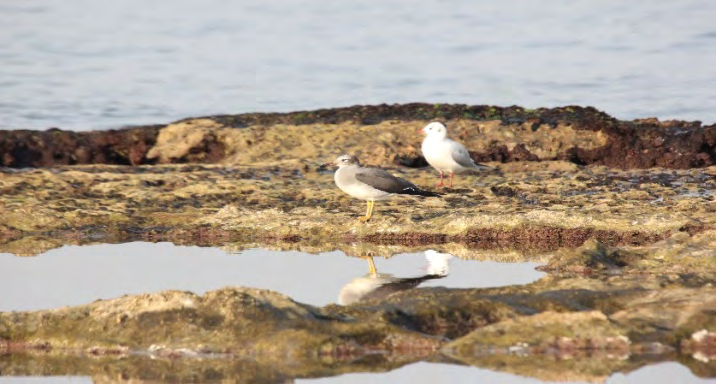
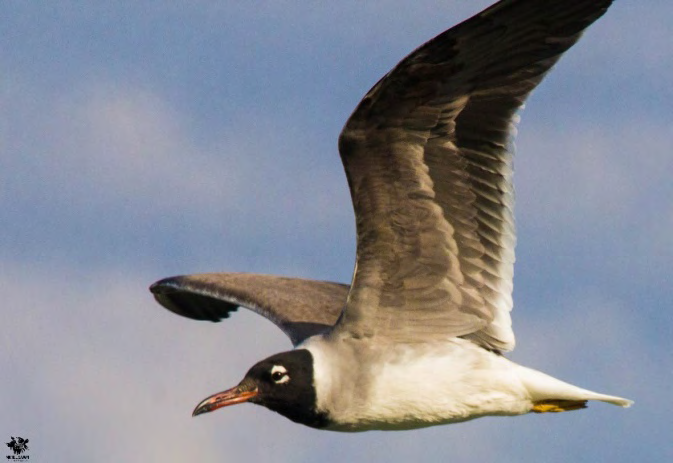
On the 31st of December 2020, I was birdwatching on the seashore at Al Mina, Tripoli District in north Lebanon, I was about to leave the area when I noticed a flock of black- headed gulls Chroicocephalus ridibundus flying near the port and one White-eyed Gull among them (Figure 1), I took some shots and then I got closer. The bird landed on a rock near the water and let me take many clear shots of it (Figure 2). The bird remained till mid of April 2021 and changed its plumage into the breeding appearance, and then it disappeared from the area (Figure 3). After the confirmation of the identity of the species by Bassel Abi Jumaa and Dr Ghassan Ramadan Jaradi, it was confirmed to be a first record and added to the National Bird Checklist of Lebanon.
References
-
Burger J, Gochfeld M, Kirwan GM, Garcia EFJ (2016) White-eyed Gull (Larus leucophthalmus). In: del Hoyo J, Elliott A, et al. (Eds.). Handbook of the Birds of the World Alive. Lynx Edicions, Barcelona.
-
Rose PM, Scott DA (1997) Waterfowl population estimates. Wetlands International, Wageningen, Netherlands.
-
Urban EK, Fry CH, Keith S (1986) The Birds of Africa, Volume II. Academic Press, London, UK.
-
Del Hoyo J, Elliott A, Sargatal J (1996) Handbook of the Birds of the World. Volume 3: Hoatzin to Auks. Lynx Edicions, Barcelona, Spain.
-
Habib MI (2017) Surveys of White-eyed Gull on islands in Red Sea, Egypt, and notes on behaviour. Durch Birding 39(1): 13-21.
-
Grimmett R, Inskipp C, Inskipp T (1999) Pocket guide to the birds of the Indian Subcontinent. New Delhi: Oxford University Press pp: 1-384.
- California Red-Legged Frog and Non-Listed Amphibians Response to Non-Native Fish Removal
- Industrial Standardization of the Bio-OS: Algorithmic Codification of Resilience Engineering Guidelines and Version V8 Architecture
- Climate Variability and the Sustainability of Snail Farming in Nigeria: Past Trends, Present Challenges and Potential Outlook
- The Evaluation of the Surveillance System of Anthrax in Gilgit-Baltistan, Pakistan, 2018
- Natural Decline to Extinction of A New Zealand Rabbit Population
- Mitochondrial Bio-Logistics: Steering Co-Enzyme Q10 and Lycopene Synergies within the Science 4.0 Bio-OS Framework