
First Record of the Kurdish Wheatear Oenanthe xanthoprymna in Lebanon 2022
This species has a very large range, and hence does not approach the thresholds for Vulnerable under the range size criterion (Extent of Occurrence <20,000 km2 combined with a declining or fluctuating range size, habitat extent/quality, or population size and a small number of locations or severe fragmentation). The population trend appears to be stable, and hence does not approach the thresholds for Vulnerable under the population trend criterion (>30% decline over ten years or three generations). The population size may be moderately small to large, but it is not believed to approach the thresholds for Vulnerable under the population size criterion (<10,000 mature individuals with a continuing decline estimated to be >10% in ten years or three generations, or with a specified population structure). For these reasons the species is evaluated as Least Concern. On the 1st of April 2022, I was birdwatching on Mount Terbol, Dannieh District in North Lebanon when I noticed an individual catching some insects on a rock in the valley. I took many photos of the bird immediately after I confirmed the ID and reported it and it was accepted to be added officially to the National Birds Checklist in Lebanon.
Mini Review
This species has a very large range, and hence does not approach the thresholds for Vulnerable under the range size criterion (Extent of Occurrence <20,000 km2 combined with a declining or fluctuating range size, habitat extent/ quality, or population size and a small number of locations or severe fragmentation). The population trend appears to be stable, and hence does not approach the thresholds for Vulnerable under the population trend criterion (>30% decline over ten years or three generations). The population size may be moderately small to large, but it is not believed to approach the thresholds for Vulnerable under the population size criterion (<10,000 mature individuals with a continuing decline estimated to be >10% in ten years or three generations, or with a specified population structure). For these reasons the species is evaluated as Least Concern.
In Europe, the breeding population is estimated to number 600-2,000 pairs, which equates to 1,200-4,000 mature individuals [1]. Europe forms c.10% of the global range, so a very preliminary estimate of the global population size is 12,000-40,000 mature individuals. The population is suspected to be stable in the absence of evidence for any declines or substantial threats. The European population is estimated to be stable [1].
During the breeding season, this species is found on dry rocky mountain slopes and in valley bottoms where patches of dwarf shrubs and herbs (e.g. Ferula) are interspersed with bare rocks, scattered boulders or stunted trees. On the wintering grounds in Africa it is found in coastal plain and rocky hills, mostly in arid habitats such as cliffs, gorges, acacia grassland, annual grassland and rocky desert. In eastern Turkey, nests with young have been recorded in mid-June and early August. The nest is unreported but is presumably similar in type and placement to that of Oenanthe chrysopygia. The diet includes ants, beetles, termites, caterpillars and many other insect species and occasionally small lizards, seeds and fruit. The species is migratory, wintering in Africa [2, 3].
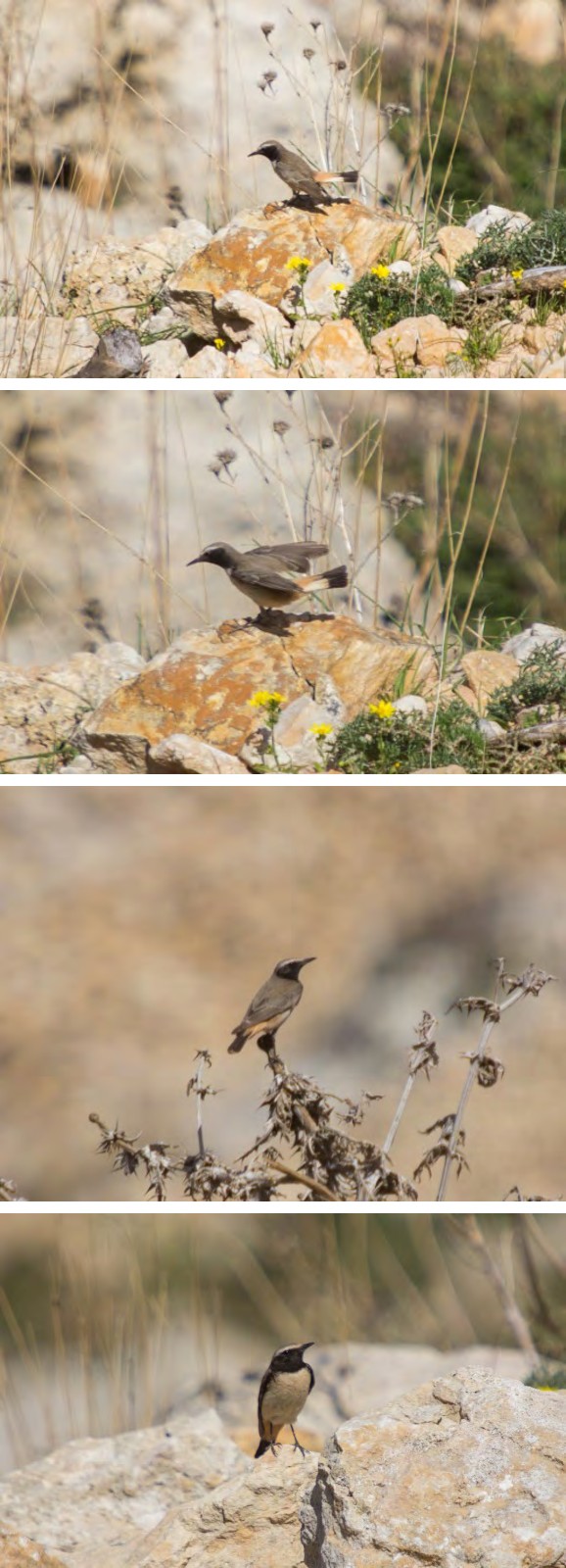
The estimated population size is 12000-40000 and the population trend is Stable On the 1st of April 2022, I was birdwatching on Mount Terbol, Dannieh District in North Lebanon when I noticed an individual catching some insects on a rock in the valley. The bird stayed there for more than 4 hours, jumping on the rocks and chasing insects from the ground. The next day it was not found there at the same place. I took many photos of the bird immediately after I confirmed the ID and reported it and it was accepted to be added officially to the National Birds Checklist in Lebanon.
References
-
BirdLife International (2015) European Red List of Birds. Office for Official Publications of the European Communities, Luxembourg.
-
Collar N, De Juana E (2015) Chestnut-rumped Wheatear (_Oenanthe xanthoprymna_). In: Del Hoyo J, Elliott A, et al. (Eds.), Handbook of the Birds of the World Alive, Lynx Edicions, Barcelona, Spain.
-
IUCN (2019) The IUCN Red List of Threatened Species.
- California Red-Legged Frog and Non-Listed Amphibians Response to Non-Native Fish Removal
- Industrial Standardization of the Bio-OS: Algorithmic Codification of Resilience Engineering Guidelines and Version V8 Architecture
- Climate Variability and the Sustainability of Snail Farming in Nigeria: Past Trends, Present Challenges and Potential Outlook
- The Evaluation of the Surveillance System of Anthrax in Gilgit-Baltistan, Pakistan, 2018
- Natural Decline to Extinction of A New Zealand Rabbit Population
- Mitochondrial Bio-Logistics: Steering Co-Enzyme Q10 and Lycopene Synergies within the Science 4.0 Bio-OS Framework