
Post Covid19 Olfactory Disorders Emerging Therapeutic Option
In addition to the olfactory disorders that have been observed as a consequence of the infection by SARS CoV2 (COVID19), in certain latitudes with special climatic characteristics, many patients suffer simultaneously from crusty rhinitis (historically, this entity has also received the name of atrophic rhinitis). This combination represents -for the Specialist- a double challenge. A therapeutic alternative will be presented that, in the first instance, has shown very satisfactory results. Hopefully, we will be able to expand the knowledge of its mechanism of action and, thus, favor a greater number of patients.
Introduction
Throughout 2021, numerous cases of post-COVID19 olfactory disorders (consisting of parosmias, dysosmias, phantosmias, consecutive to the manifestations of anosmia / hyposmia caused by acute viral infection) were seen. Most of the patients had developed between 6 and 9 months of evolution with the olfactory disorder at the time of the examination, having tried various treatments (nasal and oral corticosteroids, thioctic acid) unsuccessfully [1, 2].
A patient in this group -in addition to a parosmia of 8 months of evolution- presented a dry rhinitis, very characteristic of the place (Ushuaia), due to the dry climate in general and the use of heating to cope with the low temperatures prevailing, even in Summer (Figure 1).
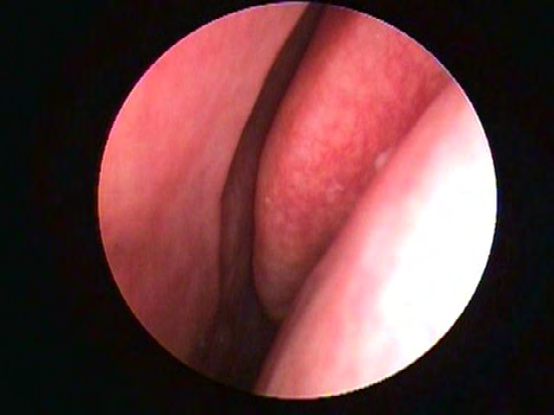
Due to this last comorbidity, a nasal application of the commercial otonasal Fusimed B® product was used, the formulation of which is Fusidic Acid 2%, Betamethasone 0.1% in the form of an emulsion (three times daily for at least 10 to 15 days, according to the evolution [3].
After controlling the patient at seven days, it was found that the dry rhinitis had resolved and that the parosmia that afflicted him had notably improved. The subjective experience of the patient was to perceive odours in an almost completely normal way, for the first time in 8 months (Figure 2). Initially, it was thought that the improvement could have been occasional; but -with a growing number of patients with post-COVID19 olfactory disorders, and not having success with the other indicated treatments- otonasal Fusimed B® began to be prescribed in all of them.
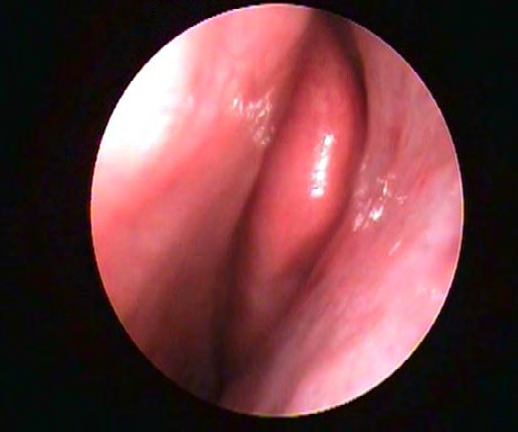
Thus, similar results were obtained, consisting of the partial disappearance of the olfactory disorder within 5 to 10 days. All patients were analyzed with a smell test (coffee, chocolate, cloves, lemon), recording the results:
- Perception or not of aroma,
- Correct or not description of aroma,
- Exact identification or not of aroma rightly.
In addition, video rhinoscopies were performed, observing rubeosis of the mucosa of the middle turbinate of both nostrils. The disappearance of symptoms was complete by 10 to 15 days of treatment in most patients. All patients experienced a subjective improvement in olfaction, with the phenomena of parosmia, phantosmia and dysosmia disappearing [4].
Objective improvement also occurred with the olfactory test, identifying odours, and an improvement in the mucosa of the middle turbinate of both nostrils was recorded. With these results, we started evaluating why other treatments such as oral, local corticosteroids in the form of spray and thioctic acid had not been successful in the same cohort of patients.
Since spray-born corticosteroids (fluticasone, mometasone) had not worked, it was strange that a corticosteroid such as betamethasone via emulsion would give a different result. It could be suspected that the vehicle by which it was applied, an emulsion, had made the difference, interpreting that the persistence of the active principle in the olfactory neuroepithelium and adjacent areas of the nostrils had achieved the result. This interpretation could be linked to the phenomenon of dry mucous membranes common in the Ushuaia population.
However, it would be expected that improvements would occur in hyposmias or anosmias, because in cases of dry mucous membranes, they would be favored in the air flow received by the olfactory neuroepithelium and not in parosmias and dysosmias, just because in them there is not a problem of the flow of olfactory particles impacting on it. It was also thought that fusidic acid could have caused the favorable action, even though the mechanism by which it would occur was not known.
Other possibilities were also analyzed, such as the content of the excipient of the commercial product finding.
The formulation is as follows: each 100 g of dermal emulsion contains: Fusidic Acid 2.00 g; Betamethasone Valerate (equivalent to Betamethasone 0.10 g) 0.12 g. Excipients: Mineral Oil, Isopropyl Myristate, Non-ionic Self- Emulsifying Wax, Benzyl Alcohol, Xanthic Gum, Ceramide, Tocopheryl Acetate, Butylhydroxytoluene, Disodium Edetate, Sodium Hyaluronate, Purified Water.
Any of these products - or the coadjuvant among them- could have had an action, in addition to fusidic acid and betamethasone.
Comments
The challenge caused by a pathology with a high impact on the quality of life of patients is to find a treatment that provides relief or total resolution, which seems to have been achieved. However, further studies would have to be carried out (reproducing similar results in other cities with a humid climate, to disaggregate the dry climate from among the other variables; standardized multicenter studies, validated olfactory tests, etc.) to adequately analyze this finding.
References
-
Natalia Cabrera S, P Samanta Ruz, Constanza J (2013) Atrophic rinitis. Rev Otorrinolaringol Cir. Head Neck 73(3).
-
Fresno MJ, Santander H, Valenzuela S, Gutiérrez MF, Miralles R (2011) Olfactory sensory perception. Rev Méd Chile 139(3): 362-367.
-
Carrillo B, Carrillo V, Astorga A, Hormachea DF (2017) Diagnosis in smell pathology: Literature review. Rev Otorrinolaringol Cir Cabeza Cuello 77: 351-360.
-
Morillo VC, Calero CG, Muñoz JJF, Muñoz AT, Huete JF, et al. (2017) Sensorineural anosmia: relationship between subtype, recognition time, and age. Clínica Salud 28(3): 155-161.
- 4th Branchial Cleft Sinus Anomaly Presenting as Recurrent Thyroid Abscess in A Child: A Case Report
- Parotid Duct Injury Repaired Using an Angiocatheter Stent: A Case Report
- Organization and Functionality of the Referral and Counter-Referral System for ENT Disorders in District Hospitals of N’Djamena, Chad: A Cross-Sectional Analytical Study
- Facial Metastases from a Gastrointestinal Stromal Tumor: A Case Report
- Panorama of Ent Cancers and Literature Review: Epidemiological Profile and Therapeutic Management
- Could Antimicrobial Resistance Prove to Be Both a Threat and an Opportunity for us?