
Outcome of Cochlear Implantation in Children with Auditory Neuropathy-A Dual Case Study
Objectives: The aim of this study is to compare the outcome of cochlear implantation in two pediatric auditory neuropathy cases. Methods: Two cases with auditory neuropathy were taken. Case 1 was 10 year old male. Case 2 was 11 year old male. In preoperative assessment both have bilateral severe to profound sensory-neural hearing loss. Case 1 was implanted by MED-EL using sonata Ti100 opus 2 processor. Case 2 was implanted using MED-EL using sonata Ti100 opus 2 processor. Both cases were given auditory verbal therapy. Both cases attended auditory verbal therapy for a period of 2 years. In postoperative assessment for each individual subject, electrically evoked compound action potentials (ECAPs), electrically evoked stapedius reflex threshold (ESRT), and electrically evoked auditory brainstem response (EABR) thresholds were determined. The following questionnaire extended receptive expressive emergent language scale (E-REELS) , Categories of Auditory Performance (CAP) score, Speech Intelligibility Rating (SIR) scale, Meaningful Auditory-Integration Scale (MAIS) and Meaningful Use of Speech Scale (MUSS) are scales were administered. Results: In the postoperative assessment, ECAP, ESRT, EABR, MUSS, MAIS shows that case 1 with auditory neuropathy have better performance than case 2. Conclusion: It is essential that all possible complications and postoperative performance should be considered in cochlear implantation for auditory neuropathy individuals
Introduction
Auditory neuropathy (AN) is term used to refer hearing disorders for which physiological test show that the eight cranial nerve or the lower brainstem is functioning abnormally even though the outer hair cells are operating normally. Auditory neuropathy (AN) refers to individuals with abnormal auditory neural responses in the presence of normal cochlear function. Patients with Auditory neuropathy can have any degree of sensory-neural hearing loss ranging from mild to severe, and they can have poor speech recognition performance [1]. Auditory neuropathy (AN) is a heterogeneous condition for which the optimal method of auditory rehabilitation has been a matter of some debate until recently . Auditory neuropathy patients often do not receive sufficient benefit from hearing aids [2]. Electrically evoked compound action potentials (ECAPs) are the summary of multiple neurons’ spikes, representing the neural synchronization under electrical stimulation, and can be recorded by a bidirectional stimulation-recording system through the implanted multichannel electrodes. ECAP is an objective test and the recordings do not require patient attention [3]. The MED-EL MAESTRO cochlear implant system have standard electrode array allows a deeper insertion. This long electrode array is capable of stimulating the most apical region of the cochlea, and in apical region one can observe significant higher ECAP amplitude, lower thresholds and steeper amplitude growth function slopes [4]. In auditory neuropathy patients with cochlear implant the amplitudes of ECAP reported to be low incidence, low differentiation and large variation as the characteristics. However, ECAPs cannot yet be a good indicator of post-operative hearing and speech performance in these patients [5]. The electrically elicited stapedius reflex has a threshold and demonstrates amplitude growth till saturation. These responses can be recorded ipsi or contralaterally eSRTs were measured either in an awake state or during natural sleep [6]. The auditory brainstem response (ABR) can be performed by electrical stimulation through the cochlear implant, which is so called electrically evoked ABR (EABR). Wave V is typically the most robust and is usually the only wave of EABR that remains visible at the lowest level. To verify the function of electrodes, device and peripheral auditory system EABR can be used [7]
Many Studies reported that Auditory Neuropathy patients may benefit from cochlear implantation (CI), but reported outcomes are variable. The aim of this study is to compare the outcome of cochlear implantation in two pediatric auditory neuropathy cases.
Methods and Procedure
Two cases with auditory neuropathy were taken. Case 1 was 10 year old male. Case 2 was 11 year old male. In preoperative assessment for hearing evaluation both individuals the following test are administered otoacoustic emission and auditory brainstem response. The otoacoustic emission results show that for both cases bilateral adequate functioning of outer hair cells. The auditory brainstem response results show that both cases have bilateral severe to profound sensory neural hearing loss. Case 1 was implanted by MED-EL using sonata Ti100 opus 2 processor. Case 2 was implanted using MED-EL using pulsar opus 2 processor. Both cases were given auditory verbal therapy. Both cases attended auditory verbal therapy for a period of 2 years. In postoperative assessment for each individual subject, electrically evoked compound action potentials (ECAPs), electrically evoked stapedial reflex threshold (ESRT), and electrically evoked auditory brainstem response (EABR) thresholds were determined. The following questionnaire Extended Receptive Expressive Eemergent Language Scale (E-REELS), Categories of Auditory Performance (CAP) score, Speech Intelligibility Rating (SIR) scale, Meaningful Auditory-Integration Scale (MAIS) and Meaningful Use of Speech Scale (MUSS) are scales were administered.
Results and Discussion
In postoperative assessment, both cases after attending auditory verbal therapy for a period of 2 years, Electrically Evoked Compound Action Potentials (ECAPs), Electrically Evoked Stapedial Reflex Threshold (ESRT), and Electrically Evoked Auditory Brainstem Response (EABR) thresholds were determined, the following results are obtained
| Test name | Case 1 | Case 2 |
|---|---|---|
| ECAP | Responses are present in all electrodes | Responses are absent in all electrodes |
| ESRT | Responses are present in all electrodes | Responses are absent in all electrodes |
| EABR | Responses are present in all electrodes | Responses are absent in all electrodes |
ESRT Results
Case 1
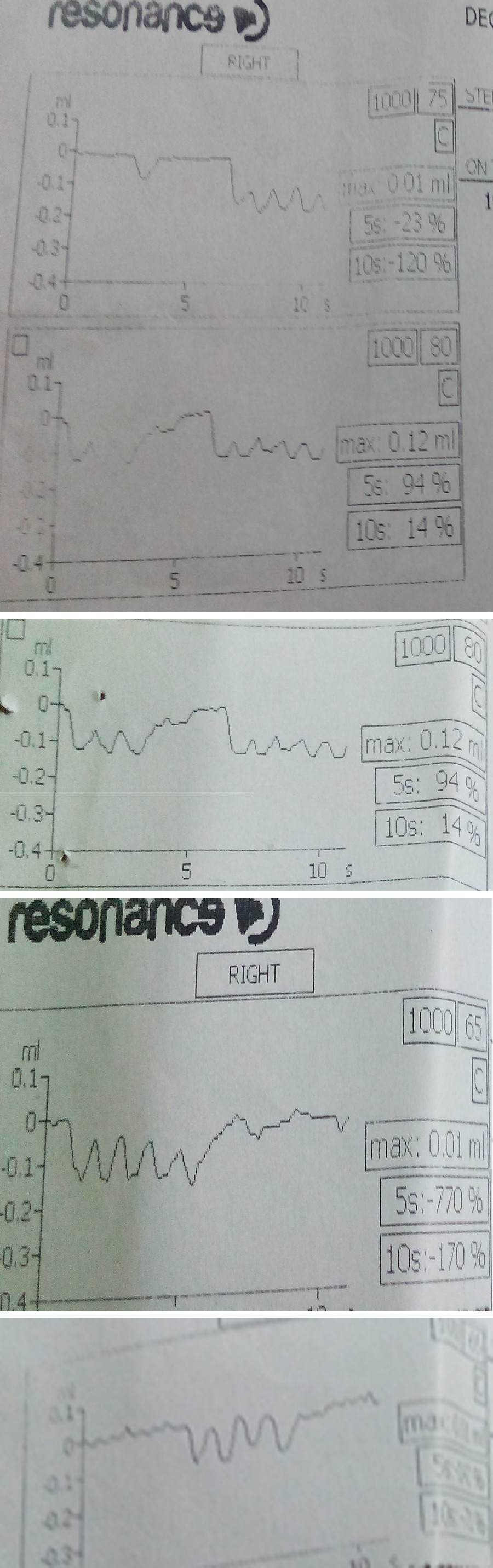
3rd electrode
7th electrode
12th electrode
From the above ESRT case 1 report one can find the responses are present.
EABR Results Case 1
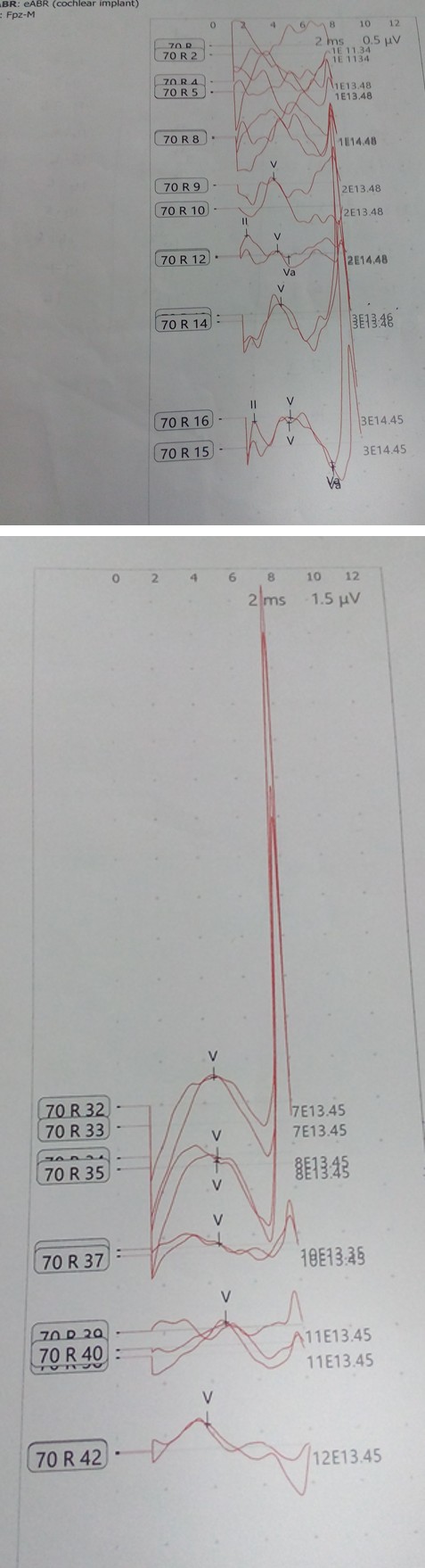
From the above EABR case 1 report, one can find the responses are present.
Case 2 ESRT
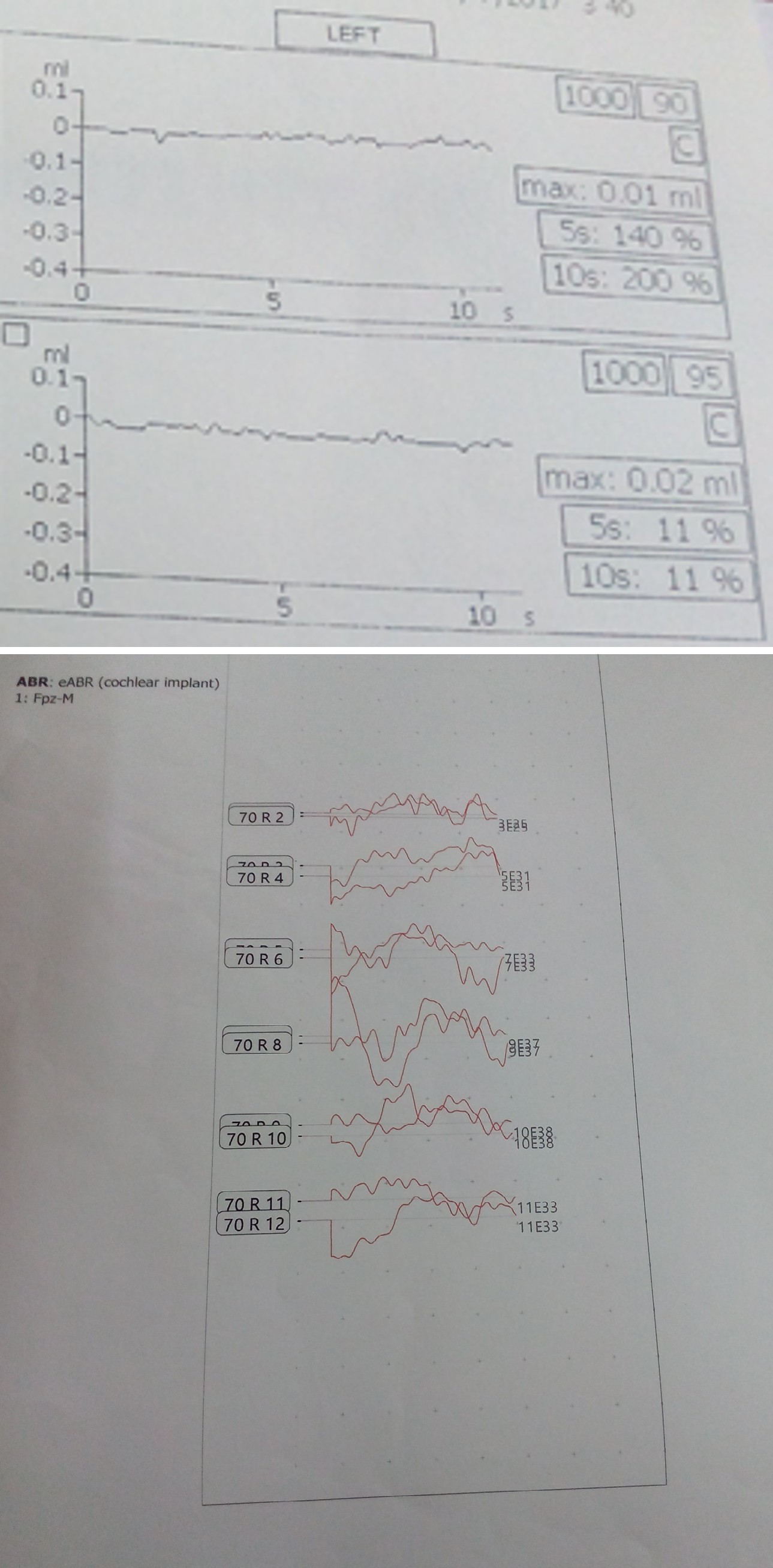
From the above ESRT case 2 report, one can find the responses are absent.
EABR
From the above EABR case 2 results, one can find the responses were absent.
By comparing the results of ECAP, ESRT, EABR for both cases, it shows that case 1 have better responses than case 2.
The following questionnaire were administered for both cases after attending auditory verbal therapy for a period of
2 years extended receptive expressive emergent language scale (E-REELS), Categories of Auditory Performance (CAP) score, Speech Intelligibility Rating (SIR) scale, Meaningful Auditory-Integration Scale (MAIS) and Meaningful Use of Speech Scale (MUSS).
| Scale name | Case 1 | Case 2 | ||
|---|---|---|---|---|
| Preoperative assessment | Postoperative assessment | Preoperative assessment | Postoperative assessment | |
| E-REELS | 2 to 3 months | 33 to 36 months | 2 to 3 months | 10 to l1 months |
| CAP | Category 0 | Category 5 | Category 0 | Category 2 |
| SIR | Category 1 | Category 4 | Category 1 | Category 2 |
| MAIS | - | Total Score 38 | - | Total Score 25 |
| MUSS | - | Total score 31 | - | Total score 8 |
The above results indicated that case 1 had better performance than case 2.
Conclusion
This study highlights the possible outcome of cochlear implants in auditory neuropathy individuals. This study also indicates the use of ECAP, ESRT, EABR in post therapy assessment for predicting the outcome of patients with auditory neuropathy fitted with cochlear implant. The accessible outcome measurement will provide information for professionals and parent. It is essential that all possible complications and postoperative performance should be discussed with the parents. Finally, counseling for the parents is mandatory in order to explain the possible impact of the diagnosed disabilities on performance and habilitation.
References
-
Stanley A (2020) Gelfand Essentials of Audiology. In: 2nd (Edn,). 199: 585.
-
Frederick N (2019) Martin Introduction to Audiology.
-
Fei Ji, Ke Liu, Yang SM (2014) Clinical application of electrically evoked compound action potentials. Journal of Otology 9(3): 117-121.
-
Brill S, Müller J, Hagen R (2009) Site of cochlear stimulation and its effect on electrically evoked compound action potentials using the MED-EL standard electrode array. Biomed Eng Online 8: 40.
-
Fei J, Jia-Nan L, Ke L (2014) NRT test in auditory neuropathy patients with cochlear implants. Acta Otolaryngol 134(9): 930-42.
-
Kosaner J, Anderson I, Turan Z, Deibl M (2009) The Use of ESRT in Fitting Children with Cochlear Implants. Int Adv Otol 5(1): 70-79.
-
Hughes M (2017) Objective Measures in Cochlear Implants.
- 4th Branchial Cleft Sinus Anomaly Presenting as Recurrent Thyroid Abscess in A Child: A Case Report
- Parotid Duct Injury Repaired Using an Angiocatheter Stent: A Case Report
- Organization and Functionality of the Referral and Counter-Referral System for ENT Disorders in District Hospitals of N’Djamena, Chad: A Cross-Sectional Analytical Study
- Facial Metastases from a Gastrointestinal Stromal Tumor: A Case Report
- Panorama of Ent Cancers and Literature Review: Epidemiological Profile and Therapeutic Management
- Could Antimicrobial Resistance Prove to Be Both a Threat and an Opportunity for us?