
High-Rated Hearing Test Android Mobile Applications: Are they Appropriate for Action?
Background: Mobile smart phones are currently in the hands of most people. Smartphones have come a long way in automating hearing tests and auditory exams. Current phones have excellent microphones and noise-cancelling speaker outputs. Android phone hearing tests applications are currently used widely esp. after the COVID-19 pandemic. Aims/Objectives: This research was designed to address the accuracy of two high rated hearing test applications on Google play in relation to conventional pure tone clinic testing. Material & Methods: One hundred and eighty-three subjects participated in this study. They all enjoyed normal hearing thresholds when tested by a conventional pure-tone audiometer followed by hearing assessment using two mobile applications that were rated more than 4.5 on Google play: Hearing Assist and Hearing Test. Results: No significant statistical difference was found between the hearing thresholds obtained by a conventional audiometer and mobile hearing test applications at all tested frequencies (P> 0.5). Conclusions and Significance: Android mobile phone applications can be used reliably for hearing testing at home especially for follow up or screening.
Introduction
Hearing is one of the most fundamental concepts of human interaction. Communication is based on the art of listening and hearing. Thus, it is a necessary construct to maintain essential constructs of human relationships and connections. Even though most people in the world have excellent hearing, many people may have hearing problems. These problems may be sourced from genetic constructs when they were younger or maybe due to accidents. Even though hearing problems can be fixed, it can be hard to diagnose the problem and cause hearing disabilities. However, as technology advances, innovations have achieved the concept of testing the extent of hearing problems. These technologies help people test their hearing capabilities without necessarily needing to go to health care facilities.
Hearing tests provide an opportunity for individuals to monitor their health passively without needing special skills, equipment, or personnel. This activity is essential, especially for young kids whose development is still dependent on so many factors. After birth, hearing tests can be carried out on children to determine whether they were born with significant hearing deficiencies. Routine checks play a significant role in the fight to help individuals diagnose hearing problems as early as possible. It is important to diagnose hearing problems in children early enough because hearing problems can cause children’s speech skills and language development [1].
There are several causes of hearing problems where nerve deafness is one of the major causes of hearing deficiencies. The condition is also referred to as sensorineural hearing loss. It is caused by the structure of the ear or the nerves in the ears [2]. Another source of auditory problems is conductive hearing loss caused by the blockage of sound waves into the inner realms of the ear. Conductive hearing loss can affect individuals of any age regardless of their medical and traumatic backgrounds. There are several different tests that physicians and individuals can use to determine whether they have any hearing deficiencies or the extent of the disability if it exists. Most hearing tests check individuals’ responses to sounds, tones, and voices delivered at different pitches. Some of these sound tests include Acoustic reflex measures. This test investigates how well the ear responds to loud voices. There are a series of muscles in the ear that respond to changes in the volume of sounds. The physician measures the number of involuntary reflexes that the ear muscle does in response to loud noises.
The pure tone test investigates the lowest sounds that an ear can hear at different pitches. It is also called audiometry. It is usually executed by sending a series of tones into headphones when a subject is wearing them. Hearing of the tones is indicated by raising the hand. The range, pitch, and tones of the sounds are varied to determine the extent of the subject’s hearing capabilities. This tone can be automated and integrated into mobile applications. It does not need special skills to execute. Other auditory tests are the tuning fork, speech, word recognition, and tympanometry [2]. Mobile smart phones are currently in the hands of most people. While more than 5 billion people have mobile phones, more than 2.5 billion people possess mobile smart phones [3]. A median of 76% across 18 advanced economies surveyed have smartphones, compared with a median of only 45% in emerging economies. Egypt is a growing economy that may have a median higher than 45% due to the escalating economic growth and the anti-poverty measures taken by the Egyptian authorities.
Smartphones have come a long way in automating hearing tests and auditory exams. Current phones have excellent microphones and noise-cancelling speaker outputs [4]. By improving the clarity of sounds and accessing an individual’s listening environment, smartphones provide the opportunity for individuals to utilize their acoustic capabilities to carry out hearing tests. Hearing aids no longer need to be physically connected to the phone or controlling device. Instead, smartphones can connect wirelessly to the hearing aid equipment. The approach of using portable equipment enables individuals to carry out hearing tests at any location without any prerequisite skills or personnel required. Therefore, this research was designed to address the accuracy of two high rated hearing test applications on Google play in relation to conventional pure tone clinic testing.
Material and Methods
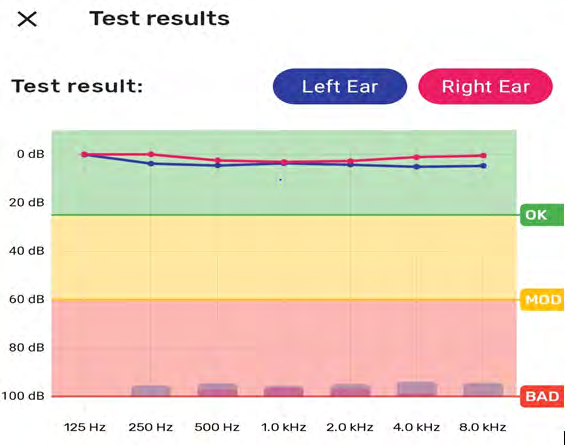
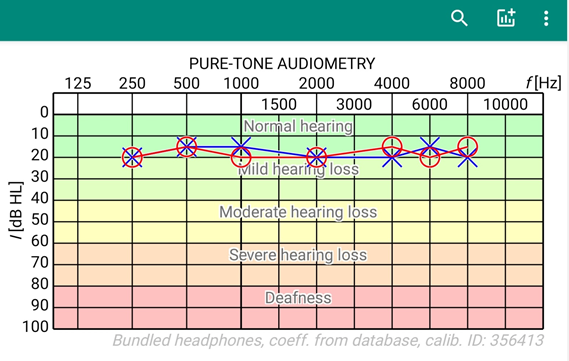
One hundred and eighty-three subjects participated in this study (101 females & 82 males). Inclusion criteria: 1- Their age ranged from 21 to 43 years (mean 33.2±2.1). 2- Thy had no past history of ear disease. 3-They all enjoyed normal hearing thresholds when tested by a conventional pure-tone audiometer (Madsen Itera 922) in a quiet room in a hearing clinic. Exclusion criteria: 1- Any past history of ear disease. 2- Abnormal hearing thresholds during conventional audiometry. All tested subjects had normal thresholds at all tested frequencies (250, 500, 750, 1000, 1500, 2000, 3000, 4000, 6000, and 8000 Hz: inclusion criterion). Then the same subjects were retested using two mobile applications that were rated more than 4.5 on Google play: Hearing Assist and Hearing Test. Subjects were provided with short videos that simply explained the way by which each mobile hearing test can be performed. The tests were administered using a unified mobile set Samsung Galaxy S10+ using calibrated headphones in a quiet room (Figures 1-3). Each subject took a screenshot of results of the hearing tests on either mobile hearing application. Data were collected and statistical analysis was conducted using SPSS 16.
Results
| 250 Hz | 500 Hz | 750 Hz | 1000 Hz | 1500 Hz | 2000 Hz | 3000 Hz | 4000 Hz | 6000 Hz | 8000 Hz | |
|---|---|---|---|---|---|---|---|---|---|---|
| Conventional | 19.3 | 18.4 | 18.2 | 16.5 | 15.9 | 15.2 | 15.3 | 14.2 | 13.5 | 14.8 |
| Hearing Test Application | 19.5 | 18.7 | 18.1 | 16.7 | 16.1 | 15.4 | 15.6 | 14.3 | 13.6 | 15.1 |
| Hearing Assist Application | 19.4 | 18.6 | 18.1 | 16.6 | 15.8 | 15.5 | 15.7 | 14.4 | 13.5 | 14.9 |
Table 1: Mean of thresholds of hearing at all tested frequencies using conventional audiometry and android mobile applications fo
Paired t-test was used to compare between the audiometric thresholds of the Itera audiometer and test results of each application for same normal hearing subjects.
No significant difference (p> 0.05) was found at all octave and mid-octave frequencies (250, 500, 750, 1000, 1500, 2000, 3000, 4000, 6000, and 8000 Hz).
Discussion
The use of mobile applications to conduct hearing tests has risen considerably in the last several years. Angela Colsman and her colleagues carried out a study to determine the accuracy and reliability of an audiometer in a mobile application in a group of adults with standard hearing capabilities. The accuracy of the application is accessed via a standard medical audiometer to provide a baseline against the app’s results. The app was used severally to carry out the same test, and the results were compared to measure reliability. The application’s passed its accuracy test by providing similar results as the medical audiometer. In addition, the values provided by the application fell within the acceptable room for error [5]. When the application underwent the reliability and consistency test, the results determine that thresholds were not normally distributed.
No significant difference (p> 0.05) was found at all octave and mid-octave frequencies (250, 500, 750, 1000, 1500, 2000, 3000, 4000, 6000, and 8000 Hz) between the medical audiometer and the used applications (Table 1). The experiment bore results that were pretty similar to those obtained by a medical audiometer. Some negligible assumptions were taken into consideration during the experiment. The exercise was conducted in a soundproof office. These conditions were necessary to bring out the exact levels of the threshold levels of auditory senses. However, it is infrequent for people in the outside world to interact with these conditions. Furthermore, the results may vary when the test is carried out in a noisy environment. That aside, the results showed that the mobile application in question produced consistent results as a medical audiometer, hence can be used accurately by individuals to measure their auditory responses. If other mobile applications could follow the same principle, the concept of testing hearing capabilities can be effectively implemented into our mobile phones.
Implementation of hearing tests on mobile phones could provide a lot of benefits to users. Most of the world’s population has access to smartphones that can support these applications. This concept increases the accessibility of this service to persons from all walks of life. There will not be a need for individuals to schedule appointments and travel long distances for hearing tests. These services will be readily available and accessible to public members [6]. Another benefit of using a mobile-based application for hearing exams is affordability. Typically, it would have taken a lot of money to schedule and undertake a medical test. All the cost associated with the test is cut down considerably. Mobile applications can use cloud technologies to store the results of hearing tests over time and provide tracking data to monitor the progress or deterioration of hearing capabilities in an individual. Apart from providing test results, these applications can be used to provide information on causes and treatment options for individuals [6]. In addition, the location of nearby specialists can be included in the applications to guide the users to local health practitioners in case of negative results on the application. As mobile applications provide numerous possibilities and advantages in hearing tests, there are a few demerits associated with mobile apps. For starters, the results obtained from tests are only accurate when undertaken in a soundproof environment. The accuracy of mobile applications reduces considerably when ambient noise is present [7]. The availability of soundproof rooms to experiment with all individuals is limited. This concept means that the data, analysis and results obtained by individuals using the mobile applications in areas with ambient noise are prone to errors and inaccurate readings [8].
As time goes by, the need for and use of technology keeps growing by the day. Even though some technology constructs are not yet accepted in the medical world, they are slowly being adopted and accepted [9, 10, 11, 12]. This idea puts a stamp on the fact that mobile applications will continue to provide these medical solutions. Therefore, instead of fighting the technology that hasn’t been perfected yet, we should work together towards ensuring we create a world where technology and medical exploits go hand in hand. This way, adjustments and improvements will continue being made to mobile apps to support the growth of these technologies [13, 14]. We embraced mobile applications to facilitate the testing and detection of hearing disabilities among individuals without going to the hospital. The few challenges that the application faces can be ironed out as technology keeps expanding. Therefore, the fear of marginal errors in the readings obtained by a mobile application should not be used as a barrier to block the numerous possibilities that the mobile application presents. It is a journey that the world has not reached its destination yet, but an inevitable one. Therefore, I think it is time we accepted the use of mobile applications in the day to day testing of hearing capabilities.
Conclusion
In healthy subjects and in the age group evaluated, no statistically significant differences were found between the use of the applications and conventional audiometry.
References
-
National Health Service (2017) Hearing tests for children. NHS, UK.
-
National Library of Medicine (2021) Hearing tests for adults: MedlinePlus medical test. MedlinePlus - Health Information from the National Library of Medicine.
-
Smartphone Ownership Is Growing Rapidly Around the World, but Not Always Equally (2019). Pew Research Center.
-
DeGroot A (2017) Hearing test apps; Are they accurate?. Hearing Ally.
-
Colsman A, Supp GG, Neumann J, Schneider TR (2020) Evaluation of accuracy and reliability of a mobile screening audiometer in normal-hearing adults. Front Psychol 11: 1-12.
-
Swanepoel DW, De Sousa KC, Smits C, Moore DR (2019) Mobile applications to detect hearing impairment: Opportunities and challenges. Bull World Health Organ 97(10): 717-718.
-
Pickens AW, Robertson LD, Smith ML, Zhao H, Mehta R, et al. (2017) Limitations of a mobile hearing test application. The Hearing Journal 70(6): 34.
-
Byrne D, Tonisson W (1976) Selecting the gain of hearing aids for persons with sensorineural hearing impairments. Scandinavian Audiology 5(2): 51-59.
-
Maidment DW, Ferguson M (2018) An application of the medical research council’s guidelines for evaluating complex interventions: A usability study assessing smartphone-connected listening devices in adults with hearing loss. American Journal of Audiology 27(3S): 474-481.
-
Martinez BP, Franchell S, Alonso RF, Navarro VR, Martinez BMA, et al. (2020) Are smartphone applications (App) useful to improve hearing?. Acta Otorhinolaryngologica Italica 40(4): 304-310.
-
Masalski M, Grysinski T, Krecicki T (2018) Hearing tests based on biologically calibrated mobile devices: Comparison with pure-tone audiometry. JMIR mHealth and uHealth 6(1): e10.
-
Nuber C (2019) Improving patient compliance to hearing healthcare services and and Treatment through Self- Efficacy and Smartphone Applications. Hearing Review.
-
Saliba J, Al-Reefi M, Carriere JS, Verma N, Provencal C, et al. (2016) Accuracy of mobile-based Audiometry in the evaluation of hearing loss in quiet and noisy environments. Otolaryngology–Head and Neck Surgery 156(4): 706-711.
-
The Hearing Journal (2021) Mobile app found useful for hearing assessment of TB patients. The Hearing Journal 74(4): 8-9.
- 4th Branchial Cleft Sinus Anomaly Presenting as Recurrent Thyroid Abscess in A Child: A Case Report
- Parotid Duct Injury Repaired Using an Angiocatheter Stent: A Case Report
- Organization and Functionality of the Referral and Counter-Referral System for ENT Disorders in District Hospitals of N’Djamena, Chad: A Cross-Sectional Analytical Study
- Facial Metastases from a Gastrointestinal Stromal Tumor: A Case Report
- Panorama of Ent Cancers and Literature Review: Epidemiological Profile and Therapeutic Management
- Could Antimicrobial Resistance Prove to Be Both a Threat and an Opportunity for us?